


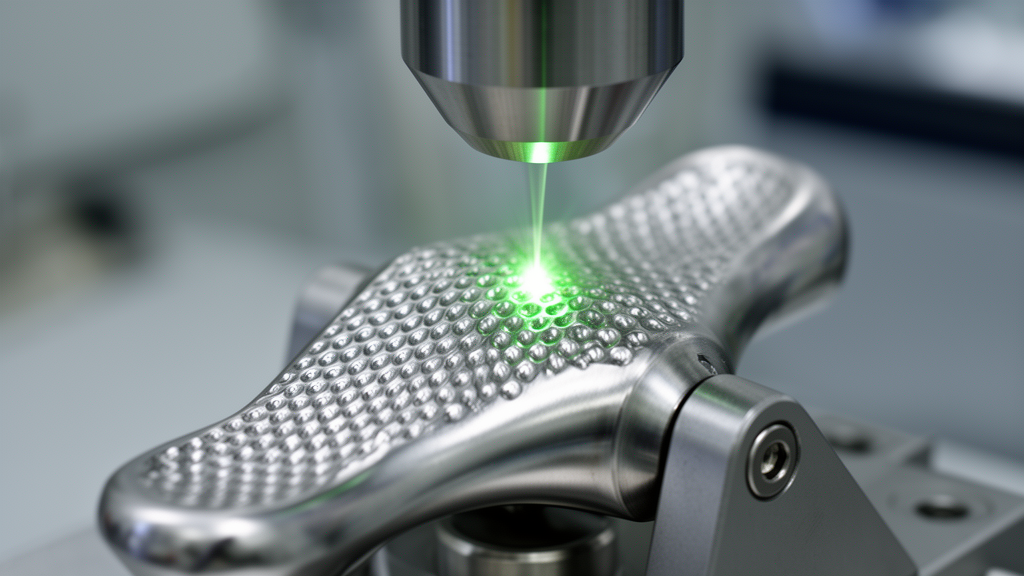
Every year, millions of people receive titanium dental implants, and the success of those devices depends on something almost invisible to the eye: the microscopic texture of the metal surface. A new study from South African researchers has now shown, for the first time, that the roughness of a titanium alloy implant can be tuned by simultaneously varying the orientation of the material, the angle at which a laser shock is applied, and the number of times a single laser shot is repeated. The work, published in Frontiers in Manufacturing Technology, combines high-fidelity computer simulation with physical laser experiments on the widely used titanium alloy Ti6Al4V, and it offers a computational shortcut for designing implant surfaces that could last longer in the mouth.
The research team, led by Lebogang Lebea of the Tshwane University of Technology and the Central University of Technology, together with Dawood Desai, Harry Ngwangwa, and Fulufhelo Nemavhola, focused on laser shock peening, or LSP, a surface modification technique that has already proven its worth in jet engines and steam turbines. In LSP, a short, intense laser pulse strikes a metallic target covered by a sacrificial ablative layer, typically a tape, with a thin film of water on top. The pulse vaporizes the sacrificial layer and generates plasma that expands explosively, sending a shock wave deep into the metal. Because the water confines the plasma, the shock wave is far more powerful than it would be in open air, and when the resulting compressive stresses exceed the metal’s yield strength, the surface plastically deforms in a controlled way. The outcome is a surface laced with compressive residual stress, which resists fatigue cracking and corrosion, and a deliberately roughened topography that bone cells can grip.
What makes the new study unusual is the set of five parameters it applies at once: single-shot angle, single-shot repetition, pulse duration, material orientation, and laser power. Previous investigations have typically explored these factors in isolation or in pairs. The South African group ran nine computational experiments in which the loading angle and material orientation were each set to either zero or 60 degrees, and the number of shot repetitions ranged from three to five, all at a laser power density of 4.2 gigawatts per square centimeter and a pulse duration of 2.5 nanoseconds. The 60-degree orientation was not arbitrary; it follows the team’s earlier work on 3D-printed titanium implants, which identified that orientation as a promising factor and aligned with the ISO 140800 standard for testing dental implants. Fatigue failures of dental implants have previously been observed between the second and third threads, and the researchers wanted to know whether LSP could strengthen exactly those vulnerable regions.
To simulate the process, the team built a finite element model in Abaqus CAE 2020 using the explicit solver, which is designed for dynamic, high-strain-rate events like laser shocks. The model contained 383,313 nodes and 359,440 linear hexahedral elements of type C3D8R, with a mesh convergence analysis used to confirm that the mesh was fine enough. The default mesh size was progressively reduced until the stress curve flattened, and a finer mesh was concentrated around the shot diameter to limit distortion. The material’s behavior was captured with the Johnson-Cook plasticity model, a popular constitutive law for metals undergoing large deformation, high strain rates, and rising temperatures. In this formulation, the yield stress under reference conditions was set at 1,098 megapascals, with a strain hardening constant of 1,092 megapascals, a strain rate strengthening coefficient of 0.026, a strain hardening coefficient of 0.04, and a thermal softening coefficient of 0.4, with a melting temperature of 1,922 kelvin and a reference temperature of 298 kelvin.
The boundary conditions allowed the laser power to be applied as a distributed load along the laser shot spot, following the pulse temporal profile, and the load was assigned a 60-degree angle for the second and third sets of computational tests. The first set had no material orientation or shot angles, allowing the researchers to isolate and compare the effects of each parameter. The team then wrote a novel surface roughness model in MATLAB 2023, taking the vertical displacement coordinates from the simulation output and computing the arithmetic mean roughness, Ra, from the distance of each surface node to a fitted contour centerline. The code also introduced parameters for the period and amplitude of a repetitive surface pattern, the number of laser passes, the laser power, and the pulse duration and time between passes, rotating the surface profile to account for material orientation. This is the first time, according to the authors, that such a combined computational framework has been used to develop surface roughness parameters for dental applications.
The experimental side of the study used titanium specimens measuring 1.4 by 1.4 by 0.2 centimeters, cut from a titanium plate and peened on one side with ablative tape using the Nd:Glass process. Each shot used a peak laser power density, a 0.2-centimeter spot diameter, and a fixed pulse width, with the output data for every shot stored on a computer connected to an oscilloscope to guarantee that the laser settings did not drift during the three shots. A consistent water flow was maintained in each shot to keep the water film thickness the same. Compressive residual stress was measured by X-ray diffraction, using the cos alpha and sin squared psi methods, which are among the four primary diffraction techniques commonly employed for residual stress measurement and can be applied with laboratory diffractometers as well as synchrotron and neutron sources.
The agreement between simulation and experiment was striking. When laser power was applied and repeated three times, the computational model predicted a compressive residual stress of minus 578.45 megapascals, while the experimental samples measured minus 592.18 megapascals, a difference of just 2.32 percent, well within the 10 percent threshold the researchers consider acceptable. The treated titanium samples showed no discernible bending deformation, but the distortion caused by the single spot shock was clearly visible, and the computed and experimental samples displayed a similar imprint. The results also compare favorably with earlier published work: a computational study by Zhou and colleagues reported a compressive residual stress of about 578 megapascals for Ti6Al4V, while an experimental study by Nie and colleagues using 4.24 gigawatts per square centimeter laser power reported 410 megapascals, and Ran and colleagues achieved up to 552.4 megapascals without ablation using a 30 percent lap rate.
The parametric results revealed a surprising dependence on repetition count and geometry. Without any angle or material orientation, the compressive residual stress was minus 578.450 megapascals after three repetitions but collapsed to minus 1.620 megapascals after four, and minus 1.536 megapascals after five. When the load was applied at a 60-degree angle without material orientation, the stress was minus 31.050 megapascals after three repetitions and minus 760.959 megapascals after four. With both a 60-degree material orientation and a 60-degree loading angle, the values rose from minus 330.85 megapascals to minus 761.020 megapascals during the fourth repetition, before dropping to minus 1.536 megapascals at five repetitions. On the roughness side, the model without angle or orientation recorded an Ra of 2.9491 micrometers at three repetitions, 2.9487 micrometers with a 60-degree loading angle, and 2.9211 micrometers with both orientation and loading applied. At four repetitions with orientation and loading, the Ra dropped to 2.7064 micrometers, and at five repetitions the values were 2.9717, 2.7082, and 2.9717 micrometers for the three configurations respectively. The authors conclude that by varying material orientation and loading angle, the Ra value can be increased fourfold, a finding they say demonstrates that Ra values can be increased through four repetitions while adjusting these parameters.
Why does this matter for patients? Surface roughness is a decisive factor in osseointegration, the direct structural and functional connection between living bone and the implant surface. Studies have shown that surfaces with Ra values of 3 to 5 micrometers are generally more favorable for osteoblast, or bone-forming cell, responses than smooth surfaces with Ra values below 1 micrometer, and in vitro work has demonstrated that rougher titanium surfaces promote bone cell proliferation and differentiation. The Ra values achieved in this study, roughly 2.7 to 3.0 micrometers, sit squarely in the range that researchers consider promising for implant integration. Earlier in vitro investigations have revealed that complex hybrid surface topographies, combining submicron pits atop larger micro-craters, produce the most developed osteoblast phenotype, and in vivo studies of rough 3D-printed titanium implants have shown no deleterious effects on bone repair. An LSP-treated surface could therefore serve a dual role: its compressive residual stress field resists the fatigue failures that have plagued dental implants between the second and third threads, while its engineered roughness encourages bone to anchor directly to the metal.
The study also carries a broader message for manufacturing. Experimental trials to investigate the impact of LSP factors on surface roughness are costly and time-consuming, and the finite element approach has recently emerged as an efficient alternative for predicting residual stress and surface displacement in metallic components. By validating their model against physical measurements with a discrepancy of only 2.32 percent, the South African team has shown that a computational framework can reliably explore design spaces that would otherwise require extensive laboratory work. The same technique has already been applied successfully to steam turbine blades, and the authors note that the approach follows a worst-case scenario in dental implant design, making it a conservative tool for engineers. As laser systems and LSP technology continue to advance, the ability to computationally tailor surface roughness and residual stress together, by adjusting material orientation, loading angle, and shot repetition, could accelerate the development of next-generation implants not only for dentistry but for orthopedic and maxillofacial surgery as well, where titanium alloys remain the biomaterial of choice thanks to their biocompatibility, corrosion resistance, and mechanical performance.
Subject of Research: Materials Science
Article Title: Influence of material orientation, loading angle, and single-shot repetition of laser shock peening on surface roughness properties
Article References: Lebea, L., Desai, D., Ngwangwa, H., & Nemavhola, F. (2024). Influence of material orientation, loading angle, and single-shot repetition of laser shock peening on surface roughness properties. Frontiers in Manufacturing Technology, 4, Article 1421589. https://doi.org/10.3389/fmtec.2024.1421589
Image Credits: AI Generated
DOI: 10.3389/fmtec.2024.1421589
Keywords: laser shock peening, Ti6Al4V, surface roughness, residual stress, dental implants, finite element analysis, biomaterials, Influence, material, orientation, loading, angle
Cite Scienmag News
Denise Maddox. (October 17, 2026). Laser Shock Peening Study Reveals How Material Orientation and Loading Angle Reshape Titanium Implant Surfaces. Scienmag. https://scienmag.com/laser-shock-peening-study-reveals-how-material-orientation-and-loading-angle-reshape-titanium-implant-surfaces/
Denise Maddox. "Laser Shock Peening Study Reveals How Material Orientation and Loading Angle Reshape Titanium Implant Surfaces." Scienmag, 17 October 2026, https://scienmag.com/laser-shock-peening-study-reveals-how-material-orientation-and-loading-angle-reshape-titanium-implant-surfaces/. Accessed 17 October 2026.
Denise Maddox. "Laser Shock Peening Study Reveals How Material Orientation and Loading Angle Reshape Titanium Implant Surfaces." Scienmag. October 17, 2026. https://scienmag.com/laser-shock-peening-study-reveals-how-material-orientation-and-loading-angle-reshape-titanium-implant-surfaces/


