


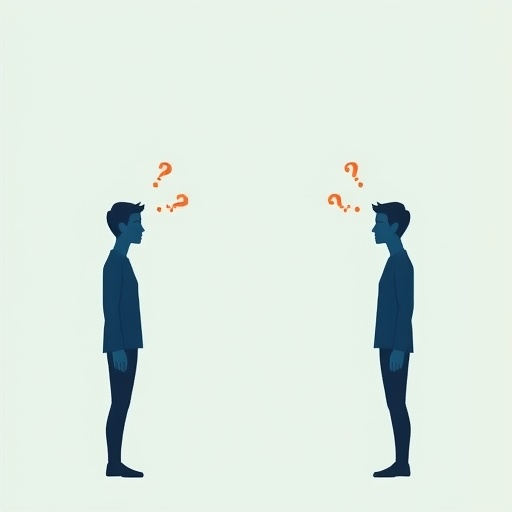
In the ever-evolving landscape of artificial intelligence and human-computer interaction, a groundbreaking study published in Communications Psychology in 2026 is reshaping our understanding of how people attribute confidence not only to their fellow humans but also to artificial agents. Colombatto and Fleming’s pioneering research delves deep into the cognitive mechanisms underpinning confidence attribution and highlights the pivotal role that our beliefs about accuracy play in shaping these perceptions. Their work may profoundly influence future AI development and societal integration, as it unpacks the complex psychological interplay between trust, confidence, and perceived reliability.
At the core of their investigation is the question of how individuals decide who or what to trust when making judgments—whether it’s a human peer or an AI system. Previous research has often focused on output accuracy as the primary metric people use to gauge trustworthiness. However, Colombatto and Fleming push the boundaries by emphasizing that it isn’t just observable accuracy that sways our confidence judgments. Instead, our prior beliefs about the accuracy or fallibility of the agent—human or artificial—heavily color these attributions. This nuanced understanding provides a richer framework for interpreting how humans interact with technology in decision-critical contexts.
The study’s methodology stands out for its sophistication and rigor. Participants were presented with tasks requiring decision-making in uncertain scenarios. These scenarios included responses generated by human participants as well as AI agents programmed with varying degrees of accuracy. Crucially, the researchers manipulated participants’ prior beliefs about the reliability of both agent types before they began these tasks. By doing so, they could isolate and identify how these beliefs directly influenced confidence ratings, independent of the actual performance outcomes of the agents.
What the researchers found disrupts some conventional assumptions. Confidence attributions were not simply a reflection of the accuracy demonstrated by the agents on the tasks. Instead, participants systematically adjusted their confidence based on how much they trusted each agent type a priori. For example, participants who held strong beliefs about AI’s superiority exhibited heightened confidence in artificial agents’ decisions, even when these agents performed equivalently or worse than humans. Conversely, participants skeptical of AI reliability tended to downplay AI outputs despite objective performance measures, showcasing the powerful anchoring effect of preconceived notions.
This discovery has profound implications for the deployment of AI in high-stakes environments, including healthcare, autonomous vehicles, and financial decision-making systems. If users’ beliefs about AI accuracy can bias their confidence—even in contradiction to empirical evidence—then fostering appropriate trust calibration becomes an imperative. Miscalibration can lead to overreliance on flawed AI judgments or underutilization of highly accurate systems, each carrying potentially serious consequences.
Colombatto and Fleming’s findings also reveal intricate dynamics within human-human trust. The study observed that people’s confidence towards other humans was similarly modulated by beliefs, albeit with a different psychological flavor. Humans are prone to social and emotional biases that influence trust differently from more mechanical perceptions of AI agents. The research underscores the importance of tailoring communication strategies to address these divergent frameworks when designing hybrid teams where humans and AI systems collaborate.
Furthermore, the study integrates sophisticated computational models to quantify belief-updating processes during interactions with both humans and AI. These Bayesian-inspired models account for how participants revise their confidence estimates in real time based on observed performance and prior beliefs. This mechanistic insight paves the way for dynamic trust-adaptive systems that can respond to user skepticism or overconfidence by providing calibrated feedback, enhancing transparency and user acceptance.
The implications extend beyond individual decision-making, touching on societal narratives about artificial intelligence. In a climate where AI technologies are often met with polarized opinions—from utopian optimism to dystopian fear—the research highlights how much of the acceptance or rejection of AI hinges on collective beliefs rather than objective benchmarks. Understanding and addressing these belief systems could be pivotal in shaping policies and educational initiatives to foster more balanced public attitudes.
Colombatto and Fleming’s research also points to future avenues of inquiry, particularly the neural and cognitive bases of confidence attribution. They suggest that identifying the brain circuits involved in processing beliefs about agent accuracy could unlock new dimensions of cognitive science, integrating social cognition with emerging AI literacy. Such investigations could reveal whether the same neural mechanisms underlie trust in human and artificial agents or if there are distinct pathways depending on agent type.
Moreover, the study touches subtly on ethical concerns related to trust manipulation. With marketers, politicians, and technologists all vested interests in shaping public trust, insights into confidence attribution mechanisms offer powerful tools that can be wielded beneficially or malevolently. The authors advocate for transparency and ethics-driven design principles to ensure that manipulations of user beliefs do not undermine autonomy or fuel misinformation.
The publication’s timing is particularly salient given the rapid proliferation of AI chatbots, recommendation algorithms, and autonomous decision agents in everyday life. As these systems increasingly guide medical diagnoses, legal advice, and consumer choices, understanding how confidence is attributed becomes central to safeguarding both user welfare and AI efficacy. The research advocates for a paradigm shift from solely improving accuracy to cultivating appropriate belief frameworks in users.
Scientifically, the article also advances methodological standards by showcasing how belief manipulation experiments can disentangle intertwined cognitive factors. Their approach offers a blueprint for future research aiming to explore other dimensions of human-AI interaction, such as emotional engagement, perceived fairness, and accountability. Each of these components likely interplays with confidence attribution, painting a multifaceted picture of trust in complex socio-technical ecosystems.
The researchers’ interdisciplinary approach—bridging cognitive psychology, behavioral economics, and AI research—demonstrates the necessity of collaborative efforts in tackling pressing questions about technology acceptance. Their use of computational modeling alongside behavioral experiments exemplifies the future of psychological science in a technologically integrated world, offering deeper explanatory power and practical solutions.
In conclusion, Colombatto and Fleming’s study is a landmark contribution that enhances our understanding of how beliefs about accuracy intricately shape confidence attributions to both humans and artificial agents. Their findings invite technologists, psychologists, policymakers, and the public to reconsider how we conceptualize trust and confidence in a world where human agency increasingly interweaves with artificial intelligence.
As AI continues its inexorable advance, the challenge lies not only in refining algorithms but also in harmonizing human beliefs with machine realities. Only by acknowledging and engineering around these belief-driven dynamics can we unlock the full potential of AI to augment human decision-making ethically and effectively.
Cite Scienmag News
Glenn Wilkins. (April 22, 2026). Beliefs Influence Confidence in Humans, AI Accuracy. Scienmag. https://scienmag.com/beliefs-influence-confidence-in-humans-ai-accuracy/
Glenn Wilkins. "Beliefs Influence Confidence in Humans, AI Accuracy." Scienmag, 22 April 2026, https://scienmag.com/beliefs-influence-confidence-in-humans-ai-accuracy/. Accessed 3 September 2026.
Glenn Wilkins. "Beliefs Influence Confidence in Humans, AI Accuracy." Scienmag. April 22, 2026. https://scienmag.com/beliefs-influence-confidence-in-humans-ai-accuracy/


