


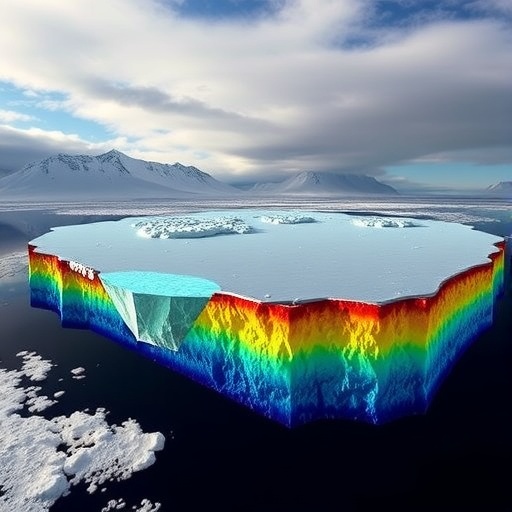
A newly published study in Nature Communications reveals a crucial factor that could significantly alter our projections of Antarctic ice melt and its contribution to future sea-level rise. This groundbreaking research uncovers how the phenomenon of bedrock uplift beneath the Antarctic ice sheet plays a mitigating role in the pace at which Antarctic ice loss will raise global sea levels over the coming centuries. Contrary to previous models that focused predominantly on ice dynamics and oceanic warming, this study integrates geophysical responses of the Earth’s crust, adding a layer of complexity and realism to climate predictions.
At the heart of this research is the concept of bedrock uplift, a geological process where the Earth’s crust rebounds upward as the immense weight of ice is removed due to melting. This phenomenon, often referred to as glacial isostatic adjustment, has long been recognized but insufficiently quantified in its capacity to influence sea-level changes. As the Antarctic ice sheet loses mass, the underlying bedrock responds by rising, which in turn affects the geometry and dynamics of the ice flow. The implications of this feedback mechanism have now been modeled at unprecedented detail and scale.
What makes this research stand out is the integration of advanced ice sheet models with geophysical simulations of Earth’s crustal movements. The study employs state-of-the-art computational tools that dynamically couple the evolving ice sheet mass with bedrock deformation. This coupling allows the researchers to investigate not only how the ice responds to climate forcing but also how the solid Earth beneath reacts and influences subsequent ice behavior. The findings indicate that as the bedrock uplifts, it effectively counteracts a portion of the ice sheet’s retreat, thereby reducing the volume of ice ultimately discharged into the ocean.
Importantly, the study projects that this bedrock uplifting effect will have a pronounced influence on sea-level projections over the next few centuries. Models that neglect this factor tend to overestimate the Antarctic contribution to global sea rise. According to the simulations presented, the uplift can reduce Antarctic sea-level contribution by significant margins, marking a previously underappreciated natural moderating mechanism. This insight suggests that some of the worst-case sea-level rise scenarios could be somewhat less likely, provided other factors remain constant.
Moreover, the authors emphasize that the uplift effect is spatially heterogeneous; it varies depending on the local geology and ice sheet thinning rates. Areas with thicker, more dynamic ice flows tend to experience more substantial unloading and therefore stronger uplift, which feeds back into local ice stability. This spatial variability complicates but enriches the predictive models, underscoring the necessity of high-resolution geological and glaciological data to refine future projections.
The study also sheds light on the temporal scales of these interactions. Bedrock uplift is not an immediate response but occurs over decades to centuries, creating a lagged negative feedback loop that progressively stabilizes the ice margin. This delayed response has profound implications for climate modeling, as it acts over timescales relevant to human society’s planning horizons, making it an essential factor in long-term sea-level rise forecasts.
These revelations come at a critical moment as global climate summits intensify debates on mitigation and adaptation strategies. Understanding the true scale and timing of Antarctic ice loss is vital for policymakers to allocate resources effectively and design resilient coastal infrastructure. Incorporating dynamic crustal uplift into climate models represents a leap forward in reducing the uncertainty around sea-level rise predictions, a key metric guiding these global decisions.
Additionally, the research offers a methodological advancement by demonstrating the importance of Earth-system coupling. By bridging disciplines—glaciology, geology, and climate science—the study opens pathways for more holistic Earth models that can capture the complexity of feedbacks in the climate system. This multidisciplinary approach promises to transform how future climate scenarios are constructed and interpreted across scientific and policy-making communities.
Critically, while bedrock uplift serves as a moderating influence, the authors caution it is not a panacea. Ice sheet disintegration remains a substantial threat under high-emission scenarios, and the uplift effect cannot fully offset continued warming and associated ice melt. Rather, it provides a nuanced understanding that tempers some earlier projections but reinforces the urgency of emissions reductions to prevent catastrophic sea-level rise.
Future research inspired by these findings will likely focus on refining the parameters that control uplift rates, such as mantle viscosity and lithospheric thickness, as well as exploring regional differences in ice-sheet response. Additional field measurements and satellite data will be essential to validate these models and reduce uncertainties further.
In conclusion, this study marks a pivotal advance in our understanding of Antarctic ice sheet dynamics by highlighting the influential role of bedrock uplift in modulating ice melt and subsequent sea-level rise. It challenges previous assumptions in climate modeling and offers a more optimistic, albeit cautious, perspective on future sea-level scenarios. The integration of crustal geophysics with ice sheet behavior underscores the multifaceted nature of Earth’s response to climate change and exemplifies the evolving sophistication of climate science tools in addressing global environmental challenges.
Cite Scienmag News
Thomas Green. (November 27, 2025). Bedrock Uplift Slows Antarctic Sea-Level Rise. Scienmag. https://scienmag.com/bedrock-uplift-slows-antarctic-sea-level-rise/
Thomas Green. "Bedrock Uplift Slows Antarctic Sea-Level Rise." Scienmag, 27 November 2025, https://scienmag.com/bedrock-uplift-slows-antarctic-sea-level-rise/. Accessed 4 September 2026.
Thomas Green. "Bedrock Uplift Slows Antarctic Sea-Level Rise." Scienmag. November 27, 2025. https://scienmag.com/bedrock-uplift-slows-antarctic-sea-level-rise/


