


Delinquent activities almost always occur outside of the home and away from adult supervision, so it is only natural for parents to blame peers for their child’s bad behavior. Not surprisingly, many parents also assume that they can prevent future problems by limiting contact with suspicious peers.

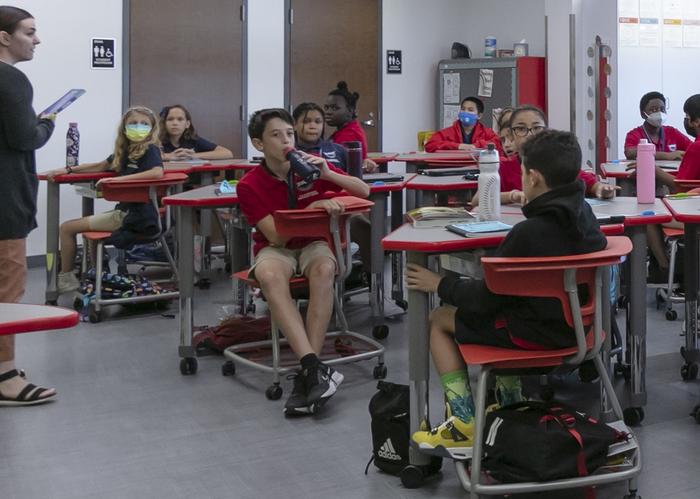
Credit: Alex Dolce, Florida Atlantic University
Delinquent activities almost always occur outside of the home and away from adult supervision, so it is only natural for parents to blame peers for their child’s bad behavior. Not surprisingly, many parents also assume that they can prevent future problems by limiting contact with suspicious peers.
However, a new study cautions parents – especially meddling moms – to resist the temptation to prohibit friendships because doing so only makes a bad situation worse. How can this be?
Results from a new longitudinal study of middle school youth, published in The Journal of Child Psychology and Psychiatry, indicates that maternal disapproval of friends in response to child conduct problems damages the child’s standing among peers, which exacerbates the behavior problems that friend prohibition was originally intended to prevent.
Brett Laursen, Ph.D., co-author and a professor of psychology at Florida Atlantic University, in collaboration with colleagues at Mykolas Romeris University in Vilnius Lithuania, followed a community sample of 292 boys and 270 girls (ages 9 to 14) over the course of a school year. Students completed surveys at the beginning, middle and end of the year. At each time point, peer status (being liked and being disliked) and classroom disruptiveness were gauged with peer nominations. Self-reports described conduct problems and perceived maternal disapproval of friends.
Results of the study reveal that maternal efforts to intervene in problematic peer relationships by prohibiting friendships backfired. Mothers who disapproved of their children’s friends inadvertently worsened their behavior problems. Specifically, mothers who responded to behavior problems (child-reported and peer-reported) with expressions of disapproval of friends inadvertently damaged the child’s relations with peers, alienating classmates. Adjustment difficulties followed.
The study compared different forms of classmate responses to maternal friendship interference. The findings suggest that maternal disapproval of friends is more likely to elicit active disliking from classmates, rather than merely reducing the number of classmates who enjoy the child’s company.
“The findings are important because they speak to the mechanism that translates disapproval of friends into elevated behavior problems. Maternal friend disapproval has counterproductive consequences for behavior problems because of the deleterious impact it has on peer status,” said Laursen, in FAU’s Charles E. Schmidt College of Science. “Youth may report restrictions and their reasons to friends. Or mothers may express their disapproval directly to friends. Neither are likely to be welcomed by recipients. Friends may respond by spreading contempt or ridicule throughout the peer group. Social opportunities are likely to wither as peers avoid affiliating with someone who is depicted as uncool.”
The researchers suggest that another possibility is that mothers actually succeed in their efforts to disrupt a friendship.
“Imagine this scenario. A friendship ends because a mother prohibits it. Now the child needs a new friend. Who wants to be friends with someone who has an unpleasant, interfering mother? Chances are good that friend options are now quite limited and the child is forced to consider someone who also is rejected by peers; someone who has a hard time making friends,” said Laursen. “All too often, such children are disliked because they have behavior problems. At the end of the day, interference in peer relationships may force the child to befriend a poorly adjusted classmate because they have no other alternatives.”
Befriending children with behavior problems subjects them to pressure to conform to the disruptive behavior that mothers are trying to discourage. Then, too, the loss of peer status elevates the risk of behavior problems because it increases distress and challenges coping mechanisms. Finally, rejected children may be excluded from social interactions with typically developing peers, depriving them of the opportunity to develop age-appropriate social skills.
“Parents should consider positive alternatives to friend prohibition,” said Laursen. “Focus on maintaining positive relationships with children, because warmth and support can be effective buffers against troublesome peer pressure, potentially disrupting the downward spiral of peer problems and adjustment difficulties.”
The researchers also suggest that parents can create opportunities for constructive peer engagement in supervised settings and encourage participation in adult-sponsored clubs and activities, which potentially limit deviant behavior.
Study co-author is Goda Kaniušonytė, a researcher at Mykolas Romeris University.
Data collection for the research was funded by the European Regional Development Fund (project No. 09.3.3-LMT-K-712-17-0009) under a grant agreement with the Research Council of Lithuania (LMTLT), awarded to Laursen and Kaniušonytė.
– FAU –
About Florida Atlantic University:
Florida Atlantic University, established in 1961, officially opened its doors in 1964 as the fifth public university in Florida. Today, the University serves more than 30,000 undergraduate and graduate students across six campuses located along the southeast Florida coast. In recent years, the University has doubled its research expenditures and outpaced its peers in student achievement rates. Through the coexistence of access and excellence, FAU embodies an innovative model where traditional achievement gaps vanish. FAU is designated a Hispanic-serving institution, ranked as a top public university by U.S. News & World Report and a High Research Activity institution by the Carnegie Foundation for the Advancement of Teaching. For more information, visit www.fau.edu.
Journal
Journal of Child Psychology and Psychiatry
Method of Research
Observational study
Subject of Research
People
Article Publication Date
14-Jul-2024
Cite Scienmag News
Courtney Benton. (September 4, 2024). Banning friendships can backfire: moms who ‘meddle’ make bad behavior worse. Scienmag. https://scienmag.com/banning-friendships-can-backfire-moms-who-meddle-make-bad-behavior-worse/
Courtney Benton. "Banning friendships can backfire: moms who ‘meddle’ make bad behavior worse." Scienmag, 4 September 2024, https://scienmag.com/banning-friendships-can-backfire-moms-who-meddle-make-bad-behavior-worse/. Accessed 3 September 2026.
Courtney Benton. "Banning friendships can backfire: moms who ‘meddle’ make bad behavior worse." Scienmag. September 4, 2024. https://scienmag.com/banning-friendships-can-backfire-moms-who-meddle-make-bad-behavior-worse/

