


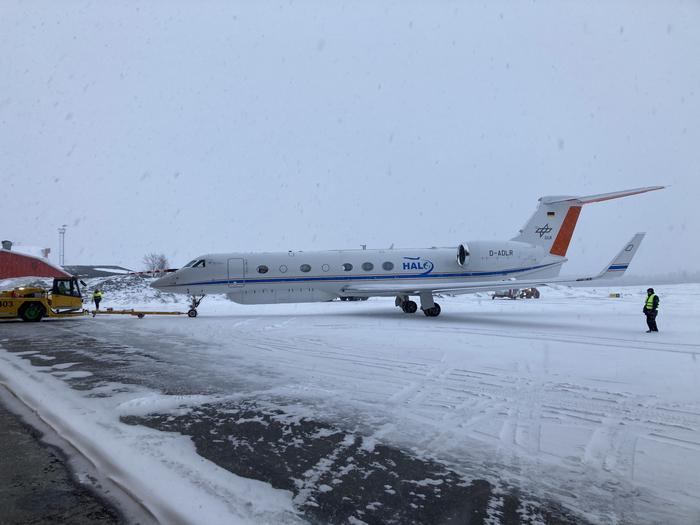
“We want to make fundamental and ground-breaking progress in our understanding of Arctic amplification and improve the reliability of models for predicting the dramatic warming in the Arctic,” says Professor Manfred Wendisch, Director of the Institute for Meteorology at Leipzig University and lead author of the study. In mid-March 2022, the large-scale international research campaign HALO (AC)³ began its investigation of changes in air masses in the Arctic. Researchers from Leipzig University and several other research institutions are involved.

Credit: Leipzig University
“We want to make fundamental and ground-breaking progress in our understanding of Arctic amplification and improve the reliability of models for predicting the dramatic warming in the Arctic,” says Professor Manfred Wendisch, Director of the Institute for Meteorology at Leipzig University and lead author of the study. In mid-March 2022, the large-scale international research campaign HALO (AC)³ began its investigation of changes in air masses in the Arctic. Researchers from Leipzig University and several other research institutions are involved.
During the campaign, they used special aircraft to study the movement of air masses to and from the Arctic via northward moist- and warm-air intrusions (WAIs) and southward marine cold-air outbreaks (CAOs). Two low-flying aircraft and one long-range, high-altitude research aircraft were flown in close formation whenever possible. “We observed air mass transformations over areas of open ocean, the marginal sea ice zone and the central Arctic sea ice,” says Wendisch.
The HALO (𝒜𝒞)³ aircraft campaign was conducted over the Norwegian and Greenland Seas, the Fram Strait, and the central Arctic Ocean in March and April 2022. A new observation strategy was used to track the changes in the air masses. This enabled the researchers to measure the moving-air parcels twice along their transport pathway. The meteorologist explains: “This allowed us to quantify the warming and cooling of the transported air masses for the first time. For example, we have shown that cold air that breaks out of the Arctic and heads south warms up to three degrees Celsius per hour on its way from the sea ice to the open sea. In addition, the humidity of the air increases as it moves south.” The scientists also studied changes in cloud properties as air masses are transported. This unprecedented data is currently being compared with calculations from the German weather forecast model.
Original title of the paper of the European Geosciences Union:
“Overview: quasi-Lagrangian observations of Arctic air mass transformations – introduction and initial results of the HALO–( )3 aircraft campaign”, doi.org/10.5194/acp-24-8865-2024
Journal
Atmospheric Chemistry and Physics
Method of Research
Observational study
Subject of Research
Not applicable
Article Title
Overview: quasi-Lagrangian observations of Arctic air mass transformations – introduction and initial results of the HALO–(𝒜 𝒞)3 aircraft campaign
Article Publication Date
13-Aug-2024
Cite Scienmag News
Sloane Callahan. (September 4, 2024). A better understanding of climate change: Researchers study cloud movement in the Arctic. Scienmag. https://scienmag.com/a-better-understanding-of-climate-change-researchers-study-cloud-movement-in-the-arctic/
Sloane Callahan. "A better understanding of climate change: Researchers study cloud movement in the Arctic." Scienmag, 4 September 2024, https://scienmag.com/a-better-understanding-of-climate-change-researchers-study-cloud-movement-in-the-arctic/. Accessed 4 September 2026.
Sloane Callahan. "A better understanding of climate change: Researchers study cloud movement in the Arctic." Scienmag. September 4, 2024. https://scienmag.com/a-better-understanding-of-climate-change-researchers-study-cloud-movement-in-the-arctic/

