


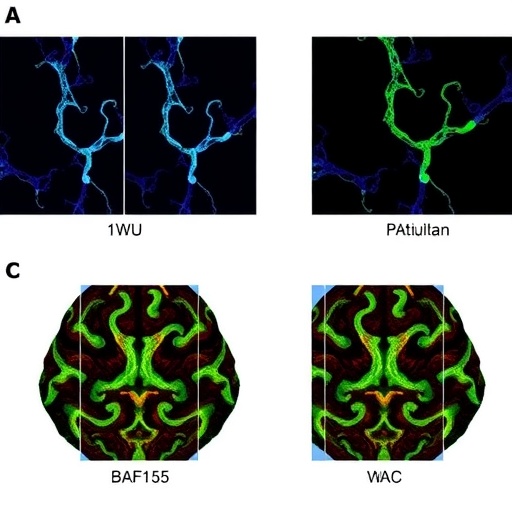
In a groundbreaking new study published in Nature Communications, researchers have uncovered a vital role for the chromatin remodeling factor BAF155 in orchestrating communication between oligodendroglial cells and neurons, a finding with profound implications for understanding regional myelination and its links to neurodevelopmental disorders such as autism spectrum disorder (ASD). This comprehensive investigation sheds light on the molecular mechanisms by which BAF155 modulates the intricate cellular interplay necessary for normal brain development and behavior.
The study focuses on BAF155, a core component of the SWI/SNF chromatin remodeling complex, which is known to regulate gene transcription by modifying chromatin accessibility. Unlike prior work that primarily examined neuronal populations in isolation, Wang, Zeng, Wu, and colleagues delve deeply into how BAF155 functions within oligodendroglial lineages to impact neuronal communication. Oligodendrocytes are critical for producing myelin, the insulating sheath around axons that enables rapid electrical signaling. Disruptions in myelination patterns have been repeatedly implicated in ASD and other neurological disorders, but the upstream regulatory factors had remained largely elusive until now.
Employing sophisticated genetic mouse models, the team conditionally deleted BAF155 specifically in oligodendrocyte precursor cells (OPCs), thereby enabling them to unravel the cell-type specific effects of BAF155 loss on central nervous system development. These BAF155-deficient mice exhibited striking region-specific abnormalities in myelin formation, most notably within cortical areas implicated in higher cognitive functions and social behaviors — domains profoundly affected in autism. This spatially restricted myelination deficit underscores the nuanced regulatory role of BAF155, which does not act uniformly across the brain but rather in a context-dependent manner reflecting the complexity of neural circuitry.
At the molecular level, transcriptome analyses revealed that loss of BAF155 leads to widespread dysregulation of gene networks governing oligodendroglial maturation and their capacity to engage in crosstalk with neurons. The study identified a cascade of genes involved in axonal ensheathment, synaptic modulation, and signaling pathways critical for establishing functional neural circuits whose perturbation mirrors molecular signatures observed in ASD patient brains. Notably, pathways involved in glia-neuron communication, including growth factor signaling and extracellular matrix remodeling, were significantly downregulated, suggesting that BAF155 serves as a master regulator coordinating the molecular dialogue essential for proper myelin deposition.
Behaviorally, the BAF155-deficient mice exhibited hallmark autism-like phenotypes, including impaired social interactions, repetitive behaviors, and increased anxiety. These findings provide compelling in vivo evidence linking chromatin remodeling machinery within oligodendrocyte lineages to complex behavioral outputs mediated by neuronal network integrity. The correlation between disrupted myelination and altered behavior adds a crucial piece to the puzzle of ASD pathogenesis, implicating non-neuronal cells and epigenetic regulation as vital contributors to disease etiology.
Another remarkable aspect of this research lies in its methodological rigor and multidisciplinary approach. By combining state-of-the-art single-cell RNA sequencing, electrophysiological recordings, and advanced imaging techniques, the authors painted a holistic picture of how chromatin remodeling orchestrates cellular and circuits-level processes. Electrophysiological assessments demonstrated altered conduction velocities in affected cortical regions, confirming that BAF155 deficiency culminates in tangible functional deficits at the neural network level. This integration of molecular insights with physiological and behavioral data sets a new benchmark for neuroepigenetics research.
Furthermore, the study challenges conventional neuron-centric paradigms in neuroscience by highlighting oligodendrocytes not merely as supportive glue but as active participants in shaping neural circuitry and behavior. The insights gained from dissecting BAF155’s role point to chromatin remodelers as potential therapeutic targets, where fine-tuning epigenetic states in glial cells could recalibrate aberrant neuronal communication implicated in neurodevelopmental disorders.
Intriguingly, the context-dependent effects observed suggest that developmental timing and brain region specificity are crucial determinants of BAF155’s function. With BAF155 impacting oligodendroglial-neuronal interactions particularly in socially relevant cortical hubs, the findings align with the notion that demyelination or disrupted myelin plasticity may underlie specific behavioral phenotypes. This regional vulnerability could inform more precise interventions, whether genetically or pharmacologically modulated, aimed at restoring normal chromatin remodeling activity to ameliorate ASD symptoms.
The global relevance of this research is underpinned by the conservation of SWI/SNF complexes across species and the prevalence of myelination defects in various neurological conditions beyond autism, such as multiple sclerosis and schizophrenia. By elucidating fundamental epigenetic mechanisms governing oligodendrocyte function, this work opens avenues for exploring shared pathological pathways across disorders characterized by white matter abnormalities.
Moreover, the authors emphasize that their findings warrant further exploration into how environmental factors interact with chromatin remodeling machinery during critical developmental windows. Given that epigenetic regulators are sensitive to external stimuli, future studies may reveal gene-environment interactions shaping myelination trajectories and behavioral outcomes, thereby enhancing our understanding of neurodevelopmental plasticity and resilience.
In summary, this landmark investigation illuminates the critical role of the chromatin remodeling factor BAF155 in bridging oligodendroglial development with neuronal circuit formation, ultimately influencing region-specific myelination and behaviors reminiscent of autism spectrum disorder. The multidisciplinary evidence presented articulates a novel framework wherein epigenetic regulation in glial cells is integral to brain function and disease, reshaping perspectives on neural development and highlighting promising targets for therapeutic intervention.
This study not only advances fundamental neuroscience but also holds translational potential, offering a new lens through which to examine and perhaps correct neurodevelopmental anomalies linked to chromatin remodeling dysfunction. As epigenetics continues to unveil intricate layers behind brain complexity, factors like BAF155 emerge as essential molecular architects safeguarding the dialogue between glia and neurons that underpins cognition and behavior.
Such discoveries emphasize the importance of integrated approaches combining genetics, molecular biology, physiology, and behavior to decode the cellular crosstalk driving brain health. The implication that subtle epigenetic disruptions in oligodendrocytes can reverberate through neuronal networks to manifest as behavioral deficits opens compelling research frontiers and inspires hope for innovative strategies combating autism and related disorders.
Cite Scienmag News
Cassandra Pierce. (December 21, 2025). BAF155 Drives Brain Myelination, Autism Behaviors in Mice. Scienmag. https://scienmag.com/baf155-drives-brain-myelination-autism-behaviors-in-mice/
Cassandra Pierce. "BAF155 Drives Brain Myelination, Autism Behaviors in Mice." Scienmag, 21 December 2025, https://scienmag.com/baf155-drives-brain-myelination-autism-behaviors-in-mice/. Accessed 4 September 2026.
Cassandra Pierce. "BAF155 Drives Brain Myelination, Autism Behaviors in Mice." Scienmag. December 21, 2025. https://scienmag.com/baf155-drives-brain-myelination-autism-behaviors-in-mice/


