


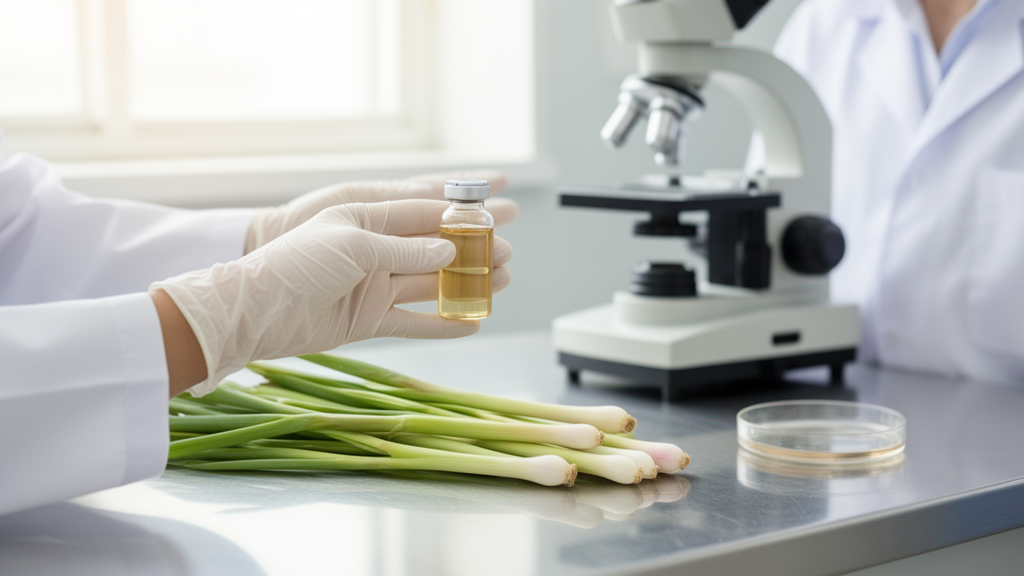
Geranic acid, a fragrant monoterpenoid long valued in perfumery, is stepping into a new role: a lab-grown candidate for protecting skin from the cellular wreckage caused by ultraviolet radiation. In a study published in Frontiers in Bioengineering and Biotechnology, researchers at PROYA Cosmetics in Hangzhou, China, report a two-part advance. They engineered an enzymatic production route that yields geranic acid with over 98 percent trans-isomeric purity from citral, the aroma compound behind the scent of lemongrass, and then showed that the biosynthesized molecule shields human keratinocytes from UVB-induced photodamage through several coordinated mechanisms.
The production challenge is more technical than it might sound. Geranic acid, formally E-3,7-dimethyl-2,6-octadienoic acid, occurs naturally in plants but at abundances too low and compositions too variable for commercial extraction. The industry has therefore relied on chemical oxidation of geraniol or citral, routes that lack stereoselectivity and produce mixtures of cis and trans isomers along with impurities such as nerol and citronellol. That matters biologically, because the trans form of geranic acid exhibits substantially higher activity than its cis counterpart. Chemical synthesis also demands harsh reagents and generates toxic byproducts, conflicting with green chemistry principles and complicating downstream purification.
To sidestep these problems, the team turned to biology. In living systems, geranic acid is generated through the NAD+-dependent oxidation of geranial, a reaction catalyzed by geranial dehydrogenase, an enzyme known from certain plants and microbes. The researchers screened databases including Biocyc, NCBI, BRENDA, and UniProt for homologous enzymes sharing 30 to 90 percent sequence identity with a previously reported geranial dehydrogenase, identifying ten candidates. Among them, an enzyme designated KDI24_07135 from a Pseudomonas species, later attributed to the bacterium Castellaniella defragrans, showed the highest catalytic activity. The 478-amino-acid protein, with a predicted molecular mass of 50.57 kilodaltons and a theoretical isoelectric point of 5.02, was codon-optimized for expression in Escherichia coli BL21 (DE3) and cloned into a pET-28a(+) vector.
Scaling up the enzyme supply required high-density fed-batch fermentation in a 10-liter glass bioreactor. The team grew the engineered bacteria to an optical density at 600 nanometers of 30 to 40, induced expression with 0.1 millimolar IPTG at 30 degrees Celsius for six hours, and harvested the cells by high-pressure homogenization to obtain crude enzyme extract. The resulting biocatalytic system, run in a 300-milliliter reaction containing 20 grams per liter citral, 2 millimolar NAD+, and cell lysates carrying both the dehydrogenase and an NADH oxidase, converted more than 90 percent of the citral to geranic acid in 12 hours at 30 degrees Celsius and pH 8.0, yielding a product titer of approximately 15 grams per liter.
The cofactor recycling step is central to the process economics. NAD+ acts as an essential redox cofactor in the oxidation, but intracellular pools are constantly catabolized and must be efficiently recycled to maintain metabolic flux. The team paired the dehydrogenase with an NADH oxidase that uses oxygen as the terminal electron acceptor, regenerating NAD+ while producing only water as a byproduct. This arrangement conforms to green chemistry principles and reduces purification burdens. The purified product was characterized by gas chromatography-quadrupole time-of-flight mass spectrometry, which showed a dominant peak accounting for over 98 percent of the total ion current, and by proton nuclear magnetic resonance spectroscopy, which confirmed the chemical identity and revealed no resolvable impurity peaks.
With high-purity trans-geranic acid in hand, the researchers shifted to the biological question: does the molecule protect skin cells from UVB damage? They used HaCaT human immortalized keratinocytes, exposing them to a single calibrated UVB dose of 15 millijoules per square centimeter and treating them immediately afterward with geranic acid for 24 hours. First, they confirmed safety: geranic acid showed no obvious cytotoxicity across 0 to 250 milligrams per liter, with cell viability remaining above 90 percent after 24 hours. They then selected three doses, 62.5, 125, and 250 milligrams per liter, for the protective experiments.
The photoprotective effects emerged across multiple layers. UVB irradiation triggered a substantial rise in intracellular reactive oxygen species, which geranic acid suppressed dose-dependently. The treatment also reduced accumulation of malondialdehyde, a core marker of lipid peroxidation, and restored the activities of two key endogenous antioxidant enzymes, superoxide dismutase and glutathione peroxidase, which UVB had markedly suppressed. At the organelle level, JC-1 staining showed that UVB caused mitochondrial membrane potential depolarization, and geranic acid reversed this loss, with medium and high concentrations showing the most prominent effects. Because mitochondrial dysfunction is both a cause and a consequence of oxidative stress, this restoration suggests the molecule acts at the source of the damage cascade rather than merely mopping up downstream radicals.
The team then probed the inflammatory and calcium signaling pathways. UVB exposure upregulated secretion of the pro-inflammatory mediators MCP-1 and IL-6, which geranic acid markedly suppressed in a dose-dependent manner. Fluo-4 AM fluorescence detection revealed that UVB induced a massive influx of intracellular calcium, and this overload was effectively attenuated by the treatment. Immunofluorescence analysis showed that UVB upregulated expression of TRPV1, a calcium-permeable ion channel implicated in skin inflammation and pain, and of NF-κB, a transcription factor central to inflammatory signaling. Geranic acid downregulated both proteins, consistent with its inhibitory effects on calcium influx and cytokine secretion. The researchers interpret this as evidence that the molecule acts on the TRPV1/NF-κB axis, a pathway not previously linked to geranic acid in photodamage models.
Downstream of oxidative stress and inflammation lie DNA damage and cellular senescence, and here too the treatment showed protective activity. Immunofluorescence analysis of γ-H2AX foci, a sensitive marker of DNA double-strand breaks, showed that UVB increased foci formation and that geranic acid significantly reduced this accumulation. Western blot analysis demonstrated that UVB upregulated the senescence-associated proteins p16 and p21, and this upregulation was effectively reversed by the treatment. The team also measured secretion of matrix metalloproteinases MMP-1 and MMP-3, enzymes that degrade the extracellular matrix during photodamage and photoaging. Geranic acid dose-dependently attenuated the upregulation of both, suggesting a protective effect against UVB-induced extracellular matrix damage.
The authors acknowledge several limitations. Substrate concentrations in the biocatalytic system were restricted to prevent enzyme inhibition, and all biological evaluations were conducted in vitro in HaCaT cells, requiring further validation in animal models and human skin tissue. The molecular basis underlying geranic acid-mediated modulation of the calcium/TRPV1/NF-κB signaling axis in skin photodamage models remains to be fully elucidated. Regulatory authorities have classified geranic acid as a safe flavoring substance with low acute toxicity, yet its dermatological and photoprotective applications lack formal evaluation, leaving a critical gap for cosmeceutical development. The study, funded without external financial support and conducted entirely by researchers employed by PROYA Cosmetics, provides both a sustainable biomanufacturing strategy and mechanistic foundations for developing geranic acid as a natural anti-photodamage active ingredient for cosmetic and dermatological applications.
Subject of Research: Biotechnology
Article Title: Enzymatic synthesis of geranic acid and its protective effects against UVB-induced skin photodamage
Article References: Lin, J., Zhang, P., Wang, X., Xuan, L., Zhang, S., Wang, J., & Huang, H. (2026). Enzymatic synthesis of geranic acid and its protective effects against UVB-induced skin photodamage. Frontiers in Bioengineering and Biotechnology, 14, Article 1891436. https://doi.org/10.3389/fbioe.2026.1891436
Image Credits: AI Generated
DOI: 10.3389/fbioe.2026.1891436
Keywords: geranic acid, enzymatic synthesis, UVB photodamage, keratinocytes, biocatalysis, skin aging, cosmetics, monoterpenoid, Enzymatic, synthesis, geranic, acid
Cite Scienmag News
Denise Maddox. (October 17, 2026). Bacteria-Derived Enzyme Turns Lemongrass Compound Into Skin Shield Against Sun Damage. Scienmag. https://scienmag.com/bacteria-derived-enzyme-turns-lemongrass-compound-into-skin-shield-against-sun-damage/
Denise Maddox. "Bacteria-Derived Enzyme Turns Lemongrass Compound Into Skin Shield Against Sun Damage." Scienmag, 17 October 2026, https://scienmag.com/bacteria-derived-enzyme-turns-lemongrass-compound-into-skin-shield-against-sun-damage/. Accessed 17 October 2026.
Denise Maddox. "Bacteria-Derived Enzyme Turns Lemongrass Compound Into Skin Shield Against Sun Damage." Scienmag. October 17, 2026. https://scienmag.com/bacteria-derived-enzyme-turns-lemongrass-compound-into-skin-shield-against-sun-damage/


