


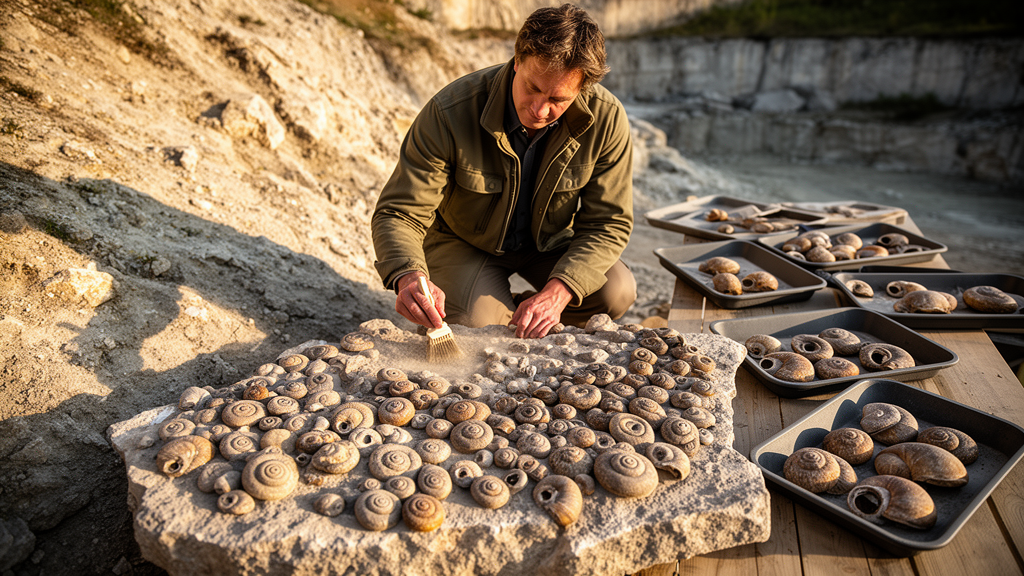
Deep in a limestone quarry near the Bavarian village of Saal, close to the Danube River, palaeontologists have documented one of the most species-rich fossil snail faunas ever assembled from the Late Jurassic. A newly published monograph in the journal Zitteliana closes a four-part series on the reef-dwelling gastropods of Saal and the Nattheim area of southern Germany, adding forty species of the subclass Heterobranchia from Upper Kimmeridgian reefal limestones. Six of those species are entirely new to science, and the study crowns Saal as the site with the highest known gastropod diversity of the Kimmeridgian anywhere in the world.
The new work, led by Joachim Gründel and colleagues including collector Fritz Lang and the Bavarian State Collection for Palaeontology and Geology in Munich, describes six new species: Ceritella convexa, Nerinea donosa, Endoplocus acutus, Endoplocus inflatus, Pseudonerinea ? pseudomelaniformis and Itieroptygmatis cylindrata. All of them were recovered from the Saal quarry, and a lectotype has been designated for the historically confusing species Ptygmatis ? tornata, first described by Quenstedt in 1852. With this final instalment, the research team has now reported 156 gastropod species across the two regions, of which 125 come from Saal and 54 from the Nattheim area, with only 23 species shared between the two localities.
What makes the Saal quarry so extraordinary is not just the number of species but the way they are preserved. The massive Upper Jurassic limestones there are extremely dense, yet along the contact with Cretaceous karst fissures the rock has been weathered into a porous zone only a few millimetres to about sixty millimetres thick. Acidic karst waters percolating through this layer gently etched the fossils free, allowing small shells of gastropods, bivalves, echinoderms, brachiopods and corals to be washed out almost intact. In 2003 and 2014, Fritz Lang isolated more than 300 and more than 1,000 gastropods respectively by carefully washing loose material scraped from the karst surfaces, a painstaking technique that has paid enormous dividends.
The quarry itself exposes more than 100 metres of massive limestone of Middle and Late Kimmeridgian age, possibly extending into the basal Tithonian. The deeper part of the section is dominated by associations of siliceous sponges and microbes, but platy corals of the genus Microsolena become increasingly common upward until a continuous transition into pure coral reef facies is reached at the middle quarrying level, roughly 380 metres above sea level. In the upper 40 to 50 metres of reef limestone, from which the gastropod fauna was retrieved, the switch from a deeper-water sponge association to a shallow-water coral facies is complete. The reef bodies host a highly diverse coral fauna alongside reef debris and lagoon sediments with coated grains and dasycladacean algae, the latter informally known as Breistein, or porridge stone.
Rare ammonite finds reported from different levels of the quarry confirm a Late Kimmeridgian age, supported by specimens of Hybonoticeras beckeri, Sutneria subeumela and an indeterminate Virgataxioceras between 335 and 415 metres above sea level. The exact age of the very top of the reef limestone remains disputed, with some evidence suggesting it may reach into the basal Tithonian, but the gastropod fauna itself is firmly anchored in the Upper Kimmeridgian.
By contrast, the fossils from the Nattheim area on the Swabian Jura are silicified, meaning that originally aragonitic and calcitic shells were converted during diagenesis into silica. This allows them to be freed from the dense limestone with acetic or formic acid, though the silicification is rather coarse and often destroys fine ornament. The Nattheim coral facies belongs to the more than 120-metre-thick Mergelstetten Formation, which ammonite finds place in the uppermost Kimmeridgian, the Beckeri Zone, Ulmense Subzone, making it contemporaneous with the famous Nusplingen Lithographic Limestone. During the nineteenth century, bean ore mining opened numerous outcrops in the Nattheim, Blaubeuren and Gerstetten area, but today finds are essentially limited to field cobbles and temporary construction exposures.
The taxonomic work behind the new study was far from straightforward. The Nerineoidea, a group of turreted snails that dominated these reefs, are notoriously difficult to classify. Shell shape, ornament, the number and morphology of internal plaits and ontogenetic changes all matter, but different authors have used these characters inconsistently, leaving the supraspecific classification unstable. Many nerineoids are large and slender, and specimens often survive only as fragments of a few whorls, with both ornamentation and inner plaits changing during growth. This made it frequently impossible to assign fragments to any taxon with confidence, and the authors note that previous students faced the same problems, leading to contradictory species characterisations in the older literature.
Despite these challenges, the diversity statistics are striking. Rarefaction analysis at a sample size of 200 individuals yields roughly 50 expected species at Saal and 52 at Nattheim, suggesting the two faunas share the same high diversity even though they share few species. Simpson indices of 0.96 and 0.95 and Shannon indices of 3.864 and 3.417 point to exceptionally even, species-rich communities. Remarkably, the gastropod diversity of both Late Jurassic sites exceeds that of the reef-associated Late Triassic fauna of the St. Cassian Formation in northern Italy, long considered a benchmark for Mesozoic reef diversity, where around 40 expected species at comparable sample sizes have been reported.
In total, up to 300 species of marine macro-invertebrates have been reported from the Saal quarry, including 33 bivalve species, 13 brachiopods, 8 serpulid tube worms, 7 echinoids, 27 coral genera and 19 arthropod species, alongside ammonites and sponges. Gastropods are by far the most diverse group at Saal, a pattern the authors describe as a modern aspect of this fauna, since in today’s oceans snails typically dominate shallow marine invertebrate assemblages. The high diversity of vetigastropods and neritimorphs, groups with calcitic outer shell layers that preserve well, appears to reflect an original ecological signal rather than a preservation artefact, although the strong lithification of the limestone likely biases the record against small caenogastropods and heterobranchs that would be more easily recovered from soft shales.
The story is not over. An additional private collection from Saal, acquired by the Bavarian State Collection in 2017, contains numerous unstudied gastropod specimens that promise further undescribed species, and the authors expect that more than 150 gastropod species will eventually be documented from the quarry alone. As the final chapter of this monographic series closes, the Saal reef stands as a vivid reminder that tropical shallow seas of the Late Jurassic harboured snail communities as rich as any in the fossil record, and that patient collecting in an unassuming Bavarian quarry can still rewrite what we know about life on ancient reefs.
Subject of Research: Late Jurassic reef gastropod diversity and taxonomy in southern Germany
Article Title: Late Jurassic (Upper Kimmeridgian) Heterobranchia ( Gastropoda ) of the coral-facies of Saal near Kelheim and the viciniy of Nattheim (Germany)
Article References: Gründel, J., Keupp, H., Lang, F., & Nützel, A. (2022). Late Jurassic (Upper Kimmeridgian) Heterobranchia (Gastropoda) of the coral-facies of Saal near Kelheim and the viciniy of Nattheim (Germany). Zitteliana, 96, 179-221. https://doi.org/10.3897/zitteliana.96.84187
Image Credits: AI Generated
DOI: 10.3897/zitteliana.96.84187
Keywords: gastropods, Late Jurassic, Kimmeridgian, Saal quarry, Nattheim, Nerineoidea, reef palaeontology, Heterobranchia, biodiversity, palaeontology, Germany, fossils
Cite Scienmag News
Margaret Porter. (October 17, 2026). Jurassic reef in Bavaria yields record-breaking haul of 125 gastropod species. Scienmag. https://scienmag.com/jurassic-reef-in-bavaria-yields-record-breaking-haul-of-125-gastropod-species/
Margaret Porter. "Jurassic reef in Bavaria yields record-breaking haul of 125 gastropod species." Scienmag, 17 October 2026, https://scienmag.com/jurassic-reef-in-bavaria-yields-record-breaking-haul-of-125-gastropod-species/. Accessed 17 October 2026.
Margaret Porter. "Jurassic reef in Bavaria yields record-breaking haul of 125 gastropod species." Scienmag. October 17, 2026. https://scienmag.com/jurassic-reef-in-bavaria-yields-record-breaking-haul-of-125-gastropod-species/


