


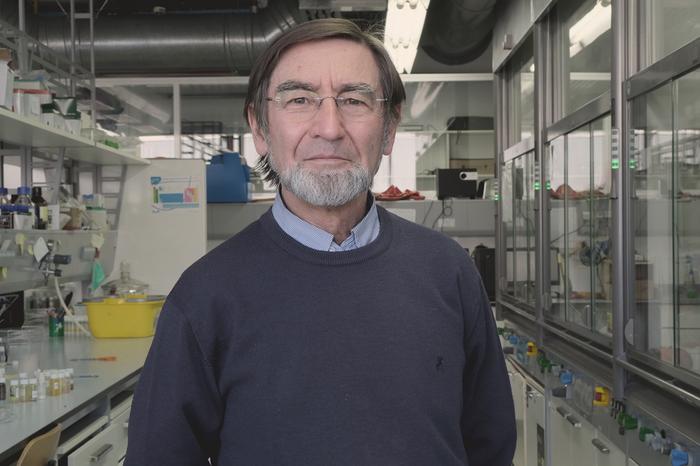
The Specialised Group on Chemistry of Natural Products (GQPN) of the Spanish Royal Society of Chemistry (RSEQ) has awarded its Excellence in Research Award 2023 to Professor Ricardo Riguera. The Evaluation Committee thus recognises his valuable contribution to this area of chemistry. Among other advances, his work has made it possible to describe a large number of bioactive metabolites, such as the first heptacyclopeptide and the first cyclodepsipeptide isolated from marine organisms. Riguera also identified one of the first examples of cytotoxic metabolites from marine bacteria, the first description of L-galactose as part of a natural product, and the first description of a glycoconjugate of marine origin that until then was considered to be exclusive to humans. In the 1990s, R. Riguera’s team was one of three research groups in the world, and the only European one, to address the study of high molecular weight water-soluble compounds of marine origin, carrying out the first exhaustive study of this type of compounds in deep-sea animals from the Chilean Antarctic and the North Pacific.

Credit: CiQUS USC
The Specialised Group on Chemistry of Natural Products (GQPN) of the Spanish Royal Society of Chemistry (RSEQ) has awarded its Excellence in Research Award 2023 to Professor Ricardo Riguera. The Evaluation Committee thus recognises his valuable contribution to this area of chemistry. Among other advances, his work has made it possible to describe a large number of bioactive metabolites, such as the first heptacyclopeptide and the first cyclodepsipeptide isolated from marine organisms. Riguera also identified one of the first examples of cytotoxic metabolites from marine bacteria, the first description of L-galactose as part of a natural product, and the first description of a glycoconjugate of marine origin that until then was considered to be exclusive to humans. In the 1990s, R. Riguera’s team was one of three research groups in the world, and the only European one, to address the study of high molecular weight water-soluble compounds of marine origin, carrying out the first exhaustive study of this type of compounds in deep-sea animals from the Chilean Antarctic and the North Pacific.
His research also covered areas such as Pharmaceutical Chemistry and Synthetic Methodology, with important publications on synthesis, pharmacological evaluation and AER of various enzyme inhibitors. His work in Nuclear Magnetic Resonance, where Prof. Riguera is a reference figure in the field, is particularly noteworthy.
R. Riguera was Principal Investigator at CiQUS from the beginning of the centre until 2021, leading research on the formation of polymeric structures (smart polymers) and their applications in drug transport and as chiral sensors. Currently Emeritus Professor at the USC, Riguera is the author of more than 250 publications, has supervised more than 30 theses and taught postgraduate courses at numerous universities. He has also been director of the Department of Organic Chemistry, Dean of the Faculty of Chemistry and Vice-Chancellor of the University of Santiago de Compostela.
This award is in addition to other recognitions: in 2013, the RSEQ awarded him the Félix Serratosa Medal for his work in Organic Chemistry, and in 2018 the GERMN Award for his research in the field of NMR.
Cite Scienmag News
Bethany Barker. (July 10, 2024). Award for Excellence in Natural Product Chemistry to Ricardo Riguera. Scienmag. https://scienmag.com/award-for-excellence-in-natural-product-chemistry-to-ricardo-riguera/
Bethany Barker. "Award for Excellence in Natural Product Chemistry to Ricardo Riguera." Scienmag, 10 July 2024, https://scienmag.com/award-for-excellence-in-natural-product-chemistry-to-ricardo-riguera/. Accessed 4 September 2026.
Bethany Barker. "Award for Excellence in Natural Product Chemistry to Ricardo Riguera." Scienmag. July 10, 2024. https://scienmag.com/award-for-excellence-in-natural-product-chemistry-to-ricardo-riguera/

