


Giant lizards called heath goannas could save Australian sheep farmers millions of dollars a year by keeping blowfly numbers down – and must be prioritised in conservation schemes to boost native wildlife, say researchers.

Credit: Tom Jameson
Giant lizards called heath goannas could save Australian sheep farmers millions of dollars a year by keeping blowfly numbers down – and must be prioritised in conservation schemes to boost native wildlife, say researchers.
A study led by the University of Cambridge has found that heath goannas – a species of giant, scavenging lizard – act as natural clean-up crews by clearing maggot-ridden animal carcasses from the landscape.
This reduces the emergence of blowflies, which attack sheep by laying eggs on their backsides that hatch into flesh-eating maggots. The disease, known as ‘fly strike’, costs the Australian sheep farming industry an estimated $280 million a year.
This study was carried out at 18 sites across the Marna Banggara Rewilding Project area on Australia’s southern Yorke Peninsula, where over 90% of the native mammals are now extinct.
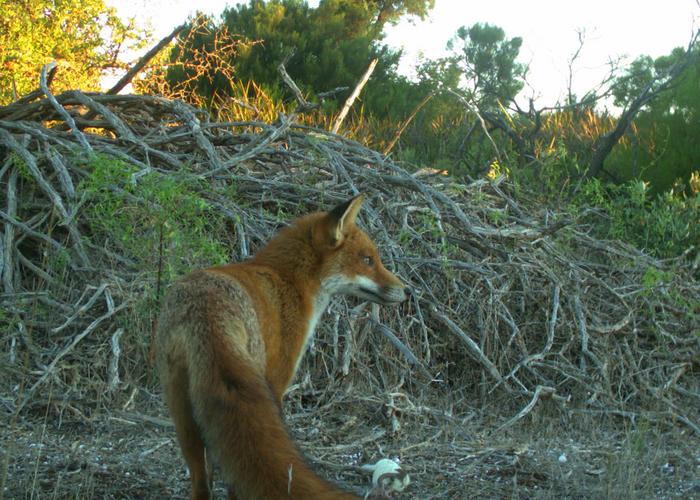
The study found that heath goannas perform a superior blowfly control service to introduced European mammals, including red foxes and cats, which are displacing them.
The researchers say that boosting populations of native large reptiles like heath goannas is vital in restoring Australia’s ecosystem and the services it supports.
“We found that Australia’s native scavengers like heath goannas are much more effective in removing blowflies from the landscape than invasive scavengers like European foxes and cats,” said Tom Jameson, a PhD researcher in the University of Cambridge’s Department of Zoology and first author of the report.
High densities of blow flies put sheep at risk of ‘fly strike’, a disease where blowfly maggots burrow into the sheep’s flesh and start to eat it alive, causing painful wounds. This affects the market value of the sheep, reduces breeding success and often results in death.
“Blowflies are a massive problem for the Australian sheep farming industry. They cause a horrible disease that is expensive for farmers to manage and a real animal welfare problem for sheep,” said Jameson.
This is the first study to show the importance of large reptiles as scavengers. It is published today in the journal Ecology and Evolution.
To get these results Jameson compared the scavenging activity of different animals in a region of southern Australia. He left hundreds of dead rats at feeding stations, with camera traps, across the landscape. He returned after five days to see whether the rats had been eaten, and to count the number of blowfly maggots left on any remaining carcasses. Camera trap footage revealed which scavenging animal had found the rat, and how quickly.
Native Australian scavengers ate more of the dead rats, and with them the flesh-eating maggots, than scavengers introduced from Europe.
“It was disgusting – we were counting maggots. After five days we’d find over 1000 maggots in one rat if a scavenger hadn’t found it. Those maggots produce blowflies that can spread up to 20 kilometres in a week, putting local sheep flocks at risk of fly strike,” said Jameson.
In natural situations, any dead animal in the landscape will fill with blowfly maggots very quickly.
“The results suggest that conservation work in southern Australia to remove invasive species should also focus on boosting the population of heath goannas and other native species because they’re really important for the wider ecosystem,” said Jameson.
He added: “As well as benefiting native wildlife this will have knock-on benefits for local agricultural industry, and also attract more wildlife tourism.”
Marna Banggara, supported by Narungga traditional owners, is an ambitious rewilding project that aims to restore ecosystem health in the region by reintroducing missing native Australian species.
Eighteenth century European settlers to Australia brought with them red foxes for hunting, and cats as pets. Australia’s native wildlife – including many scavengers – has since been decimated by them.
The heath goanna is an endangered species of giant lizard native to the heathlands of southern Australia that can grow up to a metre and a half in length. It feeds on the dead carcasses of other animals, as well as catching live animals.
Reptiles like the heath goanna are the largest remaining native land scavengers in much of Australia today.
Journal
Ecology and Evolution
Method of Research
Experimental study
Subject of Research
Animals
Article Title
Squamate Scavenging Services: Heath goannas (Varanus rosenbergi) support carcass removal and may suppress agriculturally damaging blowflies
Article Publication Date
25-Jun-2024
Cite Scienmag News
Ophelia Keating. (June 25, 2024). Australia’s giant lizards help save sheep from being eaten alive. Scienmag. https://scienmag.com/australias-giant-lizards-help-save-sheep-from-being-eaten-alive/
Ophelia Keating. "Australia’s giant lizards help save sheep from being eaten alive." Scienmag, 25 June 2024, https://scienmag.com/australias-giant-lizards-help-save-sheep-from-being-eaten-alive/. Accessed 3 September 2026.
Ophelia Keating. "Australia’s giant lizards help save sheep from being eaten alive." Scienmag. June 25, 2024. https://scienmag.com/australias-giant-lizards-help-save-sheep-from-being-eaten-alive/

