


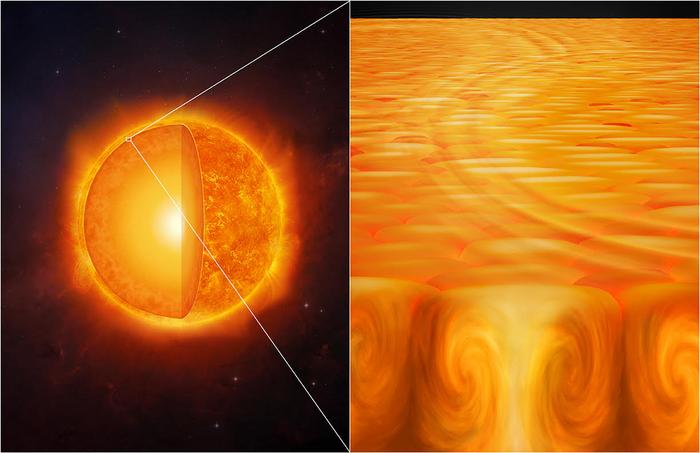
Abu Dhabi, UAE, June 25, 2024: A team of solar physicists at NYU Abu Dhabi’s Center for Astrophysics and Space Science (CASS), led by Research Scientist Chris S. Hanson, Ph.D., has revealed the interior structure of the sun’s supergranules, a flow structure that transports heat from the sun’s hidden interior to its surface. The researchers’ analysis of the supergranules presents a challenge to the current understanding of solar convection.

Credit: Illustration by Melissa Weiss.
Abu Dhabi, UAE, June 25, 2024: A team of solar physicists at NYU Abu Dhabi’s Center for Astrophysics and Space Science (CASS), led by Research Scientist Chris S. Hanson, Ph.D., has revealed the interior structure of the sun’s supergranules, a flow structure that transports heat from the sun’s hidden interior to its surface. The researchers’ analysis of the supergranules presents a challenge to the current understanding of solar convection.
The sun generates energy in its core through nuclear fusion; that energy is then transported to the surface, where it escapes as sunlight. In the study “Supergranular-scale solar convection not explained by mixing-length theory” published in the journal Nature Astronomy, the researchers explain how they utilized Doppler, intensity and magnetic images from the helioseismic and magnetic imager (HMI) onboard NASA’s Solar Dynamics Observatory (SDO) satellite to identify and characterize approximately 23,000 supergranules. Since the sun’s surface is opaque to light, the NYUAD scientists used sound waves to probe the interior structure of the supergranules. These sound waves, which are generated by the smaller granules and are everywhere in the sun, have been successfully used in the past in a field known as Helioseismology.
By analyzing such a large dataset of supergranules, which were estimated to extend 20,000 Km (~3% into the interior) below the surface of the sun, the scientists were able to determine the up and down flows associated with supergranular heat transport with unprecedented accuracy. In addition to inferring how deep the supergranules extend, the scientists also discovered that the downflows appeared ~40 percent weaker than the upflows, which suggests that some component was missing from the downflows.
Through extensive testing and theoretical arguments, the authors theorize that the “missing” or unseen component could consist of small scale (~100Km) plumes that transport cooler plasma down into the sun’s interior. The sound waves in the sun would be too big to sense these plumes, making the down flows appear weaker. These findings cannot be explained by the widely used mixing-length description of solar convection.
“Supergranules are a significant component of the heat transport mechanisms of the sun, but they present a serious challenge for scientists to understand,” said Shravan Hanasoge, Ph.D., research professor, co-author of the paper and co-Principal Investigator of CASS. “Our findings counter assumptions that are central to the current understanding of solar convection, and should inspire further investigation of the sun’s supergranules.”
The research was conducted within CASS at NYUAD in collaboration with Tata Institute of Fundamental Research, Princeton University, and New York University, using NYUAD’s high performance computing resources.
ENDS
About NYU Abu Dhabi
www.nyuad.nyu.edu
NYU Abu Dhabi is the first comprehensive liberal arts and research campus in the Middle East to be operated abroad by a major American research university. Times Higher Education ranks NYU among the top 30 universities in the world, making NYU Abu Dhabi the highest-ranked university in the UAE and MENA region. NYU Abu Dhabi has integrated a highly selective undergraduate curriculum across the disciplines with a world center for advanced research and scholarship. The university enables its students in the sciences, engineering, social sciences, humanities, and arts to succeed in an increasingly interdependent world and advance cooperation and progress on humanity’s shared challenges. NYU Abu Dhabi’s high-achieving students have come from over 120 countries and speak over 100 languages. Together, NYU’s campuses in New York, Abu Dhabi, and Shanghai form the backbone of a unique global university, giving faculty and students opportunities to experience varied learning environments and immersion in other cultures at one or more of the numerous study-abroad sites NYU maintains on six continents.
Journal
Nature Astronomy
Article Title
Supergranular-scale solar convection not explained by mixing-length theory
Cite Scienmag News
Grant Pearson. (June 25, 2024). NYU Abu Dhabi researchers present new evidence for how heat is transported below the sun’s surface. Scienmag. https://scienmag.com/nyu-abu-dhabi-researchers-present-new-evidence-for-how-heat-is-transported-below-the-suns-surface/
Grant Pearson. "NYU Abu Dhabi researchers present new evidence for how heat is transported below the sun’s surface." Scienmag, 25 June 2024, https://scienmag.com/nyu-abu-dhabi-researchers-present-new-evidence-for-how-heat-is-transported-below-the-suns-surface/. Accessed 5 September 2026.
Grant Pearson. "NYU Abu Dhabi researchers present new evidence for how heat is transported below the sun’s surface." Scienmag. June 25, 2024. https://scienmag.com/nyu-abu-dhabi-researchers-present-new-evidence-for-how-heat-is-transported-below-the-suns-surface/

