


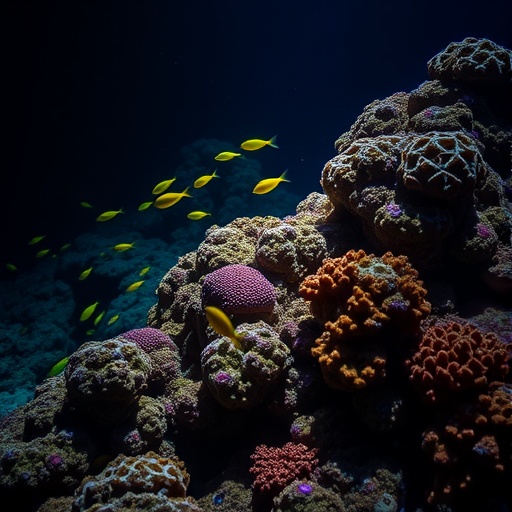
Artificial light pollution, an ever-expanding consequence of urban coastal development, is emerging as a profound disruptor of marine life behavior and physiology, according to groundbreaking research from Bar-Ilan University. The study, recently published in Current Biology, compellingly demonstrates that even minimal levels of nighttime illumination—far below what might be intuitively considered harmful—interfere with the natural sleep cycles of coral reef fish, specifically the blue-green damselfish (Chromis viridis). These disruptions carry ramifications extending to neuronal health and potentially pose risks to the vitality of entire coral reef ecosystems.
This pioneering investigation utilized an integrative approach that combined infrared videography, machine-learning behavioral tracking, controlled laboratory experiments, and extended in situ observations within the Gulf of Aqaba near Eilat, Israel. These methods validated that Chromis viridis, a species crucial to coral reef dynamics, naturally engages in sleep-like states characterized by distinct inactivity, specific postures, and lowered reactivity to stimuli. This foundational baseline established the parameters to measure the influence of artificial light at night (ALAN).
When exposed to light intensities simulating real-world coastal urban environments—where illumination levels can be up to sixty times brighter than natural starlight during nighttime—the fish exhibited stark behavioral shifts. Instead of sheltering within their customary coral refuges, these damselfish expanded their activity ranges, deviating from their diurnal feeding patterns to forage during nocturnal hours. This breakdown in circadian-regulated behaviors corresponded with increased instances of aggression among individuals, indicating profound disturbances in social dynamics.
At a physiological level, the investigation probed how disrupted sleep might instigate genomic instability within neural tissues. By analyzing neurons within brain regions implicated in sleep-dependent restorative processes, the researchers identified elevated markers associated with DNA damage in fish subjected to ALAN. These markers are generally indicative of compromised cellular maintenance and repair mechanisms, suggesting that light-induced sleep disruption could undermine essential neurobiological health pathways.
Significantly, these biologically adverse effects manifested rapidly—within just a few nights of exposure—and were sustained over an extended five-month field study on the coral reef itself. This temporal persistence highlights that the consequences of artificial lighting are not merely transient stress responses but rather represent sustained ecological pressures that could accumulate with chronic exposure, potentially endangering the neural integrity and survival fitness of affected marine species.
The findings have profound ecological implications. Coral reefs depend on a delicately balanced web of interactions among corals, their symbiotic algae, and associated fish species. Prior research led by the same team had established that artificial nocturnal illumination disrupts coral physiology and symbiotic relationships, as well as spawning synchrony crucial for coral reproductive success. Now, this study reveals that fish behavior and brain health are similarly vulnerable, raising alarms about cascading ecosystem effects.
Professors Oren Levy and Lior Appelbaum, co-leaders of the study, emphasize that these disruptions in sleep and brain function may ripple across trophic levels. The behavioral anomalies—such as nighttime feeding and heightened aggression—could alter predator-prey dynamics, resource partitioning, and intraspecific competition, thereby destabilizing reef community structure.
Currently, approximately one-fifth of global coastal zones experience some degree of light pollution, with nearly 35% of marine protected areas similarly impacted. The Gulf of Eilat exemplifies this phenomenon, where urban and port-related lighting creates nocturnal environments drastically brighter than natural conditions. This shift challenges the evolutionary adaptations of reef inhabitants finely tuned to natural light-dark cycles.
To mitigate these impacts, the researchers advocate for the development and implementation of environmentally mindful coastal lighting regimes. Strategies include minimizing unnecessary nighttime illumination, directing artificial light away from oceanic habitats, adopting smart lighting technologies with adjustable spectra and intensity, and creating regulatory guidelines favoring wavelengths less harmful to marine biota.
Further research is warranted to ascertain the reversibility of ALAN-related changes and to extend these findings across diverse marine taxa. Understanding the breadth and mechanisms underpinning light-induced physiological and behavioral disturbances will be critical for informing conservation strategies aimed at preserving coral reef resilience in an increasingly illuminated anthropogenic seascape.
The integration of technological innovation, ecological foresight, and policy reform holds promise to reconcile human development with the preservation of marine biodiversity and ecosystem function, spotlighting the urgent need to address light pollution as an underappreciated but consequential environmental threat.
Cite Scienmag News
Violet Maxwell. (June 22, 2026). Artificial Light Disrupts Reef Fish Sleep, Threatening Coral Reef Ecosystems. Scienmag. https://scienmag.com/artificial-light-disrupts-reef-fish-sleep-threatening-coral-reef-ecosystems/
Violet Maxwell. "Artificial Light Disrupts Reef Fish Sleep, Threatening Coral Reef Ecosystems." Scienmag, 22 June 2026, https://scienmag.com/artificial-light-disrupts-reef-fish-sleep-threatening-coral-reef-ecosystems/. Accessed 4 September 2026.
Violet Maxwell. "Artificial Light Disrupts Reef Fish Sleep, Threatening Coral Reef Ecosystems." Scienmag. June 22, 2026. https://scienmag.com/artificial-light-disrupts-reef-fish-sleep-threatening-coral-reef-ecosystems/


