


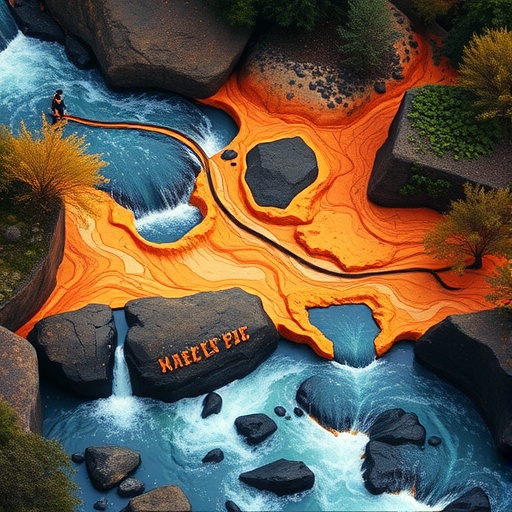
Carbon moving through rivers and streams may look like a continuous journey from land to ocean, but a new synthesis of 40 years of research suggests that freshwater carbon is governed by a far more complex set of rules. Studies from Sweden’s Krycklan Catchment Study (KCS) have helped researchers develop a framework called “variable scale domains,” or VSD, which explains how the influence of landscape features changes across space and along river networks. The approach could improve predictions of how climate change, forestry, hydrological shifts and other environmental pressures alter carbon concentrations and emissions from inland waters.
Inland waters are active components of the global carbon cycle rather than passive pipelines transporting material downstream. Streams and rivers receive carbon from soils, wetlands, groundwater and surrounding vegetation. Once carbon enters the aquatic system, it can be dissolved, transformed by microbes, stored in sediments, transported downstream or released into the atmosphere as carbon dioxide and methane. The balance among these processes affects water quality, aquatic ecosystems and the carbon budget of entire landscapes. Yet scientists have struggled to explain why carbon patterns can be smooth and predictable in some parts of a catchment but sharply uneven in others.
The VSD framework addresses this problem by distinguishing between two broad types of landscape control. Some properties vary gradually with spatial scale or position in the river network. These scale-dependent features can include the size of a contributing catchment, the length of a flow path or the changing influence of groundwater as streams become larger. Other controls are patchy, appearing in distinct locations rather than changing smoothly. Wetlands, ponds, riparian zones, geological formations and areas of intense groundwater exchange can act as localized sources or transformation hotspots.
The central idea is that different forms of carbon are controlled by different spatial domains, and that those domains can shift as water moves from headwaters to larger rivers. Dissolved organic carbon, or DOC, often originates in soils and organic-rich surface environments. Its concentration may be shaped by the area draining into a stream, the connectivity between soils and channels, and the movement of water through wetlands. In contrast, dissolved inorganic carbon, or DIC, is closely tied to chemical weathering, groundwater inputs and respiration within soils and sediments. These processes may dominate in particular parts of a catchment rather than across the entire network.
The framework also helps explain the behavior of carbon dioxide and methane, two climate-relevant gases produced and consumed within inland waters. Carbon dioxide can form when microbes break down organic matter or when groundwater carrying carbon-rich water enters a stream. Methane is commonly associated with oxygen-poor environments, including saturated soils, wetlands, lake sediments and slow-moving zones. A small patch of such habitat can have an outsized effect on local gas concentrations or emissions, even if it occupies only a limited fraction of the catchment.
According to the synthesis, the key to prediction is not choosing between continuous and patchy explanations, but combining them. A river network may exhibit a broad, scale-dependent trend in carbon concentration while also containing localized disruptions caused by specific geomorphic features. For example, carbon levels could generally change as a stream grows, yet rise or fall abruptly where groundwater emerges, a wetland connects to the channel or sediment storage becomes especially active. The VSD concept treats these patterns as interacting controls rather than contradictory observations.
The Krycklan Catchment Study provides an unusually long and detailed basis for this perspective. Over four decades, researchers have examined the movement of water and carbon through a boreal landscape containing small headwater streams, wetlands, forests, lakes and larger channels. Long-term measurements are particularly valuable because carbon dynamics can vary with season, storm events, snowmelt and drought. They also reveal how processes that appear minor during ordinary flow can become dominant when hydrological connectivity changes and previously isolated parts of a catchment become linked.
This multiscale view has important implications for environmental change. Climate warming may alter soil respiration, microbial activity, snowmelt timing and the length of ice-free seasons. More intense rainfall could increase the transfer of DOC from soils into streams, while drought may disconnect channels from wetlands and groundwater before sudden storms reconnect them. Land-use changes can also modify riparian vegetation, drainage pathways and sediment storage. The effects will not necessarily be uniform across a river system; they may be concentrated in the particular spatial domains where sensitive processes are active.
By identifying where scale-dependent trends and patchy controls dominate, the VSD framework could guide monitoring and improve the design of freshwater carbon models. Instead of treating an entire watershed as a single averaged unit, researchers may be able to divide it into functional domains and assign greater importance to the features that control each carbon form. This could help forecast DOC and DIC concentrations, identify areas with high carbon dioxide or methane emissions, and determine where management actions are most likely to influence downstream conditions. The study does not present rivers as simple conduits, but as connected networks whose carbon behavior emerges from the interaction of landscape structure, hydrology and biogeochemistry.
Cite Scienmag News
Violet Maxwell. (August 3, 2026). Variable-scale domains unify continuous and patchy carbon dynamics across river networks. Scienmag. https://scienmag.com/variable-scale-domains-unify-continuous-and-patchy-carbon-dynamics-across-river-networks/
Violet Maxwell. "Variable-scale domains unify continuous and patchy carbon dynamics across river networks." Scienmag, 3 August 2026, https://scienmag.com/variable-scale-domains-unify-continuous-and-patchy-carbon-dynamics-across-river-networks/. Accessed 4 September 2026.
Violet Maxwell. "Variable-scale domains unify continuous and patchy carbon dynamics across river networks." Scienmag. August 3, 2026. https://scienmag.com/variable-scale-domains-unify-continuous-and-patchy-carbon-dynamics-across-river-networks/


