


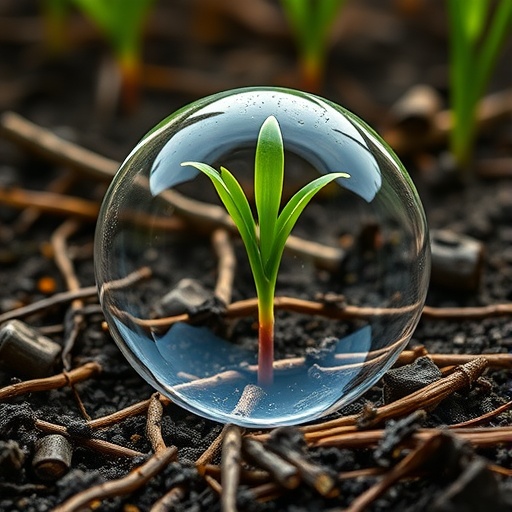
Cadmium contamination in paddy fields is one of the most persistent threats to rice production and food safety. The toxic metal can accumulate in soils for years, enter rice plants through their roots, and eventually reach the human food chain. Now, researchers have developed a new form of biochar that does more than simply trap cadmium. By loading the porous carbon material with oxygen nanobubbles, the team created an amendment capable of actively reshaping the chemical and biological conditions around rice roots.
The material, called oxygen-nanobubble-loaded biochar, or ONBC, was tested in a greenhouse pot experiment using cadmium-contaminated paddy soil. Researchers compared its performance with untreated biochar, iron-loaded biochar, and unamended soil. The experiment focused on flooded rice cultivation, a setting in which oxygen levels can fall rapidly as water fills the soil pores. This shift toward oxygen-poor conditions can alter the behavior of metals, increase their mobility, and make cadmium more accessible to plant roots.
Conventional biochar is often described as a passive soil cleanser. Its highly porous structure and chemically active surfaces can bind pollutants, but its effects may weaken as soil conditions change. ONBC was designed to provide a more dynamic solution. The oxygen nanobubbles gradually released oxygen into the flooded soil, helping maintain a more oxidizing environment in the rhizosphere—the narrow region of soil directly influenced by plant roots. According to the researchers, this transformed biochar from a static adsorbent into an active regulator of soil chemistry.
During important stages of rice growth, ONBC maintained dissolved oxygen concentrations of approximately 3 to 4 milligrams per liter. It also kept the rhizosphere redox potential positive, indicating that the root-zone environment remained relatively oxidizing. In contrast, untreated soil and the other biochar treatments moved closer to oxygen-depleted conditions. Redox potential is a critical control on cadmium chemistry because it influences the stability of iron and manganese minerals, organic compounds, and other soil phases capable of binding or releasing the metal.
The chemical shift produced a dramatic change in cadmium distribution. Compared with untreated soil, ONBC reduced the exchangeable cadmium pool—the fraction considered most mobile and readily available to plants—by approximately 67 to 70 percent. At the same time, more cadmium was associated with less available fractions linked to iron and manganese minerals, organic matter, and residual mineral phases. These changes suggest that ONBC did not merely remove cadmium from the soil solution temporarily; it promoted its transfer into forms that are more strongly retained by the soil matrix.
The effect was also visible inside the rice plants. Roots grown in ONBC-treated soil contained 2.7 times less cadmium than roots grown in untreated soil, while cadmium concentrations in shoots were reduced by 1.9 times. The oxygen-loaded material outperformed both conventional biochar and iron-loaded biochar in the experiment. Although the study did not produce reliable grain-cadmium measurements because the plants had not reached full maturity, the reduction of cadmium in roots and shoots points to a lower potential for metal movement through the plant.
The researchers found that ONBC influenced not only soil chemistry but also the microbial community surrounding rice roots. Metagenomic sequencing showed increased bacterial diversity and enrichment of microorganisms associated with iron and manganese oxidation. These microbes can contribute to the formation and maintenance of reactive mineral surfaces, which provide additional sites for cadmium capture. In this way, oxygen supplied by the nanobubbles may have supported a biological feedback loop: better-aerated conditions favored microbial processes that helped stabilize the contaminant.
The microbial genetic data revealed another layer of protection. ONBC reduced genes associated with cadmium entering microbial cells while increasing genes linked to metal export, detoxification, stress responses, and binding. The treatment also enhanced genes involved in carbon, nitrogen, and phosphorus cycling, suggesting that the amendment affected broader nutrient processes in the rhizosphere. “Our results show that oxygen loading can transform biochar from a passive adsorbent into an active platform that regulates soil chemistry and microbial activity around plant roots,” said corresponding author Zhimin Sha of Shanghai Jiao Tong University.
The benefits extended to plant performance. Compared with untreated soil, ONBC increased whole-plant fresh biomass by 44.7 percent, root activity by 64.5 percent, and superoxide dismutase activity by 85.4 percent. Superoxide dismutase is an important antioxidant enzyme that helps plants manage oxidative stress, including the cellular damage triggered by heavy-metal exposure. The results suggest that ONBC reduced cadmium toxicity while creating a more favorable environment for root function and plant development.
The study was conducted under controlled greenhouse conditions, so the technology still faces important tests before it can be used widely in agriculture. Field trials will be needed across different soil types, climates, flooding regimes, and rice varieties. Researchers must also determine how long the oxygen nanobubbles remain effective, how the material behaves after repeated growing seasons, and whether it can consistently reduce cadmium in edible grain. Even with these questions unresolved, the findings present ONBC as a promising multifunctional strategy: one that combines oxygen delivery, redox control, mineral stabilization, microbial regulation, and improved crop growth to address cadmium contamination in flooded rice fields.
News Publication Date: 9 June 2026
Web References: https://doi.org/10.48130/bchax-0026-0015; Biochar X
References: Chu Q, Li D, Xu S, Pan D, Cao H, et al. 2026. “An oxygen-nanobubble-loaded biochar for cadmium stabilization in contaminated paddy soil.” Biochar X 2: e018. DOI: 10.48130/bchax-0026-0015
Keywords
Cadmium contamination, paddy soil, rice, biochar, oxygen nanobubbles, ONBC, rhizosphere, soil remediation, heavy metals, metagenomics, microbial ecology, plant stress, sustainable agriculture
Cite Scienmag News
Alan Morgan. (August 4, 2026). Oxygen nanobubbles transform biochar into cadmium defense for flooded rice soils. Scienmag. https://scienmag.com/oxygen-nanobubbles-transform-biochar-into-cadmium-defense-for-flooded-rice-soils/
Alan Morgan. "Oxygen nanobubbles transform biochar into cadmium defense for flooded rice soils." Scienmag, 4 August 2026, https://scienmag.com/oxygen-nanobubbles-transform-biochar-into-cadmium-defense-for-flooded-rice-soils/. Accessed 3 September 2026.
Alan Morgan. "Oxygen nanobubbles transform biochar into cadmium defense for flooded rice soils." Scienmag. August 4, 2026. https://scienmag.com/oxygen-nanobubbles-transform-biochar-into-cadmium-defense-for-flooded-rice-soils/


