


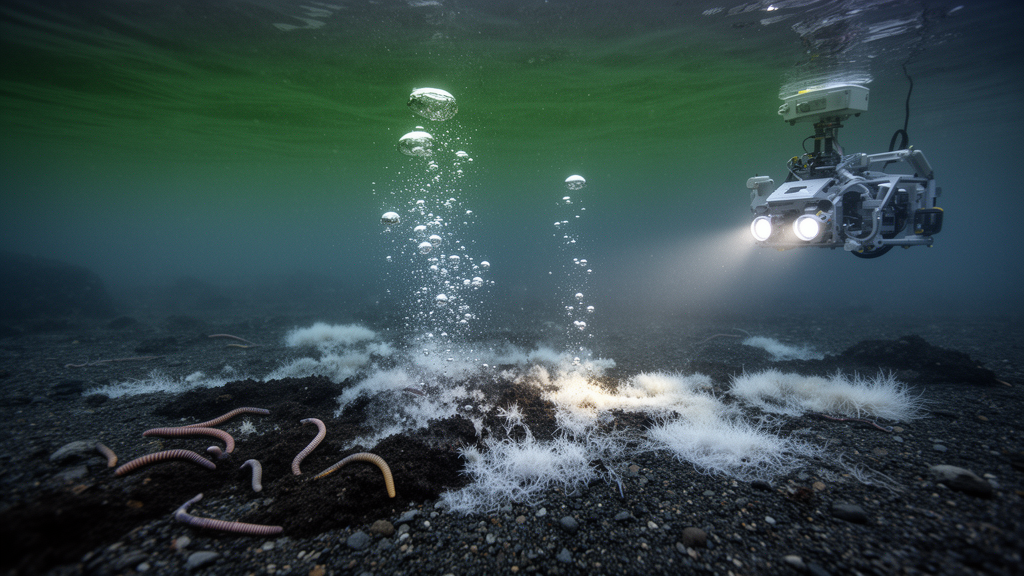
Scientists surveying the seafloor of high Arctic fjords have found that sites where groundwater seeps into the sea look nothing like the methane-rich cold seeps nearby. Instead of the dense, chemosynthesis-fueled communities that thrive at gas seeps, the submarine groundwater discharge sites in Svalbard’s fjords hosted sparse, low-diversity assemblages of burrowing worms and small bivalves. The finding, based on sampling carried out in March 2023 aboard the research vessel Kronprins Haakon, challenges the assumption that groundwater discharge carrying methane can create seep-like oases on the Arctic seabed, and it points instead to a combination of environmental stressors that appear to suppress life at these locations.
Submarine groundwater discharge, or SGD, is the flow of subsurface fluids across the land-ocean interface. It can consist of freshwater, recirculated seawater, or a mixture of both, driven by hydraulic head gradients and circulated through the subterranean estuary, the porous zone where fresh groundwater and saline seawater mix beneath the coastline. Such discharge occurs in estuaries, lagoons, islands, mangroves, salt marshes, and Arctic fjords, and it is not confined to the coast: confined aquifers beneath the continental shelf can outcrop on the seafloor far from shore. Because groundwater flushes chemicals out of sediment, SGD can deliver methane and nutrients such as phosphorus, inorganic nitrogen, and silicate to the ocean, alter pH, salinity, and temperature, accumulate organic matter, and carry elevated metal concentrations, all of which can shape marine ecosystems.
Organisms living at SGD sites must tolerate rapid fluctuations in nutrient availability and environmental conditions. Freshened sediment porewater favors euryhaline species adapted to low or variable salinity, while nutrients released from the sediment can enhance primary production in the water column and on the seafloor, depending on depth and light. In subarctic settings, methane transported with groundwater has been shown to fuel chemosynthetic microbial communities, generating sulfide through anaerobic oxidation coupled to sulfate reduction. That chemosynthetic production supports high biomass but low diversity at cold seeps, because sulfide is toxic to most animals. This raised a question the researchers set out to test: does SGD generate high-abundance, seep-like ecosystems in high Arctic fjords?
The team hypothesized that Arctic SGD locations would resemble cold seeps at similar water depths, with elevated abundance and biomass driven by methane transport and sulfide generation. To test this, they quantified the macrobenthos at three SGD sites where freshened sediment porewater had been detected in 2022: one in the inner part of Tempelfjorden at 78.4 meters water depth, the so-called Murdoch Hole in Tempelfjorden at 39.5 meters, where strong localized currents prevent stable winter sea ice, and a site in Hornsund, Svalbard’s southernmost fjord, at 117 meters. Both fjords have land- and marine-terminating glaciers that may recharge the groundwater system through subglacial infiltration of meltwater. For comparison, the researchers sampled a shallow cold seep on the Hornsund shelf at Hornsundbanken, 126 meters deep, where acoustic surveys had recorded gas flares and where the team visually confirmed active seepage with the remotely operated vehicle Ægir 6000.
Sampling was done with GEMAX corers deployed from the vessel at the two Tempelfjorden sites and with ROV push cores at Hornsund, where poor visibility and high turbidity forced the pilots to take cores directly in front of the vehicle. At Hornsundbanken, better visibility allowed precise sampling of two microhabitats: microbial mats and regular seep sediment without mats. Sediment cores were sieved over a 0.5 millimeter mesh, preserved in buffered formaldehyde, and the macrofauna sorted under a stereomicroscope and identified, usually to species level, with names verified against the World Register of Marine Species. Abundance and biomass were standardized to square meters to account for the different coring devices. Porewater was extracted with rhizons at fixed intervals from gravity and push cores, and analyzed for chloride, sulfate, total hydrogen sulfide, dissolved iron, and methane using titration, ion chromatography, ICP-OES spectroscopy, and headspace gas chromatography.
The geochemical results revealed a stark contrast between the two environment types. At all three SGD sites, porewater chloride concentrations fell below seawater values, most clearly in gravity cores from Murdoch Hole, where chloride dropped to 251 millimolar, indicating freshwater input from groundwater discharge. Yet methane concentrations in the sediment at every SGD location were below the detection limit of roughly 0.09 micromolar. Sulfide was undetectable at Tempelfjorden and remained low at Murdoch Hole and Hornsund, never exceeding 144 micromolar. At the Hornsundbanken seep, by contrast, methane rose with sediment depth to about 158 micromolar in one core, and sulfide climbed to millimolar concentrations. Iron behaved in the opposite pattern: concentrations were consistently high at all SGD sites, highest at Hornsund, while iron was almost entirely absent downcore at the seep.
The biological data told a similar story of divergence. Across all samples, the team recorded 232 individuals representing 33 taxa from five phyla. Mean abundance among the SGD samples was 1680.4 individuals per square meter, roughly three times lower than the 4742.8 individuals per square meter at the seep. Mean biomass was about 14 times lower at the SGD sites, 80.0 grams per square meter versus 1139.6 grams per square meter at the seep. Taxa richness averaged 5.0 at the SGD sites compared with 9.75 at the seep, and Shannon diversity was likewise lower, 1.27 versus 1.85, while evenness was similar between the two environments. The Chao 1 estimator also indicated higher richness at the seep. Annelids dominated overall, accounting for 75 percent of all individuals and fully 95 percent at the Hornsund SGD site, where mollusks were entirely absent. Arthropods, the third most abundant phylum, were notably missing from the seep samples.
Statistical analyses confirmed that these differences were not random. A cluster analysis and non-metric multidimensional scaling ordination based on Bray-Curtis dissimilarities of Hellinger-transformed abundance data separated the Hornsundbanken seep samples from the SGD samples, and an Analysis of Similarities test showed the separation was significant, with a global R of 0.5185 and a p-value of 0.0091. A similarity percentage analysis identified the polychaete Aphelochaeta marioni and the bivalve Yoldiella propinqua as the taxa contributing most to the dissimilarity, at 12.05 percent and 7.44 percent respectively, though both occurred in both environments. The cumacean Leucon nasica was found exclusively at the SGD sites, while the polychaete Notoproctus oculatus occurred only at the seep.
The results led the researchers to reject their central hypothesis. Because methane was undetectable at the SGD sites, chemosynthesis via methane oxidation is likely not taking place, and the absence of methane also limits anaerobic oxidation of methane, the process that generates sulfide. Sulfide concentrations at the SGD sites were more than an order of magnitude lower than at the seep, suggesting that sulfide-based chemosynthesis is also limited there. The authors note a caveat: high iron concentrations at the SGD sites could bind any sulfide produced into insoluble iron sulfides, masking its generation. Even so, free sulfide would still be scarce, and because all chemosymbionts identified in Arctic seep fauna so far are thiotrophic rather than methanotrophic, a lack of free sulfide would prevent the settlement of typical chemosymbiotrophic animals. Consistent with this, siboglinid worms and thyasirid bivalves, which dominate high Arctic seep systems, were absent from the SGD sites. Microbial mats, prominent at Hornsundbanken, were likewise absent.
Two additional stressors may compound the lack of chemosynthetic food at the SGD sites. Porewater freshening indicates freshwater intrusion, and many marine organisms adapted to stable salinity are sensitive to fluctuations; freshwater disrupts osmotic balance and can exclude stenohaline species. Notably, the polychaetes Lumbrineris mixochaeta and Aphelochaeta marioni, the most abundant species across both environment types, are among the most widely distributed species in European Arctic fjord benthos, suggesting broad salinity tolerance. High glacimarine sedimentation near glacier fronts presents a second challenge: at Hornsund, accumulation rates of up to 35 centimeters per year have been documented in ice-proximal zones, and such sediment input dilutes organic particles, buries fauna, and clogs the feeding organs of suspension feeders. High porewater iron at the SGD sites itself points to substantial glaciogenic particle input. Yet the low richness at the SGD sites, 2 to 8 taxa per core, appears even lower than at similarly shallow, sediment-impacted sites in Billefjorden, suggesting sedimentation alone does not fully explain the pattern. The authors caution that the seep habitat was represented by a single, non-replicated location, while the three SGD sites are geographically distinct rather than true replicates, though the differences are striking and the SGD abundance and biomass are low even compared with other non-seep fjord systems.
Looking ahead, the researchers suggest that climate change may reshape this picture. As glacial melt and permafrost thaw accelerate, SGD fluxes in polar regions may increase where thaw enhances subsurface connectivity, while intensified melt will also raise sediment delivery to inner fjord basins, potentially overprinting any SGD-related ecological effects. As Arctic glaciers transition from marine-terminating to land-terminating, turbidity and sedimentation should decline, and groundwater discharge may progressively emerge as an ecologically relevant process in fjord ecosystems. Whether SGD fluxes will eventually become ecologically detectable against this sedimentary background remains an open question as Svalbard’s fjords continue to change.
Subject of Research: Macrobenthic communities at submarine groundwater discharge sites compared with a cold seep in Svalbard fjords
Article Title: Macrofauna Associated With Submarine Groundwater Discharge Sites and a Cold Seep in Svalbard Fjords
Article References: Schramm, J., Hong, W.-L., ten Hietbrink, S., Szymczycha, B., Knies, J., & Sen, A. (2026). Macrofauna Associated With Submarine Groundwater Discharge Sites and a Cold Seep in Svalbard Fjords. Ecology and Evolution, 16(10), Article e74597. https://doi.org/10.1002/ece3.74597
Image Credits: AI Generated
DOI: 10.1002/ece3.74597
Keywords: submarine groundwater discharge, cold seeps, Svalbard, Arctic fjords, macrobenthos, methane, sulfide, chemosynthesis, benthic ecology, porewater geochemistry, glacimarine sedimentation, climate change
Cite Scienmag News
Gavin Prescott. (October 26, 2026). Arctic Groundwater Discharge Sites Fail to Mimic Methane Seep Ecosystems in Svalbard Fjords. Scienmag. https://scienmag.com/arctic-groundwater-discharge-sites-fail-to-mimic-methane-seep-ecosystems-in-svalbard-fjords/
Gavin Prescott. "Arctic Groundwater Discharge Sites Fail to Mimic Methane Seep Ecosystems in Svalbard Fjords." Scienmag, 26 October 2026, https://scienmag.com/arctic-groundwater-discharge-sites-fail-to-mimic-methane-seep-ecosystems-in-svalbard-fjords/. Accessed 26 October 2026.
Gavin Prescott. "Arctic Groundwater Discharge Sites Fail to Mimic Methane Seep Ecosystems in Svalbard Fjords." Scienmag. October 26, 2026. https://scienmag.com/arctic-groundwater-discharge-sites-fail-to-mimic-methane-seep-ecosystems-in-svalbard-fjords/


