


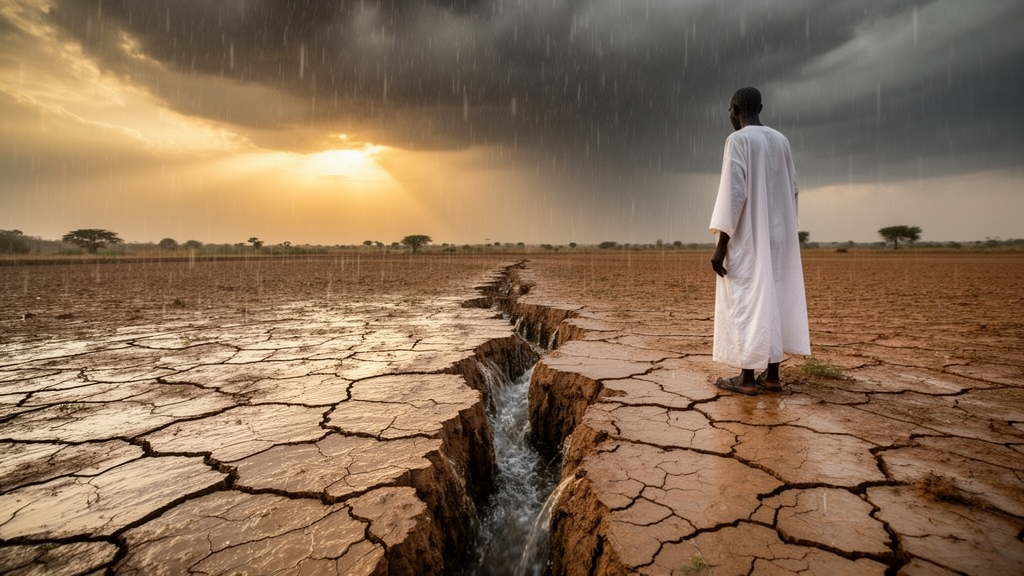
More rain has been falling over parts of Sudan's drylands during the core growing season, yet the water is not necessarily reaching the roots of crops. A study published in Theoretical and Applied Climatology examined June-to-September rainfall, temperature, root-zone soil moisture, vegetation greenness and drought across ten dryland states between 1990 and 2023, and found that a partial rainfall recovery in some states coincided with widespread declines in soil moisture and rising nighttime temperatures elsewhere. North Darfur recorded a significant trend of 1.50 millimeters per year, which the authors calculate as a cumulative increase of 38.5 percent relative to its long-term mean June-September rainfall of 132.4 millimeters.
North Kordofan gained 2.23 millimeters per year, equivalent to 38.6 percent above its long-term mean of 196.3 millimeters. On paper, these are substantial recoveries for regions where rainfed agriculture depends critically on the summer wet season. But the multi-variable assessment showed that rainfall totals alone tell an incomplete story.
Root-zone soil moisture declined in seven states: Aj Jazirah, Blue Nile, Kassala, Sennar, South Darfur, South Kordofan and White Nile. At the same time, nighttime minimum temperatures rose in North Kordofan, Kassala, Aj Jazirah, White Nile and South Kordofan, with cumulative warming of 0.34 to 0.67 degrees Celsius over the 34-year record. The choice of drought index also changed the picture materially.
When the researchers compared two widely used indicators across 340 state-year records, the Standardized Precipitation Evapotranspiration Index, which accounts for atmospheric demand as well as rainfall supply, identified 12.5 percent more drought events than the rainfall-only Standardized Precipitation Index. In other words, a drought metric that ignores evapotranspiration can understate how often growing-season water stress appears in the record. Vegetation responses added a further layer of nuance.
Satellite-derived greenness, measured through the Normalized Difference Vegetation Index, showed significant trends in only three states: West Darfur, South Darfur and Aj Jazirah. North Kordofan, despite its strong rainfall recovery, showed neutral soil moisture and a non-significant vegetation response, meaning the additional rain did not translate into a measurable vegetation signal in that state during the study period. Taken together, the findings indicate that precipitation recovery was not by itself a reliable hydroclimatic indicator in the states and period analyzed.
A state can register significant rainfall gains while its soils show declining moisture, its nights warm and its vegetation fails to respond. The authors argue that drought early-warning systems would benefit from incorporating evapotranspiration-sensitive indices and root-zone monitoring rather than relying on precipitation alone. The study's scope carries clear limits.
It covers ten dryland states over 1990 to 2023, and the significant trends it reports apply to those states and that period; the analysis is observational, so it identifies associations among rainfall, temperature, soil moisture and vegetation rather than establishing causal mechanisms. Even so, its central message is a caution for dryland hydroclimatology: in a warming environment, more rain does not guarantee more available water, and monitoring systems that count only what falls from the sky may miss the stress unfolding in the soil.
Subject of Research: Trends in growing-season rainfall, evaporative demand, root-zone soil moisture, vegetation and drought across Sudan's dryland states from 1990 to 2023
Article Title: Partial rainfall recovery and evaporative-demands effects across Sudan’s drylands: a multi-variable JJAS assessment (1990–2023)
Article References: Rudwan, A., Lou, Y., Hussien, A., Gamreldin, E., Rashid, R., Datti, A. D., & Magara, G. (2026). Partial rainfall recovery and evaporative-demands effects across Sudan’s drylands: a multi-variable JJAS assessment (1990–2023). Theoretical and Applied Climatology, 157(11), Article 754. https://doi.org/10.1007/s00704-026-06688-9
Image Credits: AI Generated
DOI: 10.1007/s00704-026-06688-9
Keywords: Sudan, drylands, rainfall recovery, root-zone soil moisture, evaporative demand, drought indices, SPEI, NDVI, JJAS rainfall, climate warming, rainfed agriculture, early-warning systems
Cite Scienmag News
Violet Maxwell. (October 26, 2026). Sudan’s returning rains are not refilling the soil beneath them. Scienmag. https://scienmag.com/sudans-returning-rains-are-not-refilling-the-soil-beneath-them/
Violet Maxwell. "Sudan’s returning rains are not refilling the soil beneath them." Scienmag, 26 October 2026, https://scienmag.com/sudans-returning-rains-are-not-refilling-the-soil-beneath-them/. Accessed 26 October 2026.
Violet Maxwell. "Sudan’s returning rains are not refilling the soil beneath them." Scienmag. October 26, 2026. https://scienmag.com/sudans-returning-rains-are-not-refilling-the-soil-beneath-them/


