

Monday, October 26, 2026
Science
No Result
View All Result
  • Login
  • HOME
  • SCIENCE NEWS
  • CONTACT US
  • HOME
  • SCIENCE NEWS
  • CONTACT US
No Result
View All Result
Scienmag
No Result
View All Result
Home Science News Technology and Engineering

New AI model sharpens subway passenger flow forecasts across three Chinese metros

October 26, 2026
in Technology and Engineering
Blake Davidson
By Blake Davidson Scienmag Editorial Profile - Data Science
Reading Time: 3 mins read
0
New AI model sharpens subway passenger flow forecasts across three Chinese metros

New AI model sharpens subway passenger flow forecasts across three Chinese metros

65
SHARES
587
VIEWS
Share on FacebookShare on Twitter
ADVERTISEMENT

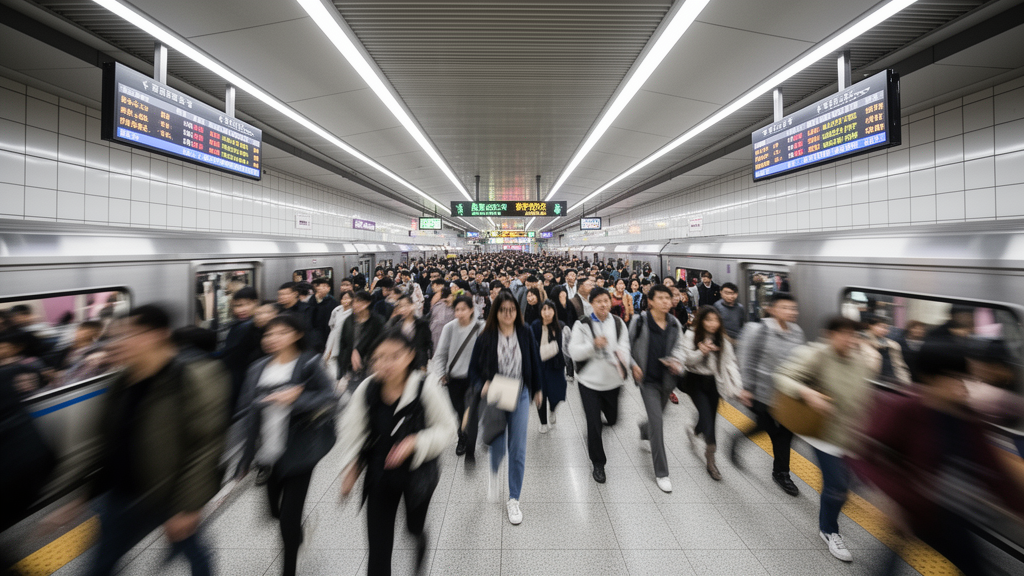
A sequence-to-sequence neural network that blends similar-day retrieval, weather and calendar cues, and the physical layout of the metro network has delivered station-level subway passenger flow forecasts with lower error than competing baselines on two of three tested systems, according to a study published in Complex & Intelligent Systems. The model, called TCSET-seq2seq, was evaluated on 30-minute smart-card records from the Hangzhou, Shanghai, and Zhengzhou metro systems during operating hours from 06:30 to 22:00, and achieved root-mean-square error values of 283.37, 355.37, and 271.46 passengers on the three cities respectively, with post-hoc nonnegative clipping applied during inference.

Short-term station-level forecasting is difficult because passenger demand is shaped by several interacting forces. Daily routines create strong regularity, but weather shifts and day-type changes—such as workdays versus holidays—alter ridership patterns, and flows at one station are coupled to flows at others through the network. TCSET-seq2seq addresses these forces in stages. For each target day, the model first retrieves similar days from earlier dates, combining rule-based matching on calendar attributes, temporal distance, and weather with a learned neural similarity score. The passenger-flow sequences of those selected days are then encoded with condition-aware temporal convolutions, which let the network condition its representation on the external features of the target day.

A squeeze-and-excitation module then recalibrates both the similar-day representations and the channel-wise features, effectively reweighting which signals matter most before prediction. The model propagates features across an undirected graph of the station topology, allowing information about crowding at neighboring or connected stations to inform forecasts at each stop. Finally, the daily forecast is generated autoregressively, with each prediction step feeding into the next. The authors trained and tested the model using repeated day-type and weather-stratified data splits, and restricted similar-day retrieval to historical data only, a design choice intended to prevent information leakage from the future into the training process.

Performance was measured with mean absolute error, root-mean-square error, and mean absolute percentage error using an inverse-scale weighting scheme. The complete TCSET configuration recorded the lowest RMSE among the tested methods on Hangzhou and Zhengzhou, while on Shanghai it came in slightly above the strongest baseline. Component ablation experiments and hyper-parameter sensitivity analyses showed that the squeeze-and-excitation recalibration, the topology propagation over the station graph, and the output clipping step were most useful on the longer Zhengzhou dataset. By contrast, the external features and the hybrid similarity mechanism proved less stable on the shorter Hangzhou and Shanghai datasets, suggesting that their benefit depends on having enough data to learn from.

The authors conclude that TCSET-seq2seq is effective for station-level forecasting on the datasets tested, but they caution that the similar-day retrieval and external-feature settings should be adjusted to the amount and character of data available in a given metro system. For operators, the practical implication is that graph-based spatial modeling and recalibration modules can carry substantial weight in forecast accuracy, particularly where long historical records exist, while feature-rich retrieval strategies may need careful tuning on smaller networks. The study was released as an open-access article on 26 October 2026, with the published version noted as citable through a permanent digital object identifier and subject to further editorial refinement before the final version of record replaces it.

Subject of Research: Multi-feature temporal sequence modeling for station-level subway passenger flow prediction

Article Title: Multi-feature temporal sequence modeling for improved subway passenger flow prediction

Article References: Hu, J., Zhong, R., Hu, S., Zeng, Z., Gan, W., & Tan, H. (2026). Multi-feature temporal sequence modeling for improved subway passenger flow prediction. Complex & Intelligent Systems. https://doi.org/10.1007/s40747-026-02505-y

Image Credits: AI Generated

DOI: 10.1007/s40747-026-02505-y

Keywords: subway passenger flow, sequence-to-sequence model, temporal convolution, squeeze-and-excitation, graph propagation, smart card data, Hangzhou metro, Shanghai metro, Zhengzhou metro, short-term forecasting, Multi-feature, temporal

Cite Scienmag News

Blake Davidson. (October 26, 2026). New AI model sharpens subway passenger flow forecasts across three Chinese metros. Scienmag. https://scienmag.com/new-ai-model-sharpens-subway-passenger-flow-forecasts-across-three-chinese-metros/


Blake Davidson. "New AI model sharpens subway passenger flow forecasts across three Chinese metros." Scienmag, 26 October 2026, https://scienmag.com/new-ai-model-sharpens-subway-passenger-flow-forecasts-across-three-chinese-metros/. Accessed 26 October 2026.

Blake Davidson. "New AI model sharpens subway passenger flow forecasts across three Chinese metros." Scienmag. October 26, 2026. https://scienmag.com/new-ai-model-sharpens-subway-passenger-flow-forecasts-across-three-chinese-metros/

Tags: AI-powered subway passenger flow forecastinggraph propagationHangzhou metrointegrating physical metro network layout into demand forecastingmachine learning for urban transit planningmetro system ridership forecasting in Chinese citiesmulti-city metro passenger flow analysisMulti-featureneural network for metro ridership predictionreal-time passenger flow prediction using neural networkssequence-to-sequence modelsequence-to-sequence models for transit forecastingShanghai metroshort-term forecastingshort-term subway ridership prediction accuracysmart card dataSqueeze-and-Excitationstation-level passenger flow predictionsubway passenger flowTCSET-seq2seq model for transportation analyticsTemporaltemporal convolutionweather and calendar influence on subway demandZhengzhou metro
Share26Tweet16
Previous Post

Hybrid LPBF-LDED printing of SS304 shows fine microstructure and corrosion trade-offs

Next Post

Sudan’s returning rains are not refilling the soil beneath them

Related Posts

Hybrid LPBF-LDED printing of SS304 shows fine microstructure and corrosion trade-offs
Technology and Engineering

Hybrid LPBF-LDED printing of SS304 shows fine microstructure and corrosion trade-offs

October 26, 2026
AI Drafts With Doctor Oversight Showed Quality Gains in Pilot Trial
Medicine

AI Drafts With Doctor Oversight Showed Quality Gains in Pilot Trial

October 26, 2026
Drop Tests in Liquid Oxygen Reveal Which Ship Materials Could Ignite on Hydrogen Vessels
Technology and Engineering

Drop Tests in Liquid Oxygen Reveal Which Ship Materials Could Ignite on Hydrogen Vessels

October 26, 2026
Snow Drought Intensifies Across the Mongolian Plateau, Driven by Warming and ENSO
Technology and Engineering

Snow Drought Intensifies Across the Mongolian Plateau, Driven by Warming and ENSO

October 26, 2026
Multi-Level Preprocessing Framework Sharpens FT-IR Imaging of Microplastics
Technology and Engineering

Multi-Level Preprocessing Framework Sharpens FT-IR Imaging of Microplastics

October 26, 2026
Engineered Organoid Platforms Bring Causal Rigor to Gut Microbiota-Cancer Research
Science News

Engineered Organoid Platforms Bring Causal Rigor to Gut Microbiota-Cancer Research

October 26, 2026
Next Post
Sudan’s returning rains are not refilling the soil beneath them

Sudan's returning rains are not refilling the soil beneath them

  • Mothers who receive childcare support from maternal grandparents show more optimized

    Mothers who receive childcare support from maternal grandparents show more parental warmth, finds NTU Singapore study

    27656 shares
    Share 11059 Tweet 6912
  • University of Seville Breaks 120-Year-Old Mystery, Revises a Key Einstein Concept

    1061 shares
    Share 424 Tweet 265
  • Bee body mass, pathogens and local climate influence heat tolerance

    682 shares
    Share 273 Tweet 171
  • Researchers record first-ever images and data of a shark experiencing a boat strike

    546 shares
    Share 218 Tweet 137
  • Groundbreaking Clinical Trial Reveals Lubiprostone Enhances Kidney Function

    531 shares
    Share 212 Tweet 133
Science

Embark on a thrilling journey of discovery with Scienmag.com—your ultimate source for cutting-edge breakthroughs. Immerse yourself in a world where curiosity knows no limits and tomorrow’s possibilities become today’s reality!

RECENT NEWS

  • Multi-scale transformer network sharpens brain tumor segmentation on MRI scans
  • Sudan’s returning rains are not refilling the soil beneath them
  • New AI model sharpens subway passenger flow forecasts across three Chinese metros
  • Hybrid LPBF-LDED printing of SS304 shows fine microstructure and corrosion trade-offs

Categories

  • Agriculture
  • Anthropology
  • Archaeology
  • Athmospheric
  • Biology
  • Biotechnology
  • Blog
  • Bussines
  • Cancer
  • Chemistry
  • Climate
  • Earth Science
  • Editorial Policy
  • Marine
  • Mathematics
  • Medicine
  • Pediatry
  • Policy
  • Psychology & Psychiatry
  • Science Education
  • Science News
  • Social Science
  • Space
  • Technology and Engineering

Subscribe to Blog via Email

Enter your email address to subscribe to this blog and receive notifications of new posts by email.

Join 5,151 other subscribers

© 2025 Scienmag - Science Magazine

Welcome Back!

Login to your account below

Forgotten Password?

Retrieve your password

Please enter your username or email address to reset your password.

Log In
No Result
View All Result
  • HOME
  • SCIENCE NEWS
  • CONTACT US

© 2025 Scienmag - Science Magazine

Discover more from Science

Subscribe now to keep reading and get access to the full archive.

Continue reading