


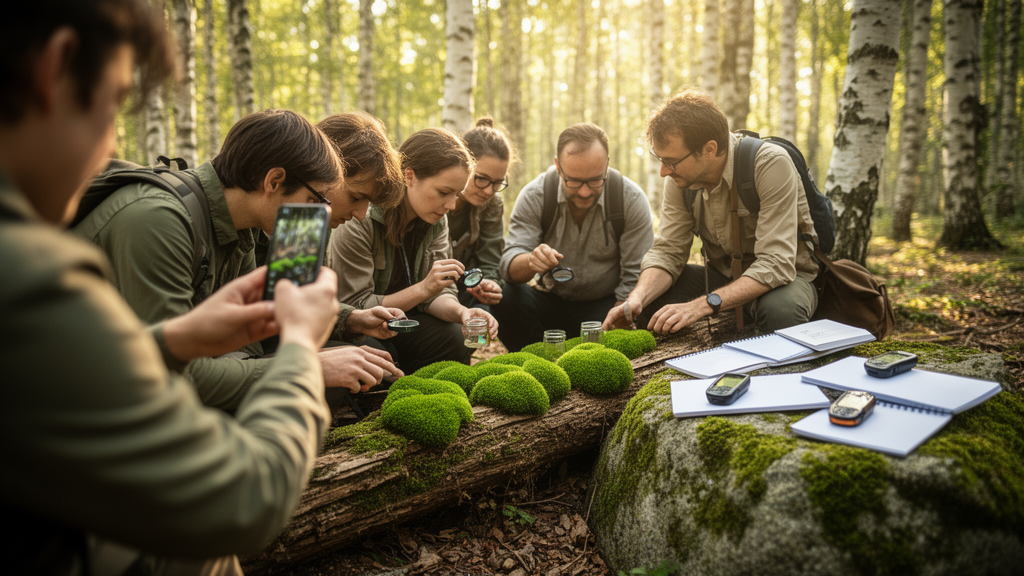
A handful of dedicated volunteers, not the general public, are behind most of what Poland’s largest citizen science platform knows about mosses. An analysis of 17,451 verified moss observations uploaded to iNaturalist between 2019 and 2025 has found that just twelve of the platform’s 1,117 moss observers generated 65.5 percent of the entire national dataset, while the ten percent most active contributors produced 87.1 percent of all records. The single most prolific observer alone submitted more than 3,500 records, roughly one in five of everything in the database. The study, published in Environmental Monitoring and Assessment by Mikołaj Latoszewski and colleagues, quantifies both the promise and the pitfalls of using opportunistic volunteer observations to track one of botany’s most taxonomically difficult plant groups.
The researchers restricted their analysis strictly to true mosses of the phylum Bryophyta, excluding liverworts and hornworts entirely, while treating the peat mosses of Sphagnum as a distinct component of the data. To ensure reliability, they filtered the raw download down to observations holding “Research Grade” status, a designation iNaturalist awards automatically to records that include a photo, a valid date, precise coordinates, and a community consensus in which more than two-thirds of identifiers agree on the identification. Duplicate records of the same taxon at the same location were removed to avoid pseudoreplication, and the 45 species represented by only a single observation were excluded from the primary statistical matrix, a filtering step affecting less than 0.3 percent of all records, though each singleton was individually reviewed and documented in the supplementary materials.
The resulting dataset reveals a community that is small, skilled, and extraordinarily uneven in its contributions. The distribution of observations per user yielded a Gini coefficient of 0.89, a level of inequality the authors describe as a “super-user effect.” To understand who these power users were, the team interviewed all twelve leading observers through the platform’s messaging system and achieved a 100 percent response rate. Seven of the twelve reported formal education in the natural sciences or forestry, and half confirmed regular use of a microscope or hand lens, equipment that turns out to be crucial for navigating the central methodological obstacle of moss identification.
That obstacle is what the authors call the “microscope barrier.” Unlike most vascular plants, which can typically be identified from flowers and fruits visible to the naked eye, many moss genera can only be pinned to species using features invisible in a standard photograph: the shape and dimensions of leaf cells, the degree of leaf margin serration, the structure of the costae, or even cross-sections of leaves and stems. Genera such as Bryum, Plagiothecium, and Orthotrichum are notorious for this. The consequence is that iNaturalist, which relies almost entirely on macroscopic appearance, effectively documents only the “visual fraction” of the bryoflora, taxa with large gametophytes and distinctive habits, while cryptic species slip through or are mislabeled.
The genus Hypnum provides the study’s starkest illustration of this problem. Although 14 species of Hypnum are reported from Poland, the analytical dataset retained only two, H. cupressiforme and H. jutlandicum, capturing just 14.3 percent of the genus’s known national diversity; the raw Research Grade dataset fared only marginally better at 21.4 percent. Without microscopic confirmation, observers and automated identification algorithms tend to funnel a wide range of similar-looking pleurocarpous mosses into H. cupressiforme, the familiar default morphotype. The authors conclude that for many moss taxa, Research Grade status should be read as agreement about visible macroscopic features rather than definitive species-level verification, a taxonomic approximation rather than a biological certainty.
Yet the manual validation of a random sample covering 9.4 percent of the dataset, 1,654 records re-examined from their photographic documentation, revealed a striking paradox. Macroscopic concordance between the photographs and the assigned taxon held in 70.4 percent of cases, while outright misidentifications amounted to only 0.2 percent, just three records. The remaining 29.4 percent were classified as uncertain, meaning the photographs inherently precluded verification of diagnostic features in genera such as Anomodon, Hypnum, and Dicranoweisia. In other words, the Polish community handles visually distinctive species well, but for a large share of the flora the photograph itself, not the observer’s skill, is the limiting factor.
Geographically, the raw data were heavily skewed. A Spearman’s rank correlation between the number of records per voivodeship and the observed species count came out at 0.86, confirming that the platform currently maps observer activity more than actual species ranges. The Pomeranian Voivodeship topped the raw rankings with 168 species from 4,015 records, but its lead observer contributed 74.1 percent of the regional data, and similar dominance appeared in the Masovian and Greater Poland voivodeships. By contrast, Lower Silesian records showed a lead-observer share of just 7.5 percent. Blank spots on the map, such as the data-poor Opole Voivodeship, may therefore reflect an absence of local enthusiasts rather than any poverty of the bryoflora itself.
To separate sampling effort from biological signal, the team applied individual-based rarefaction at a fixed sample size of 300 observations per region, a threshold that kept 14 of Poland’s 16 voivodeships in the comparison. Standardized richness again placed Pomerania first at 80.9 species, but the procedure drastically narrowed the gap to the Subcarpathian Voivodeship, which reached 78.3 with a Shannon index of 4.21 despite three times less sampling effort than Masovia. Greater Poland recorded the lowest standardized diversity at 46.8. Non-metric multidimensional scaling of species composition, with a stress value of 0.155, positioned Subcarpathia at an extreme along the first ordination axis, driven by genuinely distinctive indicator species: ten records of Hookeria lucens, a moss associated with forests of high naturalness, plus observations of Hylocomiastrum umbratum and H. pyrenaicum found nowhere else in the dataset.
The platform’s strongest performance came in invasion monitoring. Observers documented 151 unique verified records of the alien invasive moss Campylopus introflexus across 14 voivodeships between 2019 and 2025, with the highest concentration of 48 records in the Masovian Voivodeship. That figure represents more than 60 percent of the sites recorded during 30 years of traditional floristic research, which had documented the species at 248 localities between 1986 and 2016 as it spread from western toward central and eastern Poland. Because C. introflexus is easy to identify from photographs, citizen observations can track its expansion in near real-time, ahead of conventional publication cycles, positioning the platform as an early warning system for biological invasions, provided experts continue to moderate the database.
Seasonally, the data show two clear peaks of activity, a dominant one in March and a secondary one in October, with a noticeable increase in winter records during 2025. The authors attribute the March surge to visibility: with high humidity and no foliage on trees and grasses, mosses become the dominant visual element of the landscape precisely when vascular plants are dormant, allowing data collection during periods that traditional floristic surveys rarely cover. The twenty most frequently recorded species accounted for 57.26 percent of all records, led by Polytrichum formosum, Pleurozium schreberi, Atrichum undulatum, Leucobryum glaucum, and Hypnum cupressiforme, alongside the synanthropic Tortula muralis, whose high rank reflects observers’ tendency to document mosses in cities and on anthropogenic substrates.
The study’s conclusions are deliberately two-sided. On one hand, iNaturalist has grown from incidental uploads in 2019 into a significant mass-collection tool for moss distribution data in Poland, capable of detecting rare indicator species, tracking invasive ones, and flagging clusters of ecologically specialized species, such as hygrophilous or calciphilous mosses, that point specialists toward potentially valuable habitats like previously unknown mid-forest peat bogs or springs. On the other hand, the data remain a complement to, not a replacement for, professional bryological surveys, especially for taxonomically critical groups that demand microscopic validation. The authors close with practical recommendations for the community: photograph key diagnostic structures from multiple angles, consistently record the substrate in observation notes, and state clearly in the comments whenever an identification was supported by microscopic examination, ideally with microphotographs as evidence.
Subject of Research: Citizen science monitoring of moss diversity in Poland using iNaturalist data
Article Title: Citizen science data as a tool for monitoring moss diversity in Poland: potential and limitations
Article References: Latoszewski, M., Świsłowski, P., Rajfur, M., & Wolski, G. J. (2026). Citizen science data as a tool for monitoring moss diversity in Poland: potential and limitations. Environmental Monitoring and Assessment, 198(11), Article 1253. https://doi.org/10.1007/s10661-026-16092-5
Image Credits: AI Generated
DOI: 10.1007/s10661-026-16092-5
Keywords: citizen science, iNaturalist, bryophytes, mosses, Poland, biodiversity monitoring, sampling bias, rarefaction, invasive species, Campylopus introflexus, microscope barrier, super-user effect
Cite Scienmag News
Violet Maxwell. (October 26, 2026). Citizen scientists map Poland’s mosses, but a dozen enthusiasts dominate the data. Scienmag. https://scienmag.com/citizen-scientists-map-polands-mosses-but-a-dozen-enthusiasts-dominate-the-data/
Violet Maxwell. "Citizen scientists map Poland’s mosses, but a dozen enthusiasts dominate the data." Scienmag, 26 October 2026, https://scienmag.com/citizen-scientists-map-polands-mosses-but-a-dozen-enthusiasts-dominate-the-data/. Accessed 26 October 2026.
Violet Maxwell. "Citizen scientists map Poland’s mosses, but a dozen enthusiasts dominate the data." Scienmag. October 26, 2026. https://scienmag.com/citizen-scientists-map-polands-mosses-but-a-dozen-enthusiasts-dominate-the-data/


