


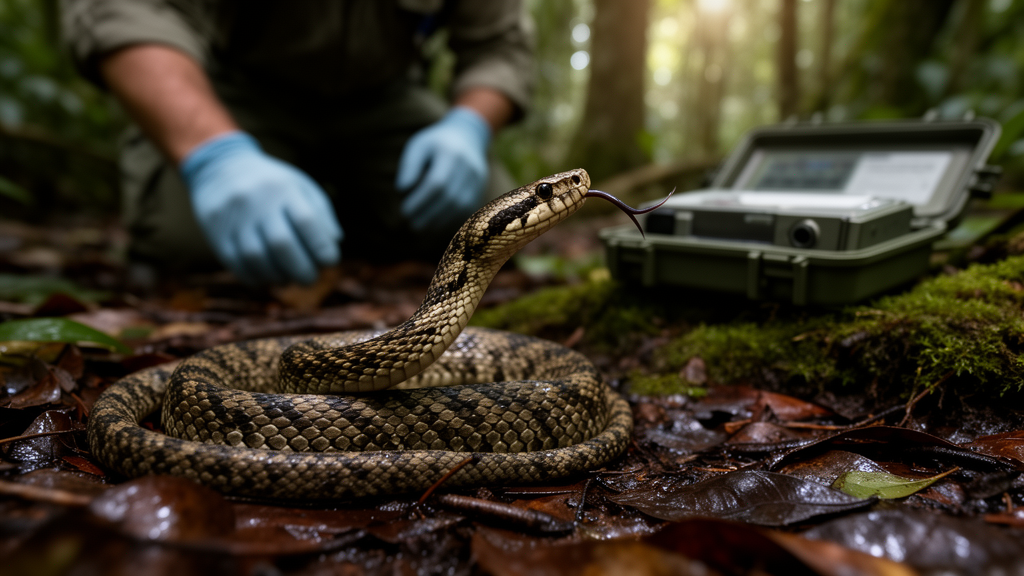
Deep in the Tapajós National Forest and the surrounding municipalities of Santarém and Belterra in the Brazilian state of Pará, researchers conducting necropsies on the Amazonian lancehead Bothrops atrox have recovered a parasite from a place it is not supposed to be. The tongue worm Raillietiella furcocerca, a worm-like endoparasite classically associated with the respiratory system of vertebrates, was found not only in the lungs of these venomous vipers but also free in the coelomic cavity, actively attached to visceral tissues and accompanied by localized hemorrhages and focal tissue reactions. The finding, published in Acta Parasitologica, provides the first quantitative parasitological baseline for this species in B. atrox from the Amazonian biome and strengthens the case that the coelomic cavity can serve as a genuine antemortem site of infection rather than an artifact of host death.
Pentastomids, commonly called tongue worms, belong to the class Ichthyostraca within the pancrustaceans, a lineage of roughly 144 valid species characterized by an elongated, pseudo-segmented body, a subterminal or central mouth, and two pairs of sclerotized anterior hooks that anchor the parasite to host tissue. The adults are obligate hematophages, and their life cycles may pass through intermediate hosts, usually insects, before the parasites reach reproductive maturity in the respiratory tract of their definitive hosts. The genus Raillietiella, the namesake of the family Raillietiellidae, is a widespread lineage that uses insects as intermediate hosts and develops in the lung tissues of reptiles, particularly lizards and snakes. Raillietiella furcocerca itself has a long taxonomic history: it was originally described as Pentastoma furcocerca by Diesing in 1836 from a boa constrictor collected in Brazil, and was later refined through the work of Heymons and Rêgo, with Raillietiella gomesi eventually recognized as a junior synonym following detailed morphometric analyses of hook architecture and spicules.
Despite being recognized as a widespread euryxenous parasite capable of infecting multiple snake families, including Boidae, Colubridae, Dipsadidae and Viperidae, the vast majority of South American records of R. furcocerca originate from the Atlantic Forest, Caatinga and Cerrado biomes, leaving major biogeographic gaps across northern Amazonian ecosystems. In Brazil, six species of the genus Raillietiella have been recorded in snakes, yet records of secondary infection sites outside the host’s respiratory system remain scarce, and before this study there had been no reports of adult pentastomids established at other infection sites in their hosts. The new work set out to close part of that gap by documenting the occurrence, morphology and infection parameters of R. furcocerca in B. atrox from the Lower Amazon region.
The research team examined a total of 48 B. atrox specimens, 28 females and 20 males, collected from six sampling sites across two sampling windows: December 2009 to December 2011, which yielded 37 snakes from the Tapajós National Forest, and December 2023 to July 2024, which added 11 more from Santarém and Belterra. Captured snakes were anesthetized and euthanized with barbiturates in accordance with Brazilian animal experimentation guidelines, and full necropsies were performed immediately after death to prevent tissue decay or passive post-mortem displacement of parasites. The liver, lungs, heart, oral cavity, larynx, stomach, small and large intestines, coelomic cavity and kidneys were all examined in situ. Recovered parasites were stored in 70 percent ethanol, clarified in Hoyer’s medium, mounted on temporary slides and identified under light microscopy at magnifications of 100 to 400 times, with selected specimens additionally prepared for scanning electron microscopy using glutaraldehyde fixation, osmium tetroxide postfixation, critical-point drying and gold-palladium sputter coating.
The parasitological results were unambiguous. Nine of the 48 hosts carried pentastomes, giving an overall prevalence of 18.8 percent, with a 95 percent confidence interval of 9.0 to 32.6 percent. In total, 23 specimens of R. furcocerca were recovered from the lungs and the coelomic cavity, producing a mean abundance of 0.48 parasites per host examined and a mean intensity of 2.56 parasites per infected host. These descriptors, calculated following the standard framework of Bush and colleagues, were accompanied by bootstrap-derived confidence intervals based on 2,000 resampling iterations to account for the typically aggregated distribution of parasites across hosts. The comparison between sampling periods revealed a markedly higher infection rate in the 2023 to 2024 cohort, where 54.5 percent of snakes were infected, compared with 8.1 percent in the 2009 to 2011 cohort, along with a corresponding difference in mean infection intensity of 3.33 versus 1.00 parasites per infected host.
The morphological characterization confirmed the identity of the parasites with considerable precision. The analyzed specimens displayed a cylindrical, vermiform body flattened in both sexes, with variable dimensions and annulations that proved difficult to observe and quantify definitively. Males showed a rounded cephalothorax contour, an anterior oral cavity and a trapezoidal arrangement of hooks, together with internal copulatory dilators that are elongated with a C-shaped curvature at the distal end and broad bases bearing ridges. Both pairs of hooks possessed well-developed bases, with the posterior hooks larger than the anterior ones. Females shared the same chitinous ring-shaped buccal complex with its bifurcated termination and equivalent hook proportions, but lacked copulatory dilators. A cluster analysis based on the Bray-Curtis dissimilarity index, applied to z-score standardized morphometric profiles, showed that the males from this study share more than 95 percent morphometric similarity with R. furcocerca specimens previously documented in Drymarchon corais from the Brazilian states of São Paulo and Mato Grosso. Intriguingly, the females showed low similarity to specimens from previously reported hosts, indicating that variation in parasite size may arise from multiple factors and not merely from differences in host species.
The infection site findings carry the greatest biological weight. Pentastomids were recovered from both the lungs and the coelomic cavity, the latter near the liver, small intestine, large intestine and cloacal adipose tissue. Crucially, the parasites recovered from the coelomic cavity were actively attached to visceral tissues and directly associated with localized hemorrhages and focal tissue reactions, evidence the authors interpret as supporting true antemortem extrapulmonary localization rather than the passive post-mortem displacement that is well documented in helminths and pentastomes, wherein parasites migrate through tissues after host death and occasionally emerge into coelomic or oral cavities. Macroscopic lesions were also identified in the pulmonary tissue, characterized by focal parenchymal damage and blood extravasation into the lung lumen. Because pentastomids are classically considered obligate parasites of the vertebrate respiratory system, the presence of adults attached to visceral serosa raises hypotheses about active tissue migration or variation in the parasite’s life cycle, although the authors caution that interpreting extrapulmonary localization requires care and further study.
To place these findings in context, the team conducted a systematic literature review following PRISMA guidelines, searching four electronic databases in March 2026 for records of pentastome infections in Neotropical snakes. The search returned 53 publications yielding 132 host-parasite interaction records, each defined as a unique occurrence of a pentastomid species or genus associated with a snake species in a given study. These records span nine identified pentastomid species across five genera, four families and two orders, infecting 59 snake species belonging to five host families: Boidae, Colubridae, Dipsadidae, Elapidae and Viperidae. Porocephalidae accounted for 57 records and Raillietiellidae for 35, with Sebekidae and Cephalobaenidae contributing 14 each. At the genus level, Porocephalus led with 41 records, followed by Raillietiella with 35, Kiricephalus with 17, and Cephalobaena and Sebekia with 14 apiece. Among identified species, R. furcocerca itself topped the list with 29 records, ahead of Porocephalus crotali with 19 and Cephalobaena tetrapoda with 14. Geographically, the records centered on Brazil, with additional occurrences reported from Argentina, Peru, Chile, Colombia, Venezuela, Paraguay, French Guiana, Costa Rica, Mexico, Panama, Honduras, Bolivia, Guatemala and Trinidad. The review also noted that extrapulmonary infections in sites such as the stomach, liver, intestine, mesentery and coelomic cavity had previously been documented in other Neotropical hosts, including Boa constrictor, Lachesis muta and Crotalus durissus, and that the occurrence of R. furcocerca in the gastrointestinal tract of Crotalus durissus terrificus reinforces the plausibility of the coelomic infections observed here.
The prevalence of 18.8 percent measured in B. atrox sits within the range reported elsewhere in Brazil: higher than the figure recorded for Leptodeira annulata in Ceará in northeastern Brazil, but lower than the 35 percent prevalence reported for Philodryas nattereri in the municipality of Crato, also in Ceará. The authors emphasize that the apparent dominance of certain parasite families and the broad host spectrum attributed to Raillietiella reflect historical differences in research effort and parasite detectability rather than absolute biological dominance across ecosystems, since increased sampling effort directly expands the number of known host associations.
Perhaps the most striking gap the study exposes is molecular. Although sequence data for Pentastomida have expanded globally, a pronounced deficit persists for Neotropical snake parasites: among the eleven pentastomid species identified in the synthesis, only three, Porocephalus crotali, Porocephalus clavatus and Sebekia oxycephala, have published sequence data, mainly nuclear 18S and 28S rDNA and mitochondrial COX1 and 12S rDNA, and most of those sequences derive from Central or North American or imported captive specimens. Widespread South American taxa such as R. furcocerca, with twelve host records in the review, and C. tetrapoda, with seven, currently lack any deposited molecular sequences. Because pentastomids exhibit conservative morphological characters, reliance on physical identification alone leaves current estimates of species richness, geographic range and host specificity vulnerable to underestimating cryptic diversity. Integrating DNA barcoding and multi-locus phylogenetics with classical morphometrics is, the authors argue, imperative to test whether widespread lineages like R. furcocerca represent single generalist species or complexes of cryptic taxa. With Brazil encompassing more than 60 percent of the Amazonian biome yet its parasitological surveys concentrated heavily in the Caatinga and Atlantic Forest, the vast Brazilian Amazon and neighboring Amazonian territories remain severely underrepresented, a discrepancy rooted in the logistical challenges of remote field sampling and wild host handling. Future targeted surveys combined with molecular characterization across underexplored Amazonian habitats will be essential to unravel the true evolutionary diversity and transmission pathways of these parasites, and the new record from the Lower Amazon marks a concrete step in that direction.
Subject of Research: First quantitative record of the pentastomid parasite Raillietiella furcocerca in the Amazonian lancehead Bothrops atrox, including extrapulmonary coelomic infection sites
Article Title: New Record of Raillietiella furcocerca (Pentastomida: Raillietiellidae) in Bothrops atrox from the Brazilian Amazon: Morphological Characterization and Infection Sites
Article References: Sarmento, A. C. O., Chagas-de-Souza, D., Bassini-Silva, R., Alves-Coêlho, T., Ribeiro, S., Corrêa, L. L., & Santos-Jr, A. P. (2026). New Record of Raillietiella furcocerca (Pentastomida: Raillietiellidae) in Bothrops atrox from the Brazilian Amazon: Morphological Characterization and Infection Sites. Acta Parasitologica, 71(6), Article 248. https://doi.org/10.1007/s11686-026-01435-6
Image Credits: AI Generated
DOI: 10.1007/s11686-026-01435-6
Keywords: pentastomids, Raillietiella furcocerca, Bothrops atrox, tongue worms, Brazilian Amazon, snake parasites, Parasitology, coelomic cavity, morphometrics, Acta Parasitologica, Neotropical region, prevalence
Cite Scienmag News
Drew Townsend. (October 26, 2026). Amazonian Lancehead Snakes Reveal Tongue Worm Parasites Lurking Beyond the Lungs. Scienmag. https://scienmag.com/amazonian-lancehead-snakes-reveal-tongue-worm-parasites-lurking-beyond-the-lungs/
Drew Townsend. "Amazonian Lancehead Snakes Reveal Tongue Worm Parasites Lurking Beyond the Lungs." Scienmag, 26 October 2026, https://scienmag.com/amazonian-lancehead-snakes-reveal-tongue-worm-parasites-lurking-beyond-the-lungs/. Accessed 26 October 2026.
Drew Townsend. "Amazonian Lancehead Snakes Reveal Tongue Worm Parasites Lurking Beyond the Lungs." Scienmag. October 26, 2026. https://scienmag.com/amazonian-lancehead-snakes-reveal-tongue-worm-parasites-lurking-beyond-the-lungs/


