


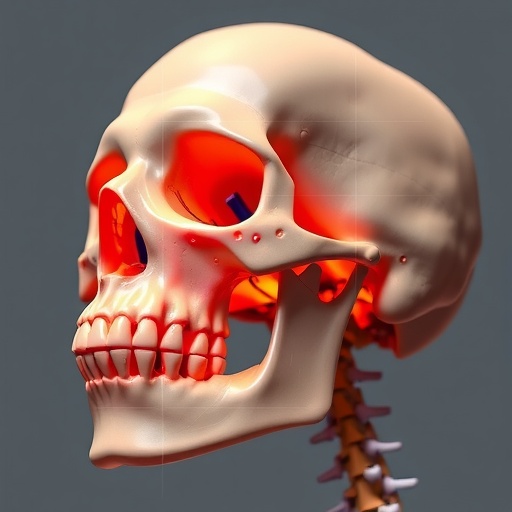
A revolutionary leap in maxillofacial reconstructive surgery has been unveiled with the development of an integrated system that combines robot-assisted osteotomy and augmented reality (AR) guidance. This groundbreaking approach, spearheaded by a team of researchers at the Beijing Institute of Technology, is set to redefine surgical precision in complex facial bone reconstructions. The system, known as the Robot-Assisted and Augmented Reality-guided Maxillofacial Reconstruction System (RAMRS), encompasses the entire surgical workflow from meticulous preoperative planning to the final bone fixation, thereby promising unprecedented accuracy and ease in challenging surgical scenarios.
At the heart of RAMRS lies a dual-module design. The first module addresses the technical challenge of cutting bones with surgical precision. Employing a collaborative robotic arm synced with an optical tracking system, the robot-assisted osteotomy module guides a bone saw along a highly specific trajectory. A hand-eye calibration technique is pivotal here, enabling the system to accurately ascertain the robotic end-effector’s position relative to tracking markers fixed on the patient. During surgery, surgeons trace the bone surface using an optical probe to gather a 3D point cloud. This digital map is then registered to the patient’s preoperative CT scans via the Super4PCS registration algorithm, harmonizing real-time data with the surgical plan. To physically constrain the saw and ensure precise cutting angles and depths, a slotted jig is robotically positioned at the planned osteotomy plane, reducing the need for invasive custom guides. Importantly, the system continuously compensates for any patient micro-movements through real-time tracking of reference markers, thereby enhancing surgical confidence and accuracy.
The second module of RAMRS innovatively addresses the notoriously difficult task of reconstructing the mandible by aligning fibular bone segments with high fidelity. This augmented reality guidance system overlays a virtual reconstruction blueprint directly onto live video feeds, empowering surgeons with intuitive, real-time visual cues regarding segment positioning. A quick-response (QR) marker affixed to the mandible acts as a reference point within this augmented space. However, the intrinsic challenges of manually picking marker corners with a hand-held probe — prone to distortion from hand tremor and lever-arm effects — were ingeniously mitigated through the development of a rotating-calipers-based compensation (RCC) algorithm. This sophisticated method projects the detected points onto an optimal fit plane and identifies a minimum-area enclosing rectangle while enforcing the known geometric constraints of the marker’s dimensions. The result is a significant reduction in corner displacement errors, improving the accuracy of AR overlay by over a quarter compared to traditional optimization methods.
Rigorous validation of RAMRS was conducted across multiple experimental models, including synthetic bone specimens and fresh cadaveric legs and heads, replicating real surgical environments complete with soft tissue interference. In fibula osteotomies, the system achieved a notable mean angular error of 3.19 degrees with a low centroid distance offset of just 1.28 millimeters, outperforming other contemporary surgical assistance techniques. Mandibular osteotomy results were equally impressive, with dimensional deviations well within clinically acceptable margins and volumetric errors under 5%. These improvements indicate a level of precision that surpasses what is achievable with current image-guided surgical tools like sagittal saws.
During mandible reconstruction, the RCC method further proved its efficacy by reducing AR fusion errors to approximately 1.26 mm, representing a 42 to 48 percent enhancement over baseline methodologies. Quantitative assessments of the final reconstructed mandibles—focusing on condylar distances, mandibular angles, and angular alignment—demonstrated substantial superiority compared to datasets from clinical series reliant on pre-bent plates or computer-aided design and manufacturing (CAD-CAM) guides. This precise alignment ability not only promises improved functional outcomes but also reduces the risk of postoperative complications associated with malalignment.
Crucially, the cadaveric experiments affirmed RAMRS’s operational integrity even when confronted with the challenges of soft tissue presence—a realistic proxy for live surgical conditions. The osteotomy errors were consistently maintained below 2 millimeters, and reconstruction accuracy remained high despite the diminished visibility and accessibility imposed by tissue coverage. This validation represents a landmark achievement, illustrating that the system’s technological advancements translate effectively beyond controlled laboratory settings into the complex realities of surgery.
Nonetheless, the research team acknowledges certain limitations intrinsic to the current design. Blood contamination during surgery can degrade the reliability of marker tracking and the fidelity of AR displays. Future efforts aim to integrate enhanced image-processing algorithms capable of counteracting visual obfuscations and to incorporate distance-warning functionalities designed to safeguard critical anatomical structures such as the facial artery. These improvements are poised to enhance intraoperative safety and further augment the system’s clinical utility.
Another pivotal aspect on the horizon is the pursuit of regulatory approvals and the refinement of standardized operational protocols. Ensuring the seamless integration of RAMRS into varied surgical workflows will be vital for widespread adoption. The vision articulated by the researchers foresees a futuristic operating room where surgeons seamlessly interact with a ‘see-and-cut, see-and-place’ paradigm. In such an environment, robots handle the geometrically demanding cutting tasks with mechanical precision, while surgeons benefit from augmented reality overlays that provide intuitive, real-time guidance for bone segment placement.
The convergence of robotics and augmented reality in RAMRS signals a transformative step forward in surgical technology. Beyond merely improving accuracy, this synergy enhances usability, reducing surgeon fatigue and cognitive load during complex reconstructions. The system exemplifies how multidisciplinary innovation spanning medical imaging, robotics, computer vision, and surgical design can collectively advance the frontiers of patient care in maxillofacial trauma and cancer reconstruction.
Led by Professor Jian Yang and a dedicated team including Sifan Cao, Jingfan Fan, Long Shao, Qing Sun, Tao Xu, Danni Ai, Tianyu Fu, Deqiang Xiao, Hong Song, and clinical collaborator Professor Tao Zhang, the research has garnered support from numerous national foundations and research funding bodies. Their paper, “Robot-Assisted Osteotomy and Reconstruction with AR Guidance in Maxillofacial Reconstructive Surgery,” was published in the highly regarded journal Cyborg and Bionic Systems, cementing its position as a milestone in the field.
As robotic precision melds seamlessly with the immersive insights of augmented reality, the future of maxillofacial reconstruction beckons a new era where surgical excellence is not an aspiration but a consistent reality. The RAMRS system embodies this groundbreaking potential, offering hope for improved patient outcomes, reduced operative times, and a finer balance of scientific ingenuity with surgical artistry.
News Publication Date: May 22, 2026
Web References: DOI: 10.34133/cbsystems.0590
Keywords
Maxillofacial surgery, robot-assisted osteotomy, augmented reality guidance, surgical navigation, fibula reconstruction, mandibular osteotomy, Super4PCS algorithm, rotating-calipers compensation, surgical robotics, real-time visualization, 3D registration, surgical precision
Cite Scienmag News
Denise Maddox. (June 17, 2026). AR-Guided Robot-Assisted Osteotomy Revolutionizes Maxillofacial Reconstructive Surgery. Scienmag. https://scienmag.com/ar-guided-robot-assisted-osteotomy-revolutionizes-maxillofacial-reconstructive-surgery/
Denise Maddox. "AR-Guided Robot-Assisted Osteotomy Revolutionizes Maxillofacial Reconstructive Surgery." Scienmag, 17 June 2026, https://scienmag.com/ar-guided-robot-assisted-osteotomy-revolutionizes-maxillofacial-reconstructive-surgery/. Accessed 4 September 2026.
Denise Maddox. "AR-Guided Robot-Assisted Osteotomy Revolutionizes Maxillofacial Reconstructive Surgery." Scienmag. June 17, 2026. https://scienmag.com/ar-guided-robot-assisted-osteotomy-revolutionizes-maxillofacial-reconstructive-surgery/


