


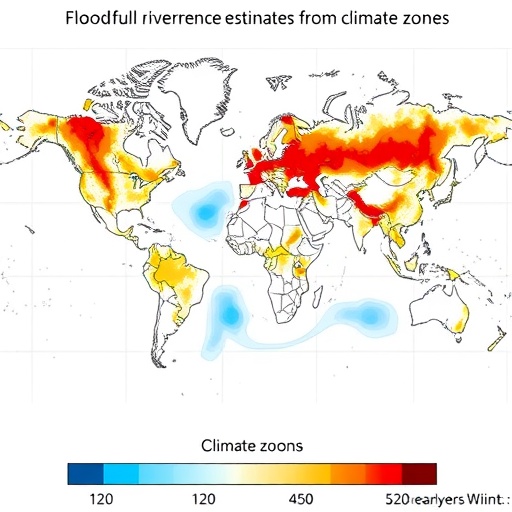
Rivers are often described as dangerous when they overflow, but a new global analysis suggests that the most revealing threshold may occur before the water reaches the dramatic levels associated with major disasters. That threshold is bankfull discharge: the flow at which a river occupies its channel up to the tops of its banks. Once discharge rises beyond that point, water begins to spill onto surrounding floodplains, where homes, roads, farms and industrial facilities are frequently concentrated. In a study published in Nature Communications, Liu, Wortmann, Hawker and colleagues estimate bankfull river discharge worldwide and show that the frequency with which rivers reach this level differs markedly between climate zones. The result challenges the assumption that a single “typical” flood recurrence can describe rivers across the planet.
Bankfull discharge is a deceptively simple concept with major consequences for flood science. A river channel is not an empty pipe with a fixed capacity: its shape, slope, roughness, sediment load and surrounding vegetation all influence how much water it can carry. At low and moderate flows, water remains within the channel, while at bankfull stage it approaches the elevation of the surrounding banks. A further increase in discharge can activate the floodplain, changing the hydraulics of the river and expanding the area exposed to inundation. Because bankfull flow is closely linked to the transition between in-channel transport and floodplain flooding, it is widely used in river management, restoration planning and assessments of geomorphic change.
The new research addresses a problem that has limited comparisons between rivers in different parts of the world: bankfull conditions are not measured consistently everywhere. Gauging stations provide long records at selected locations, but many river basins lack instruments, particularly in regions where monitoring networks are sparse or difficult to maintain. Even where gauges exist, records may be too short to capture the full range of natural variability, or they may reflect rivers that have been altered by dams, levees, channel engineering and land-use change. A global estimate therefore requires more than simply counting floods. It requires linking the physical dimensions of river channels and their hydrological regimes with a framework capable of comparing rivers across vastly different environments.
The study’s central insight is that bankfull discharge should not automatically be treated as a universal statistical event. Flood frequency is commonly expressed through return periods, such as a five-year or ten-year flood. A return period does not mean that a flood occurs on a predictable schedule; it describes the long-term average probability of an event in any given year. If a discharge has a ten-year recurrence interval, its annual exceedance probability is approximately 10 percent under stationary conditions. The researchers’ global analysis indicates that the recurrence associated with bankfull flow varies across climate zones, meaning that rivers can reach their channel-filling threshold with very different regularity depending on the environmental setting.
That finding matters because climate influences rivers through several connected mechanisms. In humid regions, frequent rainfall and sustained runoff can produce regular high flows, while large channels may be shaped by repeated exposure to substantial discharges. In arid and semi-arid landscapes, rivers may remain small or dry for long periods and then respond rapidly to intense storms, producing highly variable flows. Snow-dominated basins can experience seasonal pulses as accumulated snow melts, while tropical systems may be driven by recurring wet seasons, monsoon rainfall or cyclonic storms. Cold-region rivers can also be affected by ice formation and breakup, processes that alter flow resistance and create flood risks not captured by rainfall alone. These contrasting regimes help explain why the same statistical description cannot be applied to every river.
The distinction between bankfull recurrence and extreme-flood recurrence is especially important. A river may fill its channel relatively often without experiencing a catastrophic flood, while a much rarer event can send water far across the floodplain and cause severe damage. Bankfull discharge is therefore not synonymous with the largest or most destructive flood. Instead, it marks a hydrological and geomorphological boundary. Repeated flows near this level can shape channel width and depth, move sediment and maintain connections between rivers and floodplains. Events that greatly exceed bankfull flow may dominate disaster headlines, but the more frequent threshold can be equally important for understanding how river landscapes evolve and when communities first become exposed to overbank flooding.
A global bankfull-discharge estimate could give researchers a common baseline for comparing rivers that have previously been studied in isolation. It may improve large-scale flood models by helping distinguish ordinary channel-filling events from exceptionally rare extremes. It could also support assessments of river restoration, where the goal is often to reconnect channels with floodplains without creating unacceptable risks for nearby populations. For infrastructure planners, the findings offer a reminder that a design based on a flood statistic from one climate zone may not transfer reliably to another. The recurrence of bankfull flow is a property of the river’s hydrological and physical setting, not a universal constant.
The implications extend into a warming climate, although the study’s global estimates should not be interpreted as a forecast of future flood frequency by themselves. Climate change can alter precipitation intensity, snow accumulation and melt timing, evaporation, soil moisture and the amount of water reaching river channels. At the same time, human interventions can change the river’s capacity: levees confine flows, reservoirs regulate them, urban surfaces accelerate runoff, and sediment management can reshape channels. If discharge patterns change while channel geometry remains fixed, the probability of reaching bankfull conditions may shift. Conversely, if channels are engineered or sediment supplies change, the bankfull threshold itself may move. Understanding both sides of that relationship will be essential for translating global estimates into local risk assessments.
The researchers’ work also highlights the value and limits of global environmental datasets. Mapping rivers at planetary scale can reveal broad patterns that are invisible in individual gauge records, but large-scale estimates necessarily contain uncertainty. River channels vary over short distances, bank elevations can be difficult to identify, and satellite observations or digital terrain models may not resolve narrow channels or heavily vegetated floodplains. Hydrological models must also represent rainfall, runoff and human water management with incomplete information. These challenges do not erase the value of a global estimate; rather, they show why such products are best used as a foundation for comparison, prioritization and further field validation rather than as a substitute for local measurements.
The headline message is both technically precise and widely relevant: rivers do not share a single flood clock. The flow that fills a channel may recur frequently in one climate zone but only rarely in another, reflecting differences in rainfall, seasonality, snow, aridity, basin structure and river form. By bringing bankfull discharge into a global framework, the study provides a way to examine when rivers cross the threshold from contained flow to floodplain interaction. As cities expand along waterways and climate variability increases, recognizing that threshold—and understanding how often each river reaches it—could help scientists and communities replace generic flood assumptions with more realistic, place-specific warnings.
Cite Scienmag News
Violet Maxwell. (August 18, 2026). Global bankfull discharge estimates reveal distinct flood recurrence patterns across climate zones. Scienmag. https://scienmag.com/global-bankfull-discharge-estimates-reveal-distinct-flood-recurrence-patterns-across-climate-zones/
Violet Maxwell. "Global bankfull discharge estimates reveal distinct flood recurrence patterns across climate zones." Scienmag, 18 August 2026, https://scienmag.com/global-bankfull-discharge-estimates-reveal-distinct-flood-recurrence-patterns-across-climate-zones/. Accessed 3 September 2026.
Violet Maxwell. "Global bankfull discharge estimates reveal distinct flood recurrence patterns across climate zones." Scienmag. August 18, 2026. https://scienmag.com/global-bankfull-discharge-estimates-reveal-distinct-flood-recurrence-patterns-across-climate-zones/


