


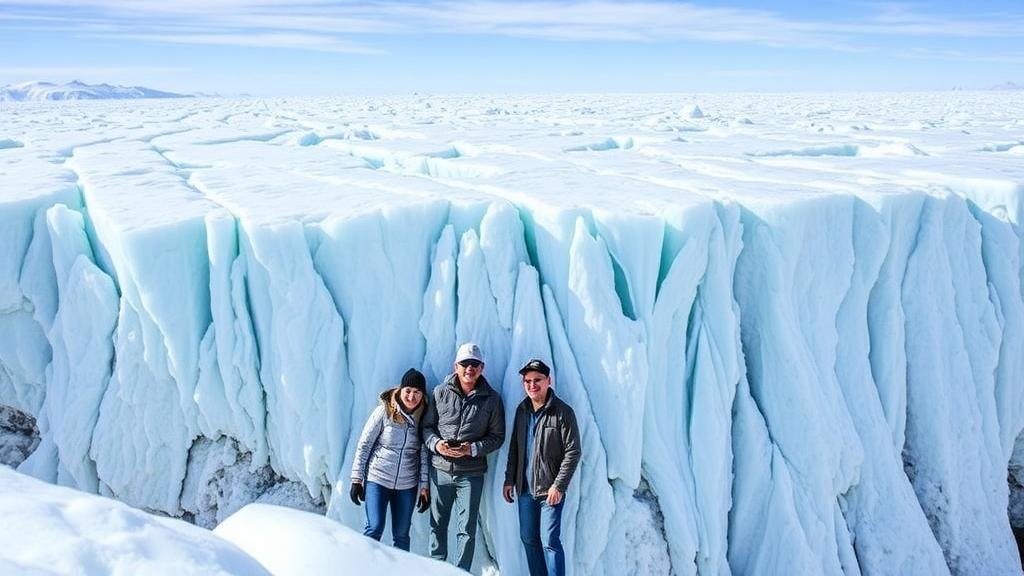
High on the Guliya Plateau in northwestern Tibet, an ice cap has been quietly guarding one of the most remarkable archives of Earth’s climate history ever recovered from outside the polar regions. A new study published in Science Advances by an international team led by researchers at The Ohio State University presents compelling evidence that ice drilled from this remote high-altitude site extends back more than 100,000 years, potentially well beyond 128,000 years, making these cores the oldest ever recovered from the region and among the most ancient non-polar ice records in existence. The finding resolves long-standing doubts about the chronology of the Guliya ice cap and confirms that glacial ice on the Tibetan Plateau survived through the last ice age and into the present warm period, a conclusion with far-reaching implications for understanding how mountain glaciers respond to dramatic shifts in global climate.
The research centered on a careful comparison of two sets of ice cores drilled from the Guliya ice cap, one recovered in 1992 and the other in 2015. When the team analyzed the oxygen isotope patterns preserved in both samples, they found strikingly similar signatures, indicating that the environmental signals locked within the ice are consistent and reproducible across a gap of more than two decades. This kind of internal agreement is a cornerstone of paleoclimate science, because it demonstrates that the record has not been distorted by melting, refreezing, or other processes that can scramble the layered history of a glacier. Lonnie Thompson, lead author of the study, professor of earth sciences and senior research scientist at the Byrd Polar Research Center at The Ohio State University, emphasized the significance of this match, noting that reproducibility of records within a given ice cap is extremely important and that obtaining an identical record a quarter of a century later reveals a great deal about the behavior of the ice over time.
Determining the true age of ancient ice is one of the most technically demanding challenges in glaciology. Ice cores serve as vital climate archives of the locations and time periods they represent, but deciphering these flash-frozen treasure troves requires an accurate knowledge of the core’s timescale. Without reliable dating, the chemical and physical signals within the ice cannot be confidently matched to specific climatic events. To overcome this obstacle, the research team deployed advanced dating techniques capable of detecting two radioactive isotopes, beryllium and chlorine, whose half-lives make them reliable tools for capturing large-scale environmental changes across deep time. These cosmogenic isotopes are produced when cosmic rays interact with the atmosphere and are then deposited onto the ice surface, where their concentrations can serve as chronological markers for extraordinary events in Earth’s history.
The pivotal marker used in this study was the Laschamp Geomagnetic Excursion, a dramatic reversal of Earth’s magnetic field that occurred more than 41,000 years ago. During this event, the planet’s protective magnetic shield weakened substantially, allowing greater fluxes of cosmic radiation to reach the atmosphere. That surge in cosmic ray intensity produced elevated concentrations of cosmogenic isotopes such as beryllium-10 and chlorine-36, which were subsequently deposited and preserved in the accumulating snow of the Guliya ice cap. By identifying this distinctive isotopic spike within the cores and anchoring it to the well-established timing of the Laschamp event, the team was able to construct a robust chronological framework for the ice, effectively pinning a known date onto the deep layers of the glacier and allowing the ages of overlying and underlying ice to be constrained with far greater confidence.
To further validate and extend this timescale, the researchers compared their isotope-based results with oxygen-isotope records obtained from cave deposits in nearby regions of the Tibetan Plateau. Speleothems, the mineral formations that grow in caves, carry their own independent records of past climate and can be dated with high precision using uranium-series methods. The alignment between the Guliya ice core signals and these cave records led the team to estimate that the age of the Guliya record may stretch back well over 128,000 years, a span that reaches into or beyond the last interglacial period. This cross-verification between two entirely independent paleoclimate archives represents a powerful convergence of evidence, strengthening the case that the deepest ice at Guliya predates the Holocene by a wide margin.
The significance of this finding becomes especially clear when placed in a global context. Thompson pointed out that outside of the polar regions, this is the only ice core from the mountaintops that reaches back that far. He contrasted the Guliya record with that of Huascarán in the Peruvian Andes, another celebrated high-altitude drilling site where the ice record extends back only over 30,000 years rather than over 100,000. That comparison makes Guliya a very unique record, preserving a continuous or near-continuous account of climate variability across a stretch of time that no other mountain glacier on Earth has been shown to retain. For scientists seeking to reconstruct how monsoons, temperature regimes, and atmospheric circulation patterns behaved across multiple glacial cycles in Asia, the Guliya cores now stand as an irreplaceable resource.
The new evidence also settles a persistent scientific controversy. Previous work had suggested that the Guliya record stopped at the Mid-Holocene, an era that began nearly 12,000 years ago, implying that the ice cap contained only relatively young ice. If that interpretation had been correct, it would have meant that the large ice sheets of the last ice age did not persist through the early Holocene on the Tibetan Plateau. The evidence from this work lays those doubts to rest, confirming that some of the ice is in fact much older than the Holocene. As Thompson explained, if only Holocene-era ice existed in Tibet, it would indicate that the great ice masses of the last glacial period failed to survive into the current warm epoch, but the data demonstrate that they did. This confirmation reshapes scientific understanding of glacial persistence in one of the most climatically sensitive regions on the planet, often described as the water tower of Asia because its glaciers feed major river systems serving billions of people.
Guliya’s distinctive topography likely plays an important role in its extraordinary ability to preserve such ancient paleoclimate records. The ice cap sits at extreme altitude, where frigid temperatures limit surface melting, and its geometry may shield deeper layers from the deformation and basal processes that typically destroy old ice. Yet the value of constructing a more accurate timescale for the ice cap extends beyond validating its antiquity. A precise chronology opens the door to answering bigger environmental questions, such as when Earth’s intense periods of glaciation began and ended. Thompson framed the challenge in stark terms, asking when ice started forming on the planet and what the natural processes of ice loss looked like, and observing that the only way to truly demonstrate these dynamics is with accurate timescales on these records. In an era when scientists are working to distinguish natural climate variability from human-driven change, benchmarks of past glacial behavior drawn directly from ice are indispensable.
Because these results open new pathways for detailed scientific investigations of the Guliya ice cores, the team plans to use future samples to determine how other key climate and environmental indicators may change in light of this revised understanding of Earth’s geologic history. Dust concentrations, trapped atmospheric gases, microbial communities, and a host of geochemical tracers preserved in the ice can now be interpreted against a trustworthy timeline, potentially yielding insights into past atmospheric composition and ecosystem responses at altitudes above six kilometers. The international collaboration behind the study included Ohio State co-authors Mary Davis and Ellen Mosley-Thompson, along with Juerg Beer from the Swiss Federal Institute of Aquatic Science and Technology, Christof Vockenhuber and Marcus Christl from ETH Zurich in Switzerland, Tandong Yao from the Chinese Academy of Sciences, and Ninglian Wang and Ling Fang from Northwest University in China, with support from the U.S. National Science Foundation. Reflecting on the work, Thompson observed that the results tell a very consistent story, and that if the science is done right, it is consistent, adding that it is human understanding of what the ice is trying to tell us that has to catch up.
Subject of Research: Dating of ancient ice cores from the Guliya ice cap on the Tibetan Plateau
Article Title: Digging deep, researchers find high-altitude glacier endured last ice age
Article References: Digging deep, researchers find high-altitude glacier endured last ice age. (n.d.). Original publication
Image Credits: AI Generated
DOI: Not provided
Keywords: Guliya ice cap, Tibetan Plateau, ice cores, paleoclimatology, Laschamp Geomagnetic Excursion, cosmogenic isotopes, beryllium-10, chlorine-36, oxygen isotopes, last ice age, glaciology, Science Advances
Cite Scienmag News
Russell Cooper. (October 1, 2026). Ancient Tibetan Ice Cap Preserves Climate Record Stretching Beyond 100,000 Years. Scienmag. https://scienmag.com/ancient-tibetan-ice-cap-preserves-climate-record-stretching-beyond-100000-years/
Russell Cooper. "Ancient Tibetan Ice Cap Preserves Climate Record Stretching Beyond 100,000 Years." Scienmag, 1 October 2026, https://scienmag.com/ancient-tibetan-ice-cap-preserves-climate-record-stretching-beyond-100000-years/. Accessed 4 October 2026.
Russell Cooper. "Ancient Tibetan Ice Cap Preserves Climate Record Stretching Beyond 100,000 Years." Scienmag. October 1, 2026. https://scienmag.com/ancient-tibetan-ice-cap-preserves-climate-record-stretching-beyond-100000-years/


