


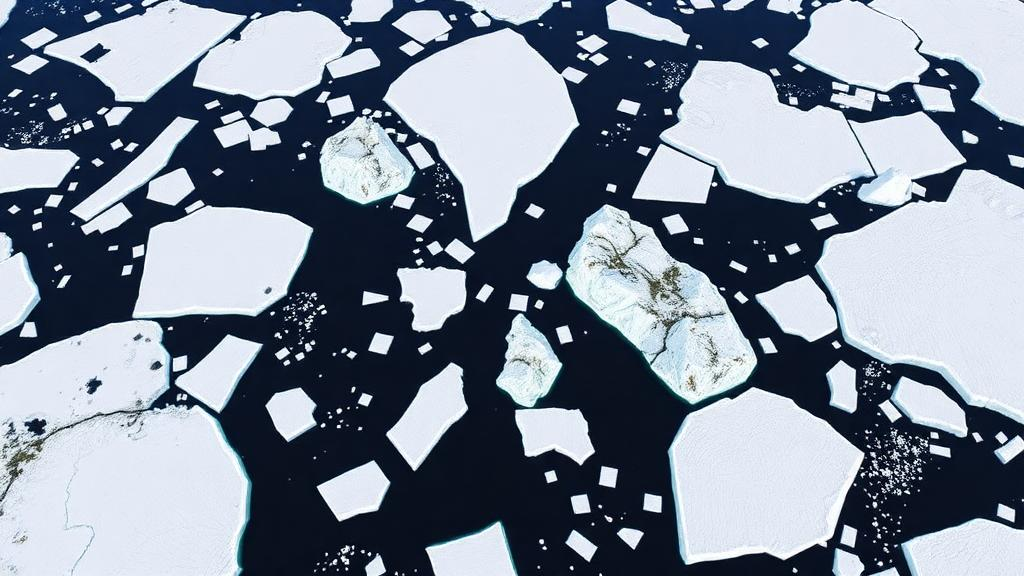
Arctic sea ice has long refused to behave the way scientists expected it to. Winds sweep across the polar ocean, and the ice follows, but not in a way that simple wind-driven models can capture. The speed at which floes move varies in unexpected ways, and the ice spreads apart far more slowly than theory says it should. For decades, researchers have reached for increasingly complicated explanations, invoking unusual wind patterns, ocean eddies, and fractures running through the ice pack. Now a team led by engineers at the University of California, Riverside, has shown that a single, almost mundane process may account for all of these puzzles at once: the floes are constantly bumping into one another.
The study, published in Physical Review Letters, was led by Bryan Shaddy, formerly an undergraduate at UC Riverside and now at the University of Southern California, together with UCR materials scientist Alex Greaney and Bhargav Rallabandi, associate professor of mechanical engineering at UCR. Their starting point was a recognition that Arctic sea ice is not the continuous sheet it appears to be from satellites or aircraft. It is a collection of individual slabs, known as floes, ranging in size from several meters to a few kilometers across. Winds push these floes across the ocean surface, causing them to drift and gradually spread apart, but as they move they also collide with their neighbors, and those collisions turn out to matter enormously.
“If you get a lot of ice floes together in the same place with some wind, they bump into each other and transfer energy to neighbors,” Rallabandi said. “We showed that that’s the only ingredient you need to explain these observations.” The claim is striking precisely because it is so economical. Rather than adding new forces or exotic atmospheric phenomena to close the gap between theory and measurement, the team found that the interactions among the floes themselves, driven by nothing more than ordinary wind, were enough to reproduce the anomalous behavior that has resisted explanation.
To test the idea, the researchers built a computer simulation that treats the ice somewhat like grains moving through a silo, with one crucial difference: these grains float on water and are pushed by turbulent winds. The model accounts for drag from the ocean as well as collisions among the floes, capturing the interplay between the external forcing that drives the ice and the internal contacts that redistribute its momentum. The silo analogy is more than a convenience. Granular materials flowing through a container are a classic problem in physics, and the mathematics of many small objects colliding while being pushed along has been studied intensively in that context. The team adapted that framework to the peculiar conditions of the polar ocean.
The real test came from data. The researchers compared their model’s predictions with measurements of sea ice in the Fram Strait, the passage between Greenland and the Norwegian archipelago of Svalbard through which Arctic ice travels toward the Atlantic Ocean. The Fram Strait is one of the main export routes for sea ice leaving the Arctic basin, which makes it an ideal natural laboratory for studying how floes move and disperse over long distances. Using measured local wind and ice conditions, and only one additional parameter that had little influence on the overall results, the model reproduced three previously puzzling observations: how quickly the ice spreads, the distribution of floe speeds, and how ice motion varies across timescales ranging from hours to days.
That a single tunable parameter sufficed is itself notable. Many geophysical models require extensive calibration to match observations, and each free parameter represents a degree of freedom that can mask missing physics. Here, the essential structure of the model was fixed by the collisional mechanics, and the observations fell into place. The reason collisions have such a large effect is that Arctic ice can be densely packed. In concentrated ice fields, floes run into their neighbors much more frequently than the wind changes. Each collision dissipates some of the energy supplied by the wind and shortens the distance a floe can travel freely before encountering another piece of ice. The result is a collective slowdown and a characteristic spread of speeds that no wind-only model can produce.
The implications reach well beyond settling an old puzzle. The amount of ocean covered by ice and the size of individual floes affect how frequently collisions occur, which in turn affects how rapidly the ice spreads. The study provides a physical framework for connecting such small-scale interactions to movement over much larger distances, linking the grain-scale mechanics of individual contacts to the basin-scale transport of the ice pack. As the Arctic warms and the ice cover thins and breaks into smaller pieces, those links could become central to predicting where the ice goes and how quickly it disperses.
The paper does not predict exactly how future warming will alter the destinations of Arctic ice, and the authors are careful on that point. But Rallabandi said the framework could ultimately help researchers investigate questions such as whether changing ice conditions allow floes to disperse more readily and reach warmer waters, where they could melt more quickly. That question sits at the heart of Arctic climate science: the fate of sea ice depends not only on how fast it melts in place but on where currents and winds carry it. A model grounded in the mechanics of collisions offers a way to explore how fragmentation of the ice pack feeds back into its own transport and loss.
The work could also prove useful for climate modeling at the global scale. Global models cannot individually track the enormous number of relatively small floes covering the Arctic; the computational cost would be prohibitive, and the smallest floes fall far below any practical grid resolution. A physics-based description of their collective behavior could help represent processes happening out of immediate view, replacing what would otherwise be an intractable accounting problem with a compact statistical description. For Rallabandi, part of the study’s value lies in demonstrating how a simple process can explain a complex real-world motion, a reminder that the right simplification can be more powerful than an accumulation of complications.
The underlying physics may extend well beyond sea ice. Any system involving many objects colliding while being driven by an unpredictable environment could behave similarly, and the paper points to possible applications including avalanches, landslides, materials science, and particle-filled inks used in 3D printing. In each of these settings, a noisy driving force acts on a dense collection of interacting particles, and the collective statistics of the motion emerge from countless individual contacts. “The model is not restricted to ice,” Rallabandi said. “It just needs a noisy source of force and the things that are moving to experience collisions.” From the Fram Strait to a printing nozzle, the same collisional rules may be quietly at work, and the UC Riverside team has shown how much of the Arctic’s stubborn behavior they can explain.
Subject of Research: Collisional dynamics of Arctic sea ice floes and their role in ice transport
Article Title: Engineers crack puzzle of Arctic sea ice movement
Article References: Engineers crack puzzle of Arctic sea ice movement. (n.d.). Original publication
Image Credits: AI Generated
DOI: Not provided
Keywords: Arctic sea ice, ice floes, Fram Strait, granular physics, collisions, wind-driven drift, climate modeling, Physical Review Letters, UC Riverside, sea ice transport, mechanical engineering, polar ocean
Cite Scienmag News
Russell Cooper. (October 4, 2026). Colliding Ice Floes Explain the Strange Drift of Arctic Sea Ice. Scienmag. https://scienmag.com/colliding-ice-floes-explain-the-strange-drift-of-arctic-sea-ice/
Russell Cooper. "Colliding Ice Floes Explain the Strange Drift of Arctic Sea Ice." Scienmag, 4 October 2026, https://scienmag.com/colliding-ice-floes-explain-the-strange-drift-of-arctic-sea-ice/. Accessed 4 October 2026.
Russell Cooper. "Colliding Ice Floes Explain the Strange Drift of Arctic Sea Ice." Scienmag. October 4, 2026. https://scienmag.com/colliding-ice-floes-explain-the-strange-drift-of-arctic-sea-ice/


