


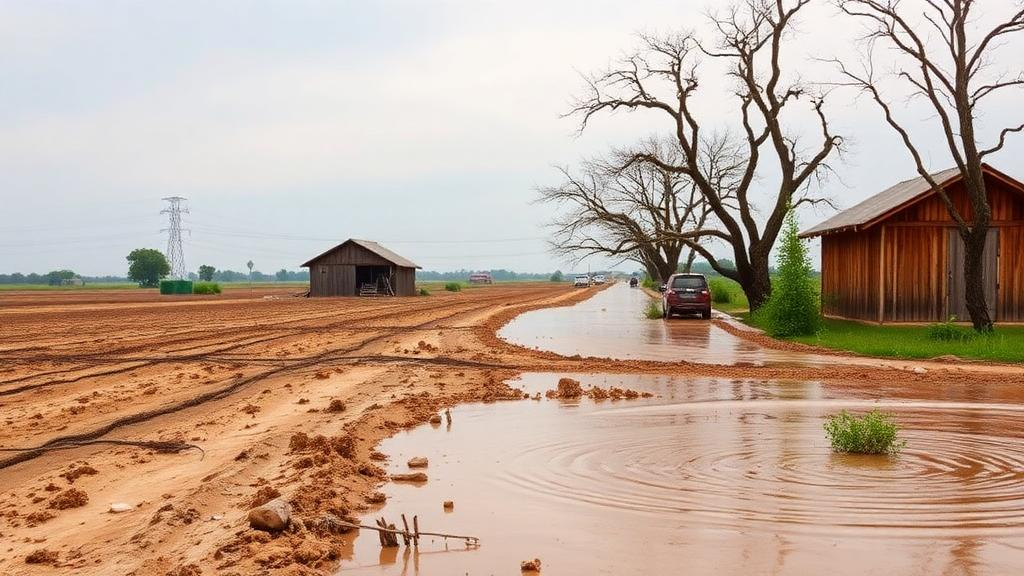
Climate change has long been understood as a threat multiplier, intensifying individual hazards such as heatwaves, droughts, and extreme rainfall. A new study published in PNAS Nexus adds a troubling dimension to that picture: it is not only the frequency of droughts and floods that is rising, but also the speed with which one disaster can follow another. Wei Qi and colleagues combined climate projections with hydrological and socioeconomic mapping to examine how rapidly alternating drought and flood events are likely to evolve across China as the planet continues to warm. Their central finding is stark. For every additional half degree Celsius of global warming, the frequency of drought–flood switching events increases by an average of 10.09 percent, a rate of acceleration that suggests these compound crises could become a defining feature of the coming decades rather than a rare anomaly.
The research focuses on three distinct categories of hydrological whiplash. The first, drought–flood alternation events, describes sequences in which prolonged water scarcity and inundation repeatedly trade places within a defined period. The second, drought-to-flood transitions, captures situations in which a drought is abruptly terminated by heavy rainfall, often overwhelming soils that have lost their capacity to absorb water. The third, flood-to-drought transitions, follows the opposite trajectory, with floodwaters receding into dry spells that can be equally damaging to agriculture and water supplies. By modeling all three types separately, the authors were able to map not just whether extremes are intensifying, but how the temporal structure of hydrological risk is shifting, a subtler question with profound implications for planning and adaptation.
The physical mechanisms behind these oscillations are well grounded in hydrology. During a drought, soils dry out, vegetation cover declines, and the land surface loses much of its sponge-like ability to soak up precipitation. When intense rainfall finally arrives, much of the water runs off directly into rivers rather than infiltrating the ground, amplifying flood peaks and increasing the risk of flash flooding and landslides. Conversely, a flood can saturate reservoirs and aquifers only briefly; if the wet episode is short and followed by sustained heat and evaporation, the apparent water surplus evaporates quickly, leaving communities exposed to renewed scarcity. This is why the sequence of extremes matters as much as their individual magnitude. A region that experiences a flood and a drought in the same season faces a fundamentally different risk profile than one that experiences either event alone.
The socioeconomic consequences of such rapid switching are equally important. Back-to-back extremes place compounding stress on crops, which may be damaged first by waterlogging and then by desiccation, or vice versa, within a single growing season. Yield losses under these conditions can exceed what would be expected from either hazard in isolation, because plants have little time to recover between shocks. Infrastructure faces a parallel problem. Flood defenses, drainage systems, and irrigation networks designed around the assumption of recovery time between events can be degraded by one disaster and then overwhelmed by the next. Emergency response capacity, financial reserves, and household savings are similarly depleted when disasters arrive in quick succession, leaving people and institutions with diminished ability to prepare for the following emergency.
Using projections of future climate alongside detailed hydrological and socioeconomic data, the researchers found that all three types of switching events are increasing as temperatures rise. The mean frequency increase of 10.09 percent per 0.5 degrees Celsius of warming provides a quantifiable scaling relationship between global temperature and the tempo of hydrological whiplash. Equally significant is the finding on spatial extent. The area affected each year by these events is projected to grow, meaning that more communities will be drawn into the cycle of alternating scarcity and inundation even if they have never previously considered themselves at risk from compound hydrological extremes.
The study identifies two regions that consistently emerge as national hotspots: the Yangtze Basin and the North China Plain. These are not random locations. The Yangtze Basin is one of the most densely populated and economically productive regions in the world, home to vast agricultural lands, major industrial centers, and an extensive network of rivers, lakes, and reservoirs. The North China Plain, meanwhile, is a critical grain-producing region that already faces chronic water stress, with groundwater depletion and variable monsoon rainfall making it acutely sensitive to any intensification of the drought–flood cycle. The convergence of high exposure, dense population, and agricultural importance in these two basins means that the projected increases in switching events carry implications that extend well beyond local boundaries, touching national food security and supply chains.
Perhaps the most sobering result concerns the distribution of risk. The analysis shows that low-income populations are likely to experience the steepest relative increases in exposure to rapid hydrological transitions. This pattern reflects a combination of geography and vulnerability. Poorer communities are often located in flood-prone lowlands, on unstable slopes, or in areas with inadequate drainage and water storage infrastructure. They also tend to have fewer resources for recovery, meaning that each successive disaster erodes their capacity to withstand the next. Wealthier households and municipalities, by contrast, can invest in flood barriers, insurance, backup water supplies, and rapid reconstruction, effectively insulating themselves from the worst consequences. The authors describe this dynamic as climate change acting as a regressive force, deepening the divide between the resilient wealthy and the vulnerable poor.
This regressive framing has important implications for how adaptation policy is designed. If exposure to compound extremes is concentrated among those least able to cope, then aggregate national statistics on disaster risk can mask severe inequities. A country may appear to be adapting well on average while its poorest regions fall further behind. The findings suggest that adaptation investments, from reservoir management and early warning systems to crop insurance and social safety nets, will need to be deliberately targeted at the communities and basins where the relative increase in switching-event exposure is greatest. They also suggest that the timing dimension of adaptation deserves more attention: systems designed to handle single hazards at a time may need to be rethought around the reality of back-to-back events with little recovery interval.
The methodological approach of the study also offers a template for future research. By integrating climate model projections with hydrological modeling and socioeconomic mapping, the authors moved beyond hazard assessment alone to examine who is exposed and how that exposure changes under warming. This integrated framing is increasingly recognized as essential, because the damage caused by an extreme event depends not only on its physical intensity but on the vulnerability and adaptive capacity of the population in its path. Quantifying how exposure shifts with income level, as this study does, provides policymakers with a concrete basis for prioritizing interventions rather than relying on broad generalizations about climate risk.
As global temperatures continue to climb, the study’s scaling relationship offers a sobering benchmark. Each half degree of warming does not merely add a proportional increment of risk; it accelerates the oscillation between opposite extremes, compressing the time available for ecosystems, economies, and communities to recover. The Yangtze Basin and the North China Plain may be the clearest hotspots in this analysis, but the underlying physics of dried soils amplifying floods and brief wet spells failing to replenish depleted reserves applies across many of the world’s densely populated river basins. The message of the research is ultimately one of urgency and equity: the whiplash between drought and flood is speeding up, and without deliberate, targeted adaptation, the burden of that acceleration will fall hardest on those with the fewest means to bear it.
Subject of Research: Increasing frequency and socioeconomic exposure of drought–flood alternation events under climate warming in China
Article Title: Drought-flood alternation under climate change
Article References: Drought-flood alternation under climate change. (n.d.). Original publication
Image Credits: AI Generated
DOI: Not provided
Keywords: climate change, drought, flood, hydrological extremes, PNAS Nexus, Yangtze Basin, North China Plain, compound events, socioeconomic exposure, adaptation, food security, climate inequality
Cite Scienmag News
Russell Cooper. (October 4, 2026). Climate Warming Speeds Up Whiplash Between Droughts and Floods, Hitting the Poor Hardest. Scienmag. https://scienmag.com/climate-warming-speeds-up-whiplash-between-droughts-and-floods-hitting-the-poor-hardest/
Russell Cooper. "Climate Warming Speeds Up Whiplash Between Droughts and Floods, Hitting the Poor Hardest." Scienmag, 4 October 2026, https://scienmag.com/climate-warming-speeds-up-whiplash-between-droughts-and-floods-hitting-the-poor-hardest/. Accessed 4 October 2026.
Russell Cooper. "Climate Warming Speeds Up Whiplash Between Droughts and Floods, Hitting the Poor Hardest." Scienmag. October 4, 2026. https://scienmag.com/climate-warming-speeds-up-whiplash-between-droughts-and-floods-hitting-the-poor-hardest/


