

Tuesday, October 27, 2026
Science
No Result
View All Result
  • Login
  • HOME
  • SCIENCE NEWS
  • CONTACT US
  • HOME
  • SCIENCE NEWS
  • CONTACT US
No Result
View All Result
Scienmag
No Result
View All Result
Home Science News Earth Science

Ancient fault rocks reveal earthquake slip turned clay fluid-like

October 27, 2026
in Earth Science
Violet Maxwell
By Violet Maxwell Scienmag Editorial Profile - Natural Hazards
Reading Time: 3 mins read
0
Ancient fault rocks reveal earthquake slip turned clay fluid-like

Ancient fault rocks reveal earthquake slip turned clay fluid-like

65
SHARES
587
VIEWS
Share on FacebookShare on Twitter
ADVERTISEMENT

When the magnitude 9.1 earthquake struck off eastern Japan in 2011, shaking continued for nearly six minutes, and the sudden displacement of the seafloor unleashed a devastating tsunami. Understanding exactly how earthquakes generate such massive seafloor displacement is central to improving early-warning systems, and one proposed mechanism involves frictional heating: rapid plate movement generates intense heat along the fault, raising the pressure of water trapped in rock pores until the fault boundaries become exceptionally slippery, allowing a huge slip that displaces the seafloor enough to launch a tsunami. Now, a research group led by Professor Tetsuro Hirono of Osaka Metropolitan University has found direct evidence in ancient rocks that this mechanism, known as thermal pressurization, can go even further, reducing fault material to a fluid-like state during an earthquake.

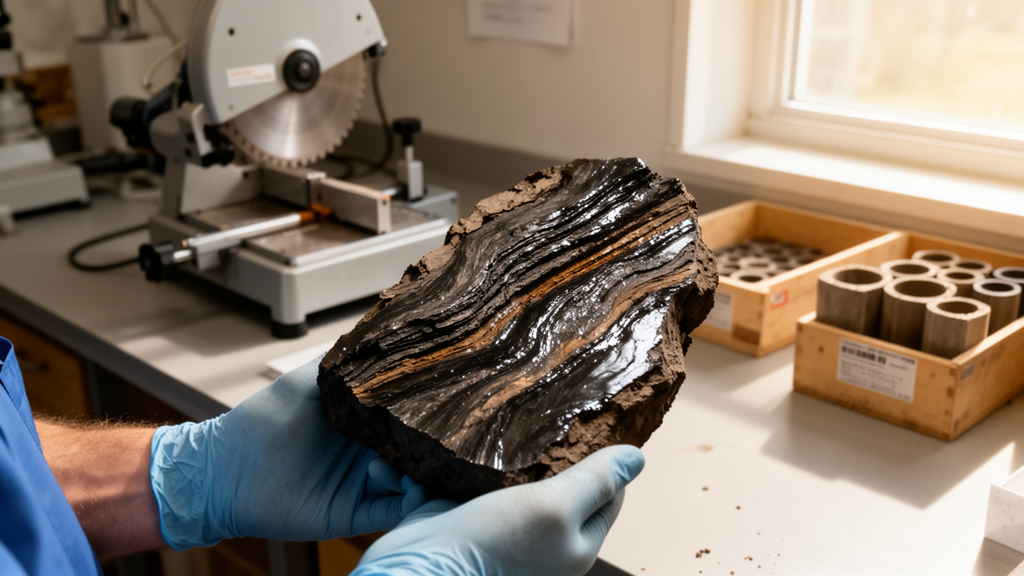
Examining rocks exposed on the Boso Peninsula in Japan, which were once part of an ancient seafloor environment, the researchers identified vortex-like structures within an ancient fault that suggest the fault material underwent fluid-like flow during an earthquake approximately 15 million years ago. The team described the rock layers as "turbulent-flow-like", because they displayed wavy and curved laminations along with vortex-like structures, the kinds of swirl patterns familiar from flowing liquids. When the researchers performed fluid-dynamical analyses of these structures, their findings suggested that thermal pressurization had been sufficient to fluidize the clay within the fault.

"Our analysis suggests that the viscosity approached that of water," Professor Hirono explained. "This would have been a dramatic reduction. The fluidized state would have acted as a form of dynamic lubrication, causing the fault to weaken dramatically.

The resulting large-scale slip would have produced a large displacement on the fault near the seafloor, potentially causing a tsunami." The significance of the finding lies in what it implies about the physics of large earthquakes on subduction zones, where one tectonic plate slides beneath another. Such large slips near the seafloor are precisely what drive the most destructive tsunamis, so recognizing the conditions under which fault material fluidizes could sharpen estimates of tsunami potential for modern subduction margins.

Because the evidence comes from rocks that preserved the aftermath of a single ancient earthquake, the study is observational in nature, and the researchers' conclusions rest on interpreting the preserved structures through fluid-dynamical analysis rather than direct measurement of a modern event. Even so, ancient exhumed faults offer something instrumental records cannot: a close-up view of the physical state of fault material at the moment of slip, frozen into the rock record millions of years ago. The group now hopes to apply the same methodology to modern faults.

"Understanding the change in viscosity in fault-slips may allow us to more accurately recognize the magnitude of fault slips, which would support tsunami mitigation efforts," Professor Hirono concluded. If the turbulent-flow signatures identified on the Boso Peninsula can be recognized or modeled in active fault zones, they could become a tool for estimating how far a fault is likely to slip in a future earthquake, a key input for tsunami forecasting and early-warning systems. The findings were published in Scientific Reports on 27 June 2026, in a paper titled "Coseismic turbulence-like flow of fault material along the shallow portion of a plate-subduction-related fault".

Subject of Research: Fluid-like flow of fault material during earthquakes and its role in tsunami generation

Article Title: Earthquakes make fault material flow like a liquid

Article References: Earthquakes make fault material flow like a liquid. Original publication (Bibliographic details unavailable.)

Image Credits: AI Generated

DOI: Not provided

Keywords: earthquakes, fault mechanics, thermal pressurization, tsunami, subduction zone, fluidization, clay, viscosity, Boso Peninsula, ancient fault rocks, Osaka Metropolitan University, Scientific Reports

Cite Scienmag News

Violet Maxwell. (October 27, 2026). Ancient fault rocks reveal earthquake slip turned clay fluid-like. Scienmag. https://scienmag.com/ancient-fault-rocks-reveal-earthquake-slip-turned-clay-fluid-like/

Violet Maxwell. "Ancient fault rocks reveal earthquake slip turned clay fluid-like." Scienmag, 27 October 2026, https://scienmag.com/ancient-fault-rocks-reveal-earthquake-slip-turned-clay-fluid-like/. Accessed 27 October 2026.

Violet Maxwell. "Ancient fault rocks reveal earthquake slip turned clay fluid-like." Scienmag. October 27, 2026. https://scienmag.com/ancient-fault-rocks-reveal-earthquake-slip-turned-clay-fluid-like/


Tags: ancient fault rock analysisancient fault rocksBoso PeninsulaclayEarthquake fault mechanicsearthquake history on Boso Peninsulaearthquake-induced rock deformationearthquakesfault mechanicsfault slip modelingfluid-like behavior in fault zonesfluidizationOsaka Metropolitan Universityrock laminations and flow patternsScientific Reportsseafloor displacement during earthquakesseismic slip and fault lubricationsubduction zonethermal pressurizationthermal pressurization in fault rockstsunamitsunami generation mechanismsviscosityvortex structures in fault rocks
Share26Tweet16
Previous Post

Persian Preschoolers Show Stronger Expressive Than Receptive Prosody, Study Finds

Next Post

Research report: The impact of immersive virtual reality on students’ satisfaction and self-confidence in clinical nursing simulation: a cross-sectional study

Related Posts

Machine Learning Maps Debris Flow Danger Along a Chinese Expressway
Earth Science

Machine Learning Maps Debris Flow Danger Along a Chinese Expressway

October 27, 2026
Hourly Well Data Reveal Two Distinct Groundwater Recharge Rhythms in Southern Brazil
Earth Science

Hourly Well Data Reveal Two Distinct Groundwater Recharge Rhythms in Southern Brazil

October 27, 2026
Salt Chemistry Steers How Freeze–Thaw Cycles Destroy Ancient Petroglyph Sandstone
Earth Science

Salt Chemistry Steers How Freeze–Thaw Cycles Destroy Ancient Petroglyph Sandstone

October 27, 2026
Soil bacteria boost lead-sucking plant’s cleanup power by nearly 97 percent
Earth Science

Soil bacteria boost lead-sucking plant’s cleanup power by nearly 97 percent

October 27, 2026
Smart Sensor Placement and Machine Learning Sharpen Satellite Soil Moisture Maps in Brazil
Earth Science

Smart Sensor Placement and Machine Learning Sharpen Satellite Soil Moisture Maps in Brazil

October 27, 2026
Drones and Interpretable AI Classify Flood-Prone Mountain Basins in Xinjiang
Earth Science

Drones and Interpretable AI Classify Flood-Prone Mountain Basins in Xinjiang

October 27, 2026
Next Post
Research report: The impact of immersive virtual reality on students’ satisfaction and self-confidence in clinical nursing simulation: a cross-sectional study

Research report: The impact of immersive virtual reality on students’ satisfaction and self-confidence in clinical nursing simulation: a cross-sectional study

  • Mothers who receive childcare support from maternal grandparents show more optimized

    Mothers who receive childcare support from maternal grandparents show more parental warmth, finds NTU Singapore study

    27656 shares
    Share 11059 Tweet 6912
  • University of Seville Breaks 120-Year-Old Mystery, Revises a Key Einstein Concept

    1061 shares
    Share 424 Tweet 265
  • Bee body mass, pathogens and local climate influence heat tolerance

    682 shares
    Share 273 Tweet 171
  • Researchers record first-ever images and data of a shark experiencing a boat strike

    546 shares
    Share 218 Tweet 137
  • Groundbreaking Clinical Trial Reveals Lubiprostone Enhances Kidney Function

    531 shares
    Share 212 Tweet 133
Science

Embark on a thrilling journey of discovery with Scienmag.com—your ultimate source for cutting-edge breakthroughs. Immerse yourself in a world where curiosity knows no limits and tomorrow’s possibilities become today’s reality!

RECENT NEWS

  • Research report: The impact of immersive virtual reality on students’ satisfaction and self-confidence in clinical nursing simulation: a cross-sectional study
  • Ancient fault rocks reveal earthquake slip turned clay fluid-like
  • Persian Preschoolers Show Stronger Expressive Than Receptive Prosody, Study Finds
  • New Plant Species Breynia phongquangensis Discovered in Vietnamese Limestone Forest

Categories

  • Agriculture
  • Anthropology
  • Archaeology
  • Athmospheric
  • Biology
  • Biotechnology
  • Blog
  • Bussines
  • Cancer
  • Chemistry
  • Climate
  • Earth Science
  • Editorial Policy
  • Marine
  • Mathematics
  • Medicine
  • Pediatry
  • Policy
  • Psychology & Psychiatry
  • Science Education
  • Science News
  • Social Science
  • Space
  • Technology and Engineering

Subscribe to Blog via Email

Enter your email address to subscribe to this blog and receive notifications of new posts by email.

Join 5,151 other subscribers

© 2025 Scienmag - Science Magazine

Welcome Back!

Login to your account below

Forgotten Password?

Retrieve your password

Please enter your username or email address to reset your password.

Log In
No Result
View All Result
  • HOME
  • SCIENCE NEWS
  • CONTACT US

© 2025 Scienmag - Science Magazine

Discover more from Science

Subscribe now to keep reading and get access to the full archive.

Continue reading