


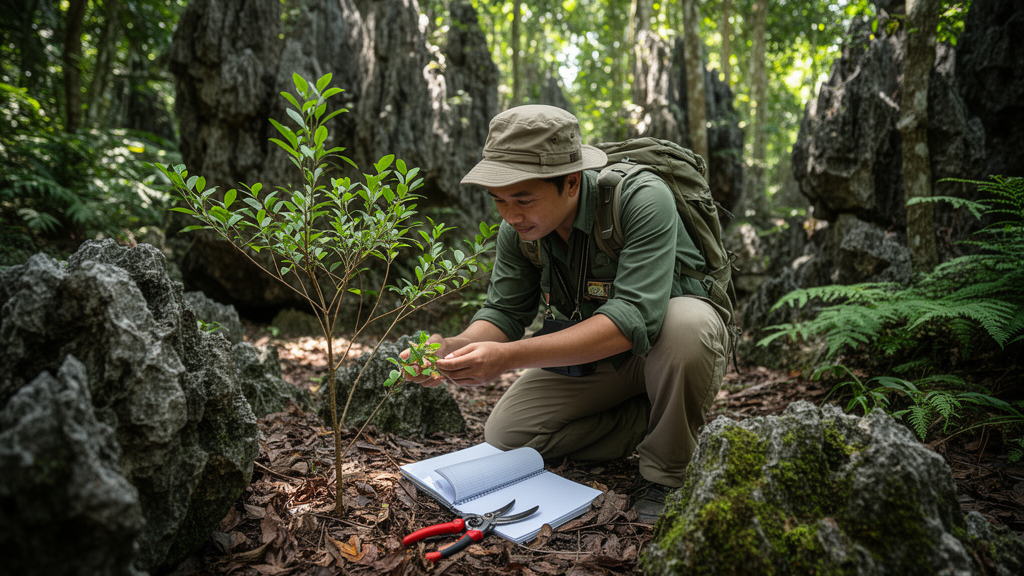
Botanists surveying the limestone forests of Phong Quang Nature Reserve in Vietnam's Tuyen Quang Province have described a previously unknown species of flowering plant, formally named Breynia phongquangensis T.H.Bui & N.H.Le. The discovery, published in the journal PhytoKeys, brings the number of Breynia species recorded in Vietnam to 26 and adds a distinctive new member to a genus whose classification has been reshaped in recent years by molecular phylogenetic research. The species was collected in March 2026 during a botanical expedition to the reserve, at an elevation of roughly 730 meters on a limestone mountain in Minh Tan Commune.
Breynia belongs to the family Phyllanthaceae and currently comprises 74 accepted species distributed from India and China through Southeast Asia to Australia and the western Pacific. The genus has attracted considerable attention from plant systematists because molecular studies revealed that Breynia, together with the genera Glochidion and Synostemon, is nested within the larger genus Phyllanthus. Rather than merging all of these lineages into a single sprawling Phyllanthus in the broad sense, researchers led by Bouman and colleagues opted in 2022 for the opposite solution: splitting Phyllanthus into strictly monophyletic genera, meaning groups that each contain all of the descendants of a common ancestor.
Under this revised framework, tribe Phyllantheae now consists of 18 genera, with Breynia and Phyllanthus among them, ensuring that formal classification tracks the evolutionary relationships recovered by genetic data. The new species was identified after the collected specimens were compared with herbarium material held at the HN herbarium in Vietnam and at international collections including K, KRIB, P, and VNM, alongside a review of the relevant taxonomic literature. The type specimen, designated VAST-PQ 74, was deposited at the HN Herbarium of the Institute of Biology in Vietnam, with isotypes preserved both there and at VNM.
Breynia phongquangensis is an erect, glabrous shrub reaching 4 to 5 meters in height, with slightly zigzag branchlets that are angular when young and become cylindrical with age. Its leaves are simple and arranged in two ranks along the stem, with blades ranging from ovate to obovate, elliptic, oblong-elliptic, or lanceolate in shape and measuring 45 to 153 millimeters long by 29 to 52 millimeters wide. The leaves bear six to eight pairs of lateral veins that are raised on the lower surface, and persistent triangular stipules with a long acuminate tip.
The flowers are where the species most clearly sets itself apart. The staminate, or male, flowers have a shallowly disk-shaped calyx of six lobes, pink-red mottled with white, measuring 4.9 to 5.8 millimeters in diameter, and crucially the sepals are fleshy, thickened to 0.4 to 0.7 millimeters. Each male flower carries three stamens borne on a very short pale yellow androphore, with anthers that split open lengthwise to release pollen.
The pistillate, or female, flowers are smaller, at 4.3 to 6.6 millimeters in diameter, borne on long pedicels of 16 to 53 millimeters, and their six sepals come in two distinct tiers: three inner sepals that are broadly ovate and three outer sepals that are broadly obovate with a notched apex. The ovary is nearly circular in cross-section with three blunt angles and three chambers, each containing two white ovules, topped by three recurved stigmas that are forked for up to three-quarters of their length. The fruit is globose and notably large for the genus, at 27 millimeters in diameter, and when it opens it separates into three free lobes, each marked with a vertical stripe down the middle.
The outer surface of the fruit is pink-red while the interior is white, and the calyx persists at the base. The seeds are three-sided with ovate, glabrous, white surfaces, measuring 22 to 23 by 13 to 14 millimeters. Flowering and fruiting specimens were collected in March and April, and the species was observed both in axillary inflorescences and in cauliflorous arrangements, meaning flowers borne directly on the older stems, a feature it shares with some of its closest relatives.
To establish that the specimens genuinely represented an undescribed species, the authors compared them in detail with the three most similar known species: B. macrantha, B. phuongiana, and B. spatulifolia. These four were selected for comparison because they share two unusual traits within the genus, flowers ranging from pink to red or purple, and female flowers with sepals of two distinct types arranged in two series. The new species is separated from all three allies by its fleshy staminate sepals.
Beyond that single defining feature, it differs from B. spatulifolia in having larger male flowers and fewer pairs of lateral veins, from B. macrantha in having shorter outer sepals on the female flowers, and from B. phuongiana in its distinct fruit shape, which is globose rather than starfish-shaped. It also possesses longer ovaries and fruits than all three related species, and longer female flower pedicels than B. phuongiana and B. spatulifolia. The quantitative contrasts are laid out in a detailed morphological comparison.
Where B. phongquangensis has male flowers 4.9 to 5.8 millimeters across, B. macrantha's measure 3.5 to 4.5 millimeters, B. phuongiana's 7.0 to 7.5 millimeters, and B. spatulifolia's roughly 3.3 millimeters. Female flower pedicels tell a similar story: 16 to 53 millimeters in the new species, compared with 20 to 63 millimeters in B. macrantha, a mere 2.5 to 4.0 millimeters in B. phuongiana, and 0.3 to 3.0 millimeters in B. spatulifolia. Fruit size is equally diagnostic, with the globose 27-millimeter fruit of the new species dwarfing the roughly 7 by 5.5 millimeter fruit of B. spatulifolia and the 10 to 25 millimeter depressed-globose fruit of B. macrantha.
From these characters the authors constructed an identification key in which the fleshy male sepals alone separate B. phongquangensis from the other three species, with fruit shape and pedicel length resolving the remaining pairings. So far, Breynia phongquangensis is known only from its type locality within Phong Quang Nature Reserve, and its occurrence elsewhere has not yet been evaluated. It grows in evergreen broadleaf forest on limestone substrate, in association with a notable community of trees and climbers including Burretiodendron tonkinense, Claoxylon indicum, Euonymus bockii, Fissistigma latifolium, Hoya vangviengiensis, Micromelum hirsutum, Miliusa balansae, and the orchid Vanilla somai.
Several of these neighbors are themselves of conservation concern: Burretiodendron tonkinense is assessed as Near Threatened on the IUCN Red List and has been evaluated as Endangered in a regional assessment, while Vanilla somai is assessed as Endangered, underscoring the conservation significance of the reserve as a whole. Assessing the new species' own extinction risk proved difficult. During field observations the authors recorded no immediate threats to the plants within the reserve, but the species occupies rugged rocky montane habitat that is difficult to access even for botanical survey teams.
As a result, the population size and the number of mature individuals remain unknown, and the species has been provisionally classified as Data Deficient under the IUCN Red List Categories and Criteria.
Subject of Research: Description of a new plant species, Breynia phongquangensis, from northern Vietnam
Article Title: Breynia phongquangensis ( Phyllanthaceae ), a new species from Vietnam
Article References: Le, N. H., Tran, T. B., Do, V. H., Tran, D. B., Duong, T. H., & Bui, T. H. (2026). Breynia phongquangensis (Phyllanthaceae), a new species from Vietnam. PhytoKeys, 275, 133-140. https://doi.org/10.3897/phytokeys.275.195982
Image Credits: AI Generated
DOI: 10.3897/phytokeys.275.195982
Keywords: Breynia phongquangensis, new species, Phyllanthaceae, Vietnam, limestone forest, taxonomy, plant systematics, Phong Quang Nature Reserve, IUCN Red List, Data Deficient, biodiversity, botany
Cite Scienmag News
Margaret Porter. (October 27, 2026). New Plant Species Breynia phongquangensis Discovered in Vietnamese Limestone Forest. Scienmag. https://scienmag.com/new-plant-species-breynia-phongquangensis-discovered-in-vietnamese-limestone-forest/
Margaret Porter. "New Plant Species Breynia phongquangensis Discovered in Vietnamese Limestone Forest." Scienmag, 27 October 2026, https://scienmag.com/new-plant-species-breynia-phongquangensis-discovered-in-vietnamese-limestone-forest/. Accessed 27 October 2026.
Margaret Porter. "New Plant Species Breynia phongquangensis Discovered in Vietnamese Limestone Forest." Scienmag. October 27, 2026. https://scienmag.com/new-plant-species-breynia-phongquangensis-discovered-in-vietnamese-limestone-forest/


