


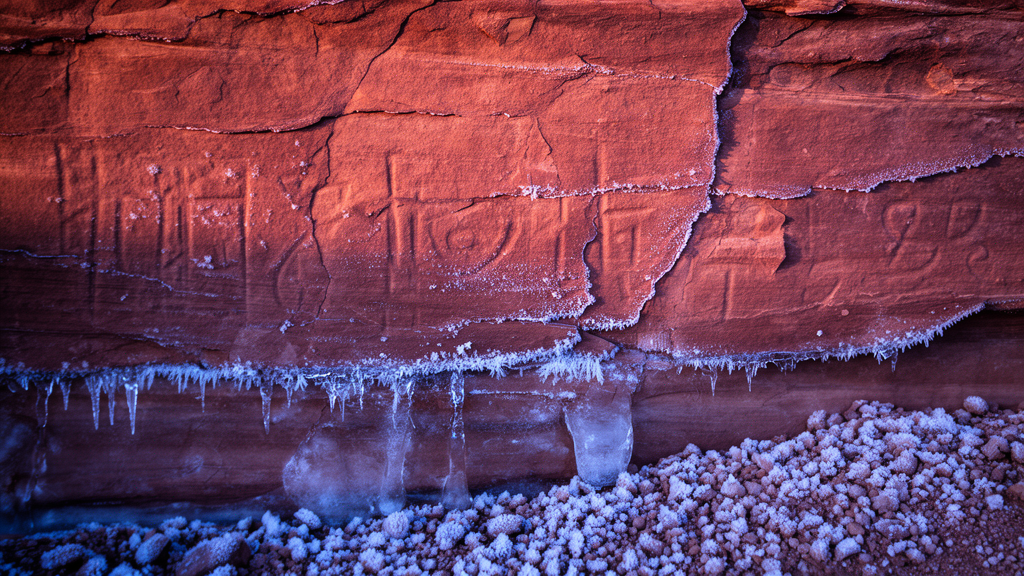
In the arid hills of Baiyin, in China’s Gansu Province, more than twenty open-air petroglyph sites scatter across cliff faces along the Yellow River corridor. Their engravings of caprids, deer, human figures, hunting scenes, and ritual dances record centuries of early cultural exchange in northwestern China. But the sandstone surfaces that carry this imagery are failing. Cracks, voids, blistering, and flaking peeling have advanced to the point that some petroglyphs now face a genuine preservation crisis, and because the engravings sit directly on exposed rock, any surface loss is an irreversible loss of archaeological information.
A new laboratory study, published in Environmental Earth Sciences, set out to pin down exactly how water, temperature swings, and dissolved salts combine to degrade these surfaces. The team, working from sandstone sampled near the Wujiachuan petroglyphs in Jingyuan County, ran controlled freeze–thaw experiments designed to mimic the region’s harsh continental climate, where annual precipitation ranges from 180 to 450 millimeters, evaporation reaches over 2,000 millimeters, and historical temperatures have swung between 40 °C and −25 °C, an extreme range of 65 °C. In that climate, freeze–thaw cycling driven by precipitation, snowmelt, and fracture-water infiltration is the primary weathering agent attacking the rock-art carriers.
What makes the study distinctive is its rejection of the fully saturated samples used in most prior freeze–thaw research. Instead, the researchers dripped 10 milliliters of solution or deionized water onto the top of each 7-centimeter cubic sample within 30 seconds, reproducing episodic precipitation or snowmelt input followed by lateral moisture migration along an exposed rock face. Each freeze–thaw cycle lasted 24 hours, with 7-hour freezing and 7-hour thawing stages, a temperature gradient of 13 °C per hour, and humidity held at 54 percent above freezing. Thirty cycles were completed in total.
The solution chemistry was chosen from real precipitation data for Baiyin, where sulfate ions dominate, followed by calcium, ammonium, nitrate, chloride, and sodium. Three salts at 0.5 mol/L — sodium sulfate, ammonium sulfate, and calcium chloride — were tested against pure water. Mass, hardness, and P-wave velocity were measured every 5 cycles, while surface morphology, pore structure, microstructure, mineralogy, and chemical composition were characterized every 10 cycles. Samples were dried at 105 °C for 48 hours before each measurement round to standardize conditions.
The macroscopic results revealed a clear hierarchy of damage. Sodium sulfate proved the most destructive by every bulk measure: after 30 cycles, its samples showed the greatest mass loss, the highest hardness loss rate, and the steepest P-wave velocity decline, with fitted curves exceeding R² values of 0.9, 0.99, and 0.98 respectively. Ammonium sulfate ranked second, calcium chloride third, and pure water consistently produced the mildest deterioration. The mass trajectories were particularly telling. Salt-treated samples initially gained mass as dissolved salts infiltrated pores and crystallized, then began losing mass as repeated freezing expansion and salt crystallization pressures fractured the rock and eroded particles. In the sodium sulfate group, mass eventually fell below its starting value after severe damage past cycle 20.
Surface morphology told the same story at visible scale. Sodium sulfate samples showed salt crystal deposits after just 10 cycles, bulging and widening peeling by cycle 20, and extensive structural collapse with thickened salt crusts by cycle 30. Ammonium sulfate samples degraded more gradually, developing large crystal coverings and noticeable flaking by the end. Calcium chloride produced only roughening and shallow local bulging, while water-treated samples remained relatively intact even after 30 cycles.
Under the scanning electron microscope, the differences persisted. Untreated sandstone showed compact, close particle contacts. Sodium sulfate samples developed cracks, surface deposits, and fibrous features near pore edges within 10 cycles, with progressive particle detachment thereafter. Ammonium sulfate samples showed columnar features emerging at 20 cycles alongside loosening texture. Calcium chloride produced interparticle cracks and pulverization, while water-treated samples showed only particle-edge peeling. The authors were careful not to assign specific mineral identities to these deposits from morphology alone, reserving that judgment for X-ray diffraction.
The XRD results delivered the study’s most surprising finding. Although sodium sulfate caused the worst structural deterioration, ammonium sulfate drove faster changes in mineral composition. Across all groups, quartz and clay minerals increased in relative content as cycles accumulated, while potassium feldspar, plagioclase, calcite, and ankerite declined. X-ray fluorescence confirmed the pattern chemically: silicon dioxide rose with cycle number while other major oxides fell, indicating dissolution of soluble minerals and irreversible compositional change. The reported oxides together accounted for 95.8 to 98.8 percent of the analyzed content, with sulfur- and chlorine-bearing components excluded because they could reflect residual treatment salts.
The mechanistic explanation lies in how each salt interacts with the rock. In pure water, damage comes mainly from freezing expansion: ice in micropores expands roughly 9 percent, generating stresses that exceed the strength of weak cemented interfaces and accumulate irreversible deformation. Sodium sulfate adds crystallization stress on top, transitioning between anhydrous and hydrated phases — including the heptahydrate and decahydrate forms reported under freeze–thaw conditions — within confined pores, while simultaneously promoting hydrolysis of feldspars and carbonates. Ammonium sulfate creates a mildly acidic pore solution that accelerates dissolution, alteration, and reprecipitation of feldspars and calcium- and magnesium-bearing carbonates, weakening mineral surfaces and cementation faster than the structure itself falls apart. Calcium chloride combines freeze–thaw action with ion exchange and dissolution of susceptible minerals, but less aggressively than the sulfates.
To quantify this evolution, the team built a surface-porosity-based damage model rooted in Kachanov’s classical damage mechanics, treating freeze–thaw cycling as an equivalent low-cycle fatigue process and defining a damage variable D from the change in two-dimensional surface pore-area fraction measured on cast thin sections. Because no complete failure occurred within 30 cycles, failure-cycle values had to be assumed for fitting, and the authors note this limitation along with the constraint that their experiments address precipitation-driven surface infiltration rather than groundwater capillary rise. Within those bounds, the model fit the observed porosity evolution well and offers a comparative framework for interpreting near-surface deterioration in sandstone heritage. The authors emphasize that for actual site diagnosis, the types and spatial distribution of soluble salts and efflorescences on the Baiyin rock-art surfaces should be directly characterized and matched against the experimental response patterns identified here.
Subject of Research: Laboratory simulation of freeze–thaw and salt-solution weathering mechanisms degrading sandstone petroglyph carrier surfaces in Baiyin, China
Article Title: Study on the degradation mechanism of petroglyph carrier surfaces in Baiyin: Under water-temperature-salt coupling effects
Article References: He, F., Kong, X., Guo, S., Ma, Y., Yang, X., Zhang, L., Lu, T., Lv, X., & Xie, M. (2026). Study on the degradation mechanism of petroglyph carrier surfaces in Baiyin: Under water-temperature-salt coupling effects. Environmental Earth Sciences, 85(17), Article 441. https://doi.org/10.1007/s12665-026-13182-y
Image Credits: AI Generated
DOI: 10.1007/s12665-026-13182-y
Keywords: petroglyphs, sandstone weathering, freeze-thaw cycles, salt crystallization, Baiyin, Gansu, cultural heritage conservation, sodium sulfate, ammonium sulfate, surface porosity, damage model, rock art degradation
Cite Scienmag News
Bethany Barker. (October 27, 2026). Salt Chemistry Steers How Freeze–Thaw Cycles Destroy Ancient Petroglyph Sandstone. Scienmag. https://scienmag.com/salt-chemistry-steers-how-freeze-thaw-cycles-destroy-ancient-petroglyph-sandstone/
Bethany Barker. "Salt Chemistry Steers How Freeze–Thaw Cycles Destroy Ancient Petroglyph Sandstone." Scienmag, 27 October 2026, https://scienmag.com/salt-chemistry-steers-how-freeze-thaw-cycles-destroy-ancient-petroglyph-sandstone/. Accessed 27 October 2026.
Bethany Barker. "Salt Chemistry Steers How Freeze–Thaw Cycles Destroy Ancient Petroglyph Sandstone." Scienmag. October 27, 2026. https://scienmag.com/salt-chemistry-steers-how-freeze-thaw-cycles-destroy-ancient-petroglyph-sandstone/


