

Tuesday, October 27, 2026
Science
No Result
View All Result
  • Login
  • HOME
  • SCIENCE NEWS
  • CONTACT US
  • HOME
  • SCIENCE NEWS
  • CONTACT US
No Result
View All Result
Scienmag
No Result
View All Result
Home Science News Earth Science

River Water Near Tanzanian Uranium Project Carries Radiation Doses Above WHO Guidelines

October 27, 2026
in Earth Science
Violet Maxwell
By Violet Maxwell Scienmag Editorial Profile - Natural Hazards
Reading Time: 3 mins read
0
River Water Near Tanzanian Uranium Project Carries Radiation Doses Above WHO Guidelines

River Water Near Tanzanian Uranium Project Carries Radiation Doses Above WHO Guidelines

65
SHARES
587
VIEWS
Share on FacebookShare on Twitter
ADVERTISEMENT

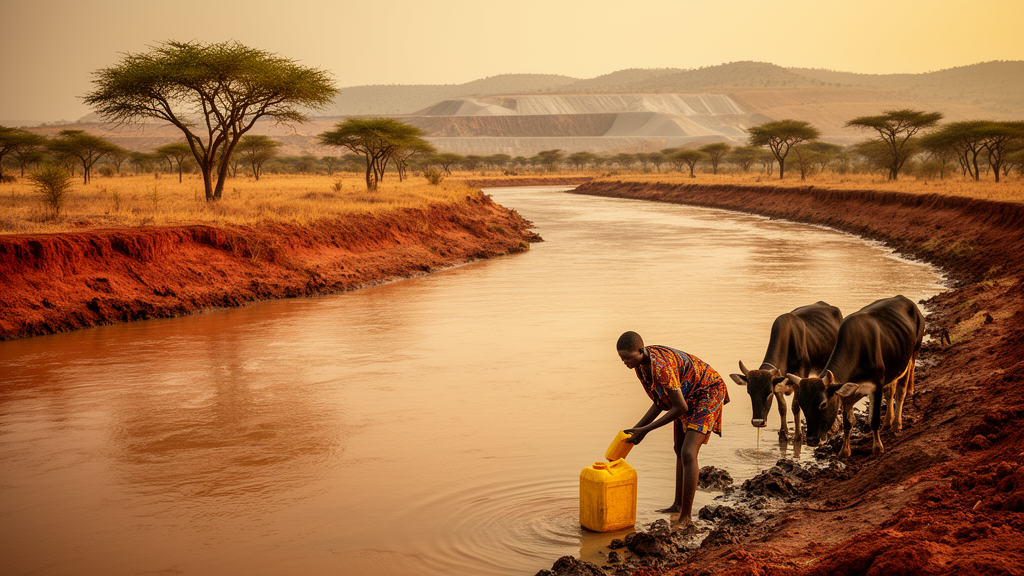
Untreated water from parts of the Likuyu River in southern Tanzania may expose people who drink it to radiation doses well above international safety guidelines, according to a new study published in Environmental Monitoring and Assessment. A team led by Charles D. Kadala sampled water and sediment at five sites along a 22.7-kilometre stretch of the river during the rainy season, collecting triplicate samples at each location. The researchers measured three naturally occurring radionuclides — radium-226, thorium-232, and potassium-40 — using high-purity germanium gamma spectrometry, a technique sensitive enough to detect the faint gamma emissions these isotopes release as they decay.

The results revealed striking spatial variation. Site A recorded the highest radium-226 activity concentration in water at 2.71 ± 0.33 becquerels per litre, while Site C showed an elevated potassium-40 level of 120.06 ± 1.62 becquerels per litre. When the researchers converted these concentrations into annual ingestion doses, Sites A and C stood out: 0.743 ± 0.109 and 0.623 ± 0.007 millisieverts per year respectively, both exceeding the World Health Organisation's total indicative dose criterion of 0.1 millisievert per year for drinking water.

The health implications extend beyond the dose figures themselves. The corresponding excess lifetime cancer risk values at these two sites were calculated at 28.6 × 10⁻⁴ and 23.97 × 10⁻⁴, both far above the tolerable risk level of 1 × 10⁻⁴ set by the International Commission on Radiological Protection. In practical terms, a person drinking untreated water from these locations over a lifetime would carry a substantially elevated estimated probability of developing radiation-associated cancer compared with the accepted benchmark.

Sediments told a different story. Although radionuclide enrichment appeared locally at Sites B and D, every radiological index computed for the sediment samples remained within safety limits. Radium equivalent activity ranged from 150.8 to 247.4 becquerels per kilogram, annual effective doses from sediments fell between 0.090 and 0.139 millisieverts per year, and both the external and internal hazard indices stayed below the threshold value of 1.

This contrast suggests that the primary exposure pathway of concern is ingestion of water rather than external exposure from riverbank sediments. To probe the origins of the contamination, the team applied Principal Component Analysis to the dataset. The analysis revealed co-enrichment of uranium-series and thorium-series radionuclides alongside potassium-driven inputs, a pattern the authors interpret as evidence of lithogenic and mineralogical control.

The study addresses a notable gap. By establishing baseline concentrations and dose estimates for the Likuyu River, the research provides reference data against which future monitoring — including any potential influence from mining operations upstream — can be judged. The authors caution that their findings apply to untreated river water and to the rainy-season conditions under which sampling occurred.

Communities relying on the river without treatment may face a significant radiological health risk at the affected sites, while sediment exposure remains within regulatory thresholds. The team frames the work as a foundation for ongoing surveillance and for water safety initiatives in uranium-affected agro-mining regions of East Africa, where the intersection of mineral wealth, agriculture, and untreated water supplies makes radiological monitoring an emerging public health priority.

Subject of Research: Natural radionuclide contamination and radiological risk assessment in the Likuyu River system, southern Tanzania

Article Title: Risk from natural radionuclides in the Likuyu River system, Tanzania: implications for radiological safety in a uranium-rich geological setting

Article References: Kadala, C. D., Rwiza, M. J., Mwaijengo, G. N., Sawe, S. F., & Mataba, G. R. (2026). Risk from natural radionuclides in the Likuyu River system, Tanzania: implications for radiological safety in a uranium-rich geological setting. Environmental Monitoring and Assessment, 198(11), Article 1251. https://doi.org/10.1007/s10661-026-16109-z

Image Credits: AI Generated

DOI: 10.1007/s10661-026-16109-z

Keywords: radionuclides, uranium, Tanzania, Likuyu River, radiological risk, drinking water, gamma spectrometry, radium-226, WHO guidelines, excess lifetime cancer risk, sediment, Mkuju River Uranium Project

Cite Scienmag News

Violet Maxwell. (October 27, 2026). River Water Near Tanzanian Uranium Project Carries Radiation Doses Above WHO Guidelines. Scienmag. https://scienmag.com/river-water-near-tanzanian-uranium-project-carries-radiation-doses-above-who-guidelines/


Violet Maxwell. "River Water Near Tanzanian Uranium Project Carries Radiation Doses Above WHO Guidelines." Scienmag, 27 October 2026, https://scienmag.com/river-water-near-tanzanian-uranium-project-carries-radiation-doses-above-who-guidelines/. Accessed 27 October 2026.

Violet Maxwell. "River Water Near Tanzanian Uranium Project Carries Radiation Doses Above WHO Guidelines." Scienmag. October 27, 2026. https://scienmag.com/river-water-near-tanzanian-uranium-project-carries-radiation-doses-above-who-guidelines/

Tags: drinking waterdrinking water safety standardsEnvironmental health risks of uranium projectsexcess lifetime cancer riskgamma spectrometryGamma spectrometry for environmental monitoringImpact of natural radioactivity on public healthLikuyu RiverMkuju River Uranium ProjectNaturally occurring radionuclides in drinking waterPotassium-40 levels in river sedimentsRadiation dose exceeding WHO guidelinesRadiation in Tanzanian river waterRadioactive contamination from mineral extractionradiological riskRadionuclide variation along Likuyu Riverradionuclidesradium-226Radium-226 contamination in watersedimentTanzaniauraniumUranium mining impactWHO guidelines
Share26Tweet16
Previous Post

Rare Movement Disorder Linked to Diabetic Ketosis Resolved with Insulin Therapy in Elderly Man

Next Post

Lisbon museum digitises 5,295 Palaearctic bee records and adds a new species for Portugal

Related Posts

New radar–gauge dataset maps South Korean rainfall every 10 minutes at 500-meter resolution
Earth Science

New radar–gauge dataset maps South Korean rainfall every 10 minutes at 500-meter resolution

October 27, 2026
Urban dam in Soweto carries antiretroviral drugs and pesticides in first-of-its-kind screening
Earth Science

Urban dam in Soweto carries antiretroviral drugs and pesticides in first-of-its-kind screening

October 27, 2026
Shallow sills and steady river flows could turn Norway’s Bolstadfjord into a stagnant lake
Earth Science

Shallow sills and steady river flows could turn Norway’s Bolstadfjord into a stagnant lake

October 27, 2026
AI Model Tracks Fading Cesium Legacy in China’s Coastal Seas
Earth Science

AI Model Tracks Fading Cesium Legacy in China’s Coastal Seas

October 27, 2026
Pyridine Nitrogen Tweaks Iron Framework to Squeeze Hydroxyl Radicals from Trace Hydrogen Peroxide
Earth Science

Pyridine Nitrogen Tweaks Iron Framework to Squeeze Hydroxyl Radicals from Trace Hydrogen Peroxide

October 27, 2026
Groundwater in Pakistan’s Dalbandin Region Carries Heavy Metals Far Above WHO Limits
Earth Science

Groundwater in Pakistan’s Dalbandin Region Carries Heavy Metals Far Above WHO Limits

October 27, 2026
Next Post
Lisbon museum digitises 5,295 Palaearctic bee records and adds a new species for Portugal

Lisbon museum digitises 5,295 Palaearctic bee records and adds a new species for Portugal

  • Mothers who receive childcare support from maternal grandparents show more optimized

    Mothers who receive childcare support from maternal grandparents show more parental warmth, finds NTU Singapore study

    27656 shares
    Share 11059 Tweet 6912
  • University of Seville Breaks 120-Year-Old Mystery, Revises a Key Einstein Concept

    1061 shares
    Share 424 Tweet 265
  • Bee body mass, pathogens and local climate influence heat tolerance

    682 shares
    Share 273 Tweet 171
  • Researchers record first-ever images and data of a shark experiencing a boat strike

    546 shares
    Share 218 Tweet 137
  • Groundbreaking Clinical Trial Reveals Lubiprostone Enhances Kidney Function

    531 shares
    Share 212 Tweet 133
Science

Embark on a thrilling journey of discovery with Scienmag.com—your ultimate source for cutting-edge breakthroughs. Immerse yourself in a world where curiosity knows no limits and tomorrow’s possibilities become today’s reality!

RECENT NEWS

  • Smart UAV and RIS Network Learns to Send Meaning, Not Just Bits, in 6G Test
  • Lisbon museum digitises 5,295 Palaearctic bee records and adds a new species for Portugal
  • River Water Near Tanzanian Uranium Project Carries Radiation Doses Above WHO Guidelines
  • Rare Movement Disorder Linked to Diabetic Ketosis Resolved with Insulin Therapy in Elderly Man

Categories

  • Agriculture
  • Anthropology
  • Archaeology
  • Athmospheric
  • Biology
  • Biotechnology
  • Blog
  • Bussines
  • Cancer
  • Chemistry
  • Climate
  • Earth Science
  • Editorial Policy
  • Marine
  • Mathematics
  • Medicine
  • Pediatry
  • Policy
  • Psychology & Psychiatry
  • Science Education
  • Science News
  • Social Science
  • Space
  • Technology and Engineering

Subscribe to Blog via Email

Enter your email address to subscribe to this blog and receive notifications of new posts by email.

Join 5,151 other subscribers

© 2025 Scienmag - Science Magazine

Welcome Back!

Login to your account below

Forgotten Password?

Retrieve your password

Please enter your username or email address to reset your password.

Log In
No Result
View All Result
  • HOME
  • SCIENCE NEWS
  • CONTACT US

© 2025 Scienmag - Science Magazine

Discover more from Science

Subscribe now to keep reading and get access to the full archive.

Continue reading