


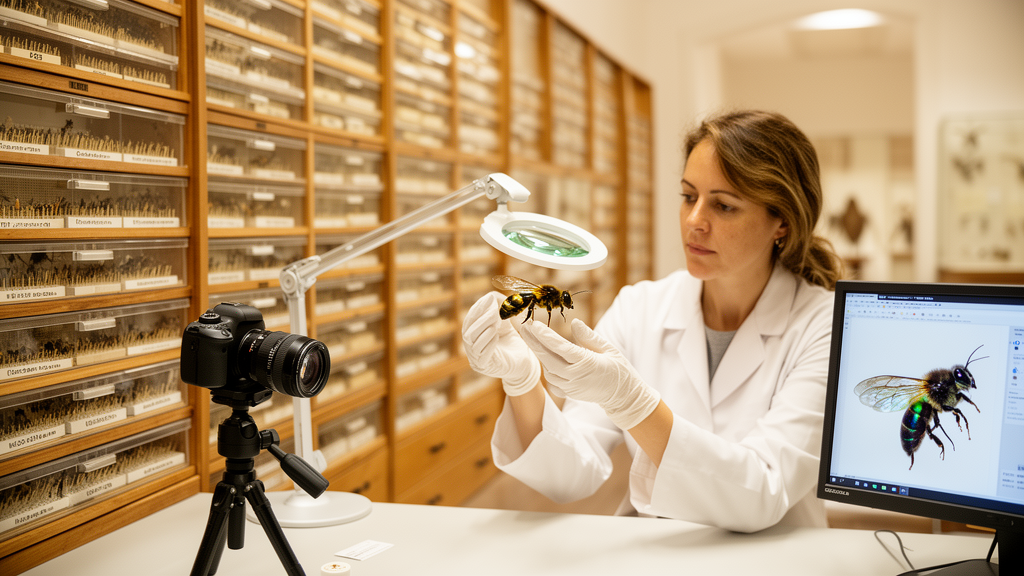
A vast trove of bee specimens held at the Museu Nacional de História Natural e da Ciência (MNHNC) at the Universidade de Lisboa has been catalogued, revised and made openly accessible through the Global Biodiversity Information Facility (GBIF), revealing a new national record for Portugal and sharpening the picture of the country’s pollinator fauna. The collection comprises 5,295 Palaearctic bee records, of which 4,830 are identified to species or subspecies level and 442 to genus or subgenus level. The digitisation effort forms part of the ARCADE project, which is revising and digitising the main pollinator collections held in Portugal. A comparable dataset covering the bee collection of the Museu de Ciência da Universidade de Coimbra has already been published, and the new MNHNC dataset continues that push to close long-standing gaps in knowledge of the Portuguese bee fauna.
The dataset records specimen counts, levels of taxonomic identification and the researchers responsible for each identification, alongside sampling locality and collection date — information that supports analyses of the distribution and seasonality of bee taxa across Portuguese territory. Images of the bee type specimens preserved at MNHNC have also been made available. Geographically, a substantial proportion of the Portuguese records originate from the southern and south-western coastal regions of the country, with the Faro District contributing the highest number of records by a considerable margin.
The holdings are largely composed of recent material, with most records collected during the 21st century — a pattern explained in part by a fire that devastated the museum in 1978, destroying its zoological collections and leaving suboptimal infrastructure for several subsequent years. As a result, only a small number of bee records in the collection predate the 1990s. In addition to Portuguese material, the museum also houses 66 bee records from other Palaearctic countries. The cataloguing process was not merely clerical: taxonomic identifications were revised for several genera, and previously unidentified specimens were identified to species level where possible.
That work produced a genuine faunistic surprise. Nomada chrysopyga Morawitz, 1871, a cuckoo bee widespread in Central and southern Europe, is recorded for the first time in Portuguese territory, based on a specimen collected in Torrão, Alcácer do Sal. The species was recently reinstated from synonymy with Nomada mauritanica, a name now restricted to specimens from North Africa. Notably, neither N. mauritanica nor N. chrysopyga had previously been recorded in Portugal. The probable host of N. chrysopyga, the mining bee Andrena fuscosa, has also been recently documented in the country, which fits with the new record.
With this addition, the national species count now stands at 737. Before the study, 736 bee species were recognised from mainland Portugal. Hylaeus convergens was subsequently removed from the national fauna following a revision of the Hylaeus garrulus species group, while the most recent checklist of European bees recognised Amegilla talaris and Amegilla albigena as separate species, both present in Portugal, raising the count by one. The new Nomada record brings the total to 737 species. Of the 54 bee genera known to occur in Portugal, 49 are represented in the museum’s collection, with Lasioglossum the most abundant, followed by Andrena and Eucera.
The collection contains specimens of 425 species, representing 57.7 percent of the bee species currently known from mainland Portugal. That coverage matters because natural history museums are the backbone of biodiversity studies, providing primary data on species taxonomy and distribution, supporting accurate species identification and preserving critical information on morphology and evolutionary history. Collections also offer historical baselines that enable researchers to document changes in insect communities in response to environmental change and to trace spatial and temporal patterns in genotypic and phenotypic variation. The growing recognition of pollinators’ importance makes it all the more pressing to digitise these collections and make their holdings — type specimens in particular — openly accessible.
Among the holdings are several species of conservation concern whose historical occurrence data may prove valuable for future conservation planning. According to the latest IUCN European Red List of Bees, the museum houses specimens of two Endangered species, Nomada blepharipes and Nomada fenestrata, and five species classified as Vulnerable: Bombus muscorum, Colletes pulchellus, Lasioglossum virens, Nomada rhenana and Trachusa interrupta. The recently published Red List of Invertebrates of Portugal identifies further species of concern, including the Iberian endemic Flavipanurgus ibericus, classified as Vulnerable, for which both male and female specimens are represented in the collection.
The type material in the collection includes the holotype and a male paratype of Hoplitis halophila, a recently described Iberian endemic species. A more complicated story surrounds a specimen from the INIAV insect collection, currently held in deposit at the MNHNC where it is being preserved, catalogued and digitised. The specimen bears a co-type label and was identified as Colletes ibericus, a junior synonym of Colletes pulchellus. Although it was identified by the species’ author prior to its formal description, no Portuguese material was included in the original type series, indicating that the specimen does not have type status. Moreover, the specimen does not correspond to C. ibericus: it differs markedly from the designated lectotype and instead more closely matches the diagnostic characters of Colletes dusmeti. As a consequence of this early misidentification, the specimen was erroneously cited in Portuguese bee checklists, first as C. ibericus by Dusmet y Alonso in 1932 and subsequently as C. pulchellus by Baldock and colleagues in 2018, based on Dusmet’s original mention. A 1959 record of C. ibericus was likely also derived from Dusmet’s publication and is probably incorrect.
The collection also carries the scars of institutional loss. The museum formerly housed holotypes of several Afrotropical bee species, but these were destroyed in the 1978 fire. Consequently, the holotypes of Anthophora atriceps, Xylocopa mixta, Megachile pallida, Megachile decemsignata and Megachile unfasciata — together with other hymenopteran types described by Radoszkowski from Angola — are presumably lost. Portugal nonetheless sits within one of the world’s great bee diversity regions: the Palaearctic includes important centres of bee diversity, notably the Middle East and the Mediterranean Basin, where abundant solar exposure, dry summers, mild rainy winters and diminished seasonal variation foster high flora diversity that favours large numbers of bee species. Bees also prefer open environments with low vegetation, including the dry shrublands common to the Mediterranean, and the region’s frequent fires clear vegetation and leave bare ground suitable for nesting. Within the Mediterranean area, the Iberian Peninsula holds an abundance of endemic species, probably due to its isolation from other regions of Europe and Africa, its multiple mountain chains and local abiotic conditions, and it served as a climatic refugium for several species during the Pleistocene glaciations.
Against this backdrop, the MNHNC collection — with its species of conservation concern and its broad generic coverage — contributes to a more comprehensive understanding of pollinator distribution in Portugal and provides essential baseline data for assessing conservation status and informing future ecological research in the country. By publishing the museum’s bee database openly, the researchers aim to make this information broadly accessible to the scientific community, contributing to ongoing efforts to reduce knowledge gaps in the Portuguese bee fauna and further improving current knowledge of national biodiversity.
Subject of Research: Digitisation and taxonomic revision of the Palaearctic bee collection of the Museu Nacional de História Natural e da Ciência, Lisbon
Article Title: From Cabinet to Catalogue: The Palaearctic bee ( Hymenoptera , Apoidea , Anthophila ) collection of the Museu Nacional de História Natural e da Ciência, Universidade de Lisboa, Portugal
Article References: Baptista, M., de Sousa, P., & Keller, R. (2026). From Cabinet to Catalogue: The Palaearctic bee (Hymenoptera, Apoidea, Anthophila) collection of the Museu Nacional de História Natural e da Ciência, Universidade de Lisboa, Portugal. Biodiversity Data Journal, 14, Article e188597. https://doi.org/10.3897/bdj.14.e188597
Image Credits: AI Generated
Keywords: bees, Portugal, natural history museum, GBIF, digitisation, Nomada chrysopyga, biodiversity, pollinators, type specimens, Iberian Peninsula, conservation, taxonomy
Cite Scienmag News
Margaret Porter. (October 27, 2026). Lisbon museum digitises 5,295 Palaearctic bee records and adds a new species for Portugal. Scienmag. https://scienmag.com/lisbon-museum-digitises-5295-palaearctic-bee-records-and-adds-a-new-species-for-portugal/
Margaret Porter. "Lisbon museum digitises 5,295 Palaearctic bee records and adds a new species for Portugal." Scienmag, 27 October 2026, https://scienmag.com/lisbon-museum-digitises-5295-palaearctic-bee-records-and-adds-a-new-species-for-portugal/. Accessed 27 October 2026.
Margaret Porter. "Lisbon museum digitises 5,295 Palaearctic bee records and adds a new species for Portugal." Scienmag. October 27, 2026. https://scienmag.com/lisbon-museum-digitises-5295-palaearctic-bee-records-and-adds-a-new-species-for-portugal/


