


University students spend their days in classrooms, libraries, dormitories and online learning environments, and much of that time is spent sitting. A new mini review published in Frontiers in Psychology argues that a growing concept in exercise science, known as exercise snacks, could offer a low-cost way to weave more movement into student life, while cautioning that the evidence base for campus settings is still too thin to declare the strategy effective.
The review, written by XiaoTian Wang of Beijing Normal University and Macao Polytechnic University and colleagues, takes an integrative thematic approach rather than pooling effect sizes or formally appraising study quality. The authors synthesize literature on exercise snacks, physical activity snacks, brief intermittent physical activity, active breaks, sedentary behavior interruption, incidental physical activity and movement-based Brain Breaks, drawing mainly on English-language peer-reviewed studies from PubMed, Web of Science and Scopus, with priority given to work published between 2020 and 2025 and foundational earlier studies retained where relevant.
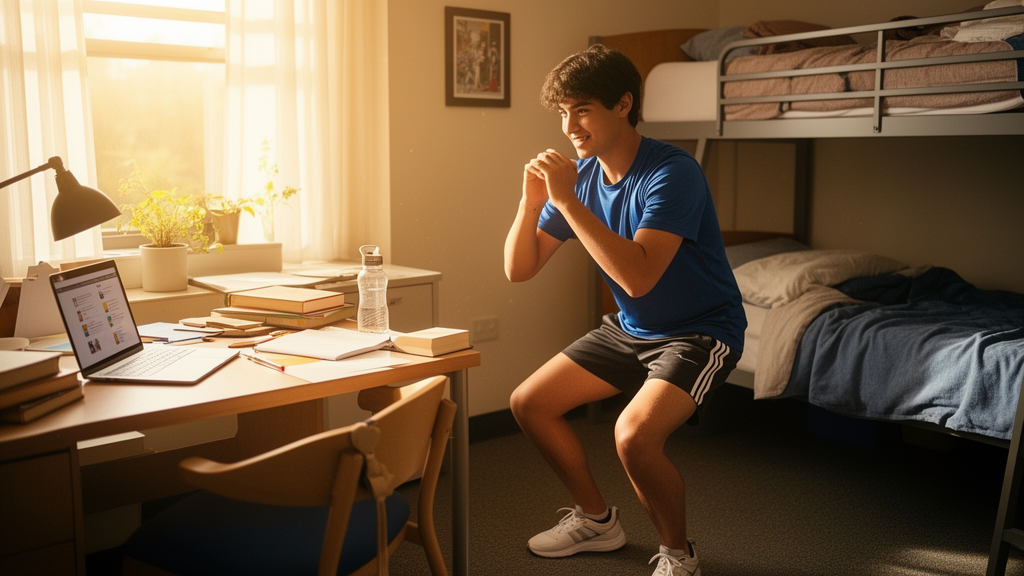
The core idea behind exercise snacks is simple but represents a shift in how physical activity promotion is framed. Instead of relying on structured exercise sessions, physical education courses or long workouts that require time, space and organization, exercise snacks are brief, repeated, low-barrier bouts of activity embedded in ordinary routines. On a campus, that could mean brisk walking between buildings, climbing stairs, dynamic stretching during a study break, or short body-weight exercises in a dormitory. The authors stress that the value lies not in the training effect of any single bout but in the accumulation and distribution of movement across the day.
The concept has roots in metabolic research. Early work showed that short activity bouts can benefit metabolic health, including findings that pre-meal exercise snacks improved glycemic control in individuals with insulin resistance. Islam and colleagues defined exercise snacks as isolated, periodic vigorous bouts lasting no longer than one minute across the day, while other researchers have described the field as one with widely varying definitions, durations, intensities, frequencies and outcomes. Related Snacktivity research suggests that embedding two-to-five-minute activity bouts into daily life may be an acceptable and accumulable strategy for people who are insufficiently active.
The review is careful to draw conceptual boundaries. Exercise snacks in higher education are not simply miniature versions of high-intensity interval training, nor are they equivalent to any incidental movement on campus. The authors propose a provisional definition in which each bout lasts one to five minutes, with intensity ranging from light to moderate or higher. Light forms include standing activity, dynamic stretching and easy walking; moderate forms include brisk walking, stair climbing and body-weight exercises; higher-intensity forms might involve short bouts of jumping jacks, fast step-ups or squat jumps. What distinguishes an exercise snack from ordinary campus walking is a clear activity intention, repeatability and a connection to specific campus contexts such as class breaks, building transitions or dormitory routines.
Adjacent concepts also matter. Incidental physical activity occurs during daily routines such as commuting or stair use without exercise as the primary purpose, while movement-based Brain Breaks use brief standing, stretching or simple movements to interrupt sedentary study. These overlap with exercise snacks but are not identical, and the review treats them as complementary models for daily-life and learning contexts. Research on vigorous intermittent lifestyle physical activity, or VILPA, shows that brief episodes of higher-intensity activity in daily life can be identified and measured by devices and may carry health significance, providing adjacent evidence for understanding short activity bouts in campus life.
The potential effects described in the review are primarily behavioral rather than clinical. Because campuses are spatially mobile environments where students regularly move among dormitories, teaching buildings, libraries and dining halls, inserting intentional activity into existing routes may increase steps, light-to-moderate activity and the frequency of movement. A second potential value is interrupting prolonged sitting, whose risk is related not only to total sitting time but also to its distribution across the day. Research suggests that more frequent breaks are associated with some cardiometabolic indicators, and that standing, light walking or simple resistance activity may improve postprandial glucose and insulin responses, although effects vary by break type and dose. The authors also note that the World Health Organization’s 2020 guidelines no longer require adult physical activity to be accumulated in bouts of at least ten minutes, which brings short bouts squarely into mainstream health promotion.
However, the review repeatedly emphasizes caution. Existing exercise snack studies involve mainly adult, older adult or general sedentary populations, with inconsistent operational definitions, activity forms, health outcomes and intervention designs. Direct evidence from real universities remains limited, and university students have distinctive study rhythms, spatial mobility and residential arrangements that differ from office workers or older adults. Student studies suggest that activity and sedentary patterns are influenced by gender, age, field of study, degree stage and everyday context, and that interventions can improve total activity and steps, but these findings do not directly establish exercise snack effects in campus settings. The authors frame exercise snacks in higher education as a promising campus-based strategy rather than a validated standardized prescription.
Universities do offer favorable contextual conditions for testing the idea. Timetables contain short windows between classes and during long study sessions, and campus spaces such as stairways, corridors, library surroundings, dormitory roads and greenways can accommodate brisk walking, stretching or body-weight exercises. Classroom activity-break research in higher education shows that standing or movement breaks are feasible in university courses and may reduce sedentary time, relieve fatigue or improve perceived focus. Digital tools also make brief bouts easier to record, since questionnaires may capture their frequency and cumulative effects poorly; the authors recommend combining wearable devices, smartphone step counts and activity logs to assess steps, moderate-to-vigorous activity, sitting interruptions and activity rhythms. At the same time, campuses are not homogeneous: class-break length, building structure, stairway safety, curriculum density and student fitness differ across institutions, and overly compulsory designs or uniform check-in tasks may reduce acceptability. Qualitative Snacktivity work suggests acceptability depends on individual perception, contextual fit, activity choice and flexibility, so future designs should emphasize voluntariness, flexibility, safety and moderation.
The review’s central conclusion is that exercise snacks should be viewed as a supplementary strategy alongside physical education and structured exercise, not a replacement for either. The authors acknowledge their own limitations, including the absence of a strict systematic search, quality appraisal or effect-size synthesis, and they note that the optimal dose and actual effectiveness of exercise snacks in universities remain undetermined. Future research, they argue, should define exercise snacks operationally for higher education, prioritize safe and feasible low- to moderate-intensity activities, test interventions within real timetables and campus spaces, and examine acceptability, safety and maintenance across class breaks, teaching buildings, libraries, dormitories and campus commuting. The frontier value of the concept, in their view, is not a shorter training model but a prompt to reconsider the basic unit and setting of physical activity promotion, shifting attention toward brief, dispersed and repeatable forms of movement that can be identified, measured and repeated in the ordinary rhythm of university life.
Subject of Research: Exercise snacks as brief physical activity bouts for reducing sedentary behavior among university students
Article Title: Exercise snacks in university settings: a mini review of daily physical activity and sedentary behavior among university students
Article References: Wang, X., Wu, J., Heng, L., Li, H., & Zou, Z. (2026). Exercise snacks in university settings: a mini review of daily physical activity and sedentary behavior among university students. Frontiers in Psychology, 17, Article 1928216. https://doi.org/10.3389/fpsyg.2026.1928216
Image Credits: AI Generated
DOI: 10.3389/fpsyg.2026.1928216
Keywords: exercise snacks, university students, sedentary behavior, physical activity, Snacktivity, active breaks, campus health promotion, wearable devices, VILPA, sitting interruption, higher education, mini review
Cite Scienmag News
Courtney Benton. (October 27, 2026). Exercise Snacks May Help University Students Break Up Long Hours of Sitting. Scienmag. https://scienmag.com/exercise-snacks-may-help-university-students-break-up-long-hours-of-sitting/
Courtney Benton. "Exercise Snacks May Help University Students Break Up Long Hours of Sitting." Scienmag, 27 October 2026, https://scienmag.com/exercise-snacks-may-help-university-students-break-up-long-hours-of-sitting/. Accessed 27 October 2026.
Courtney Benton. "Exercise Snacks May Help University Students Break Up Long Hours of Sitting." Scienmag. October 27, 2026. https://scienmag.com/exercise-snacks-may-help-university-students-break-up-long-hours-of-sitting/


