

Tuesday, October 27, 2026
Science
No Result
View All Result
  • Login
  • HOME
  • SCIENCE NEWS
  • CONTACT US
  • HOME
  • SCIENCE NEWS
  • CONTACT US
No Result
View All Result
Scienmag
No Result
View All Result
Home Science News Biology

Beneficial Microbes Help Plants Cope With Salt Stress, Review Finds

October 27, 2026
in Biology, Science News
Drew Townsend
By Drew Townsend Scienmag Editorial Profile - Cell Biology
Reading Time: 2 mins read
0
Beneficial Microbes Help Plants Cope With Salt Stress, Review Finds

Beneficial Microbes Help Plants Cope With Salt Stress, Review Finds

65
SHARES
587
VIEWS
Share on FacebookShare on Twitter
ADVERTISEMENT

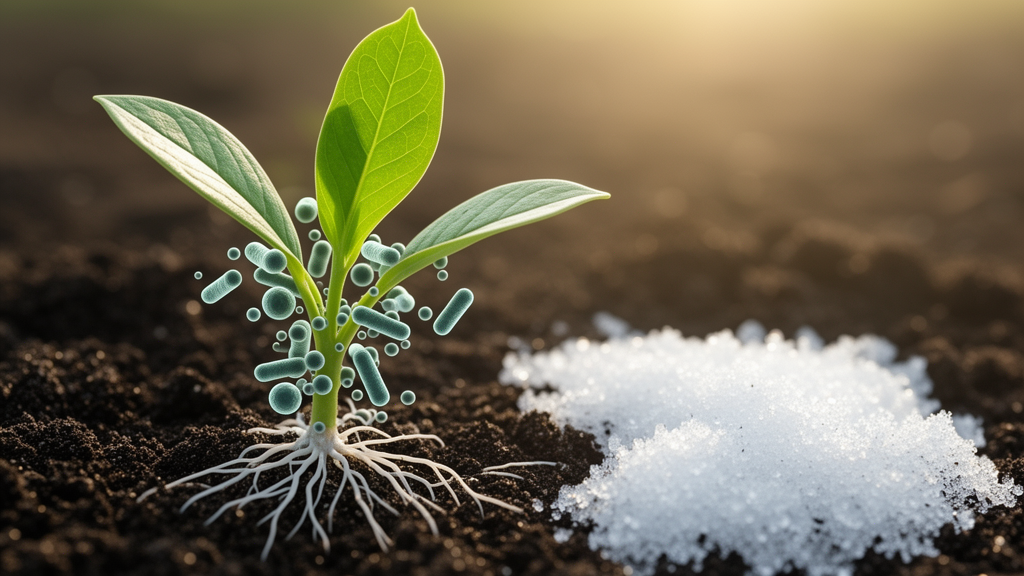
Salt accumulation in soils poses a persistent threat to crop productivity, disrupting cellular homeostasis and triggering osmotic and ionic imbalance in plants. A new review synthesizes evidence that beneficial microorganisms, including plant growth-promoting rhizobacteria, arbuscular mycorrhizal fungi, endophytic fungi, and rhizosphere-associated microbes, can enhance plant resilience against salinity stress, offering sustainable alternatives for salt-affected agricultural systems.

According to the review, salinity stimulates elevated production of reactive oxygen species in plant cells, leading to oxidative stress damage and eventual cellular dysfunction. Microbial interventions appear to counter these effects through several proposed mechanisms: osmotic adjustment, ion sequestration, mitigation of oxidative stress, phytohormone regulation, and rhizosphere-mediated stress buffering. The authors also point to improved nutrient acquisition, assistance in osmotic regulation, modulation of phytohormone signaling, and maintenance of cellular ion homeostasis as pathways by which microbes impart tolerance benefits.

A central focus of the analysis is the role of antioxidant defenses. Beneficial microorganisms can trigger both enzymatic and non-enzymatic antioxidant mechanisms in their plant hosts, and inoculation studies have reported changes in the activity of key antioxidant enzymes such as superoxide dismutase, ascorbate peroxidase, catalase, and glutathione reductase. The review stresses, however, that the magnitude and direction of these enzymatic responses are context dependent, and their interpretation requires careful consideration of the fine balance between oxidative damage and plant responses.

The authors also highlight how multi-omics approaches have expanded understanding of plant–microbe interactions under salinity. Techniques including amplicon and shotgun metagenomics, metatranscriptomics, host transcriptomics, proteomics, and metabolomics have revealed the taxa, genes, transcripts, proteins, and metabolites associated with these interactions, providing a more complete picture of how microbial communities and their hosts respond to salt stress at the molecular level.

Looking forward, the review discusses frontier integrative mechanisms for cultivating climate-resilient crops in salt-affected environments, including microbiome engineering, synthetic microbial consortia, and systems biology frameworks. By consolidating the evidential support for reported microbial effects and their proposed mechanisms of salt tolerance, with particular attention to enzymatic and non-enzymatic defense systems and multi-omics learnings, the work aims to guide the development of sustainable agricultural strategies for soils increasingly affected by salinity.

Subject of Research: Mechanisms by which beneficial microbes enhance plant tolerance to salinity stress

Article Title: Beneficial microbes in plant salt stress tolerance: mechanisms, antioxidant defense, and multi-omics insights

Article References: Shree, S., Chaudhary, A., Kumar, S., Singh, K., & Dubey, N. (2026). Beneficial microbes in plant salt stress tolerance: mechanisms, antioxidant defense, and multi-omics insights. Frontiers in Microbiology, 17, Article 1965097. https://doi.org/10.3389/fmicb.2026.1965097

Image Credits: AI Generated

DOI: 10.3389/fmicb.2026.1965097

Keywords: salinity stress, plant microbiome, plant growth-promoting rhizobacteria, arbuscular mycorrhizal fungi, antioxidant enzymes, reactive oxygen species, multi-omics, metagenomics, phytohormones, microbiome engineering, synthetic microbial consortia, sustainable agriculture

Cite Scienmag News

Drew Townsend. (October 27, 2026). Beneficial Microbes Help Plants Cope With Salt Stress, Review Finds. Scienmag. https://scienmag.com/beneficial-microbes-help-plants-cope-with-salt-stress-review-finds/

Drew Townsend. "Beneficial Microbes Help Plants Cope With Salt Stress, Review Finds." Scienmag, 27 October 2026, https://scienmag.com/beneficial-microbes-help-plants-cope-with-salt-stress-review-finds/. Accessed 27 October 2026.

Drew Townsend. "Beneficial Microbes Help Plants Cope With Salt Stress, Review Finds." Scienmag. October 27, 2026. https://scienmag.com/beneficial-microbes-help-plants-cope-with-salt-stress-review-finds/


Tags: antioxidant enzyme activity in plantsantioxidant enzymesarbuscular mycorrhizal fungibeneficial microbesEndophytic fungiion sequestration mechanismsmetagenomicsmicrobiome engineeringmulti-omicsosmotic adjustment in plantsoxidative stress mitigationphytohormone regulation under salinityphytohormonesplant growth-promoting rhizobacteriaplant microbiomereactive oxygen speciesrhizosphere microbessalinity stresssalt stress tolerance in plantssustainable agriculturesustainable salt-affected agriculturesynthetic microbial consortia
Share26Tweet16
Previous Post

Before Treatment Begins, Lung and Head and Neck Cancer Patients Know Little About Exercise

Next Post

New Alpine Moss, Rare Stonewort and Long-Lost Lichens Refresh Italy’s Flora Records

Related Posts

Headwater Lakes and Catchments Emerge as Front Line of Global Water Security
Earth Science

Headwater Lakes and Catchments Emerge as Front Line of Global Water Security

October 27, 2026
Diabetes Drugs Linked to Sharply Lower Lymphedema Risk After Breast Cancer Surgery
Cancer

Diabetes Drugs Linked to Sharply Lower Lymphedema Risk After Breast Cancer Surgery

October 27, 2026
PD-L1 Levels Fail to Predict ALK Inhibitor Benefit in Lung Cancer Cohort
Cancer

PD-L1 Levels Fail to Predict ALK Inhibitor Benefit in Lung Cancer Cohort

October 27, 2026
Exercise Snacks May Help University Students Break Up Long Hours of Sitting
Science News

Exercise Snacks May Help University Students Break Up Long Hours of Sitting

October 27, 2026
New Alpine Moss, Rare Stonewort and Long-Lost Lichens Refresh Italy’s Flora Records
Biology

New Alpine Moss, Rare Stonewort and Long-Lost Lichens Refresh Italy’s Flora Records

October 27, 2026
Before Treatment Begins, Lung and Head and Neck Cancer Patients Know Little About Exercise
Cancer

Before Treatment Begins, Lung and Head and Neck Cancer Patients Know Little About Exercise

October 27, 2026
Next Post
New Alpine Moss, Rare Stonewort and Long-Lost Lichens Refresh Italy’s Flora Records

New Alpine Moss, Rare Stonewort and Long-Lost Lichens Refresh Italy's Flora Records

  • Mothers who receive childcare support from maternal grandparents show more optimized

    Mothers who receive childcare support from maternal grandparents show more parental warmth, finds NTU Singapore study

    27656 shares
    Share 11059 Tweet 6912
  • University of Seville Breaks 120-Year-Old Mystery, Revises a Key Einstein Concept

    1061 shares
    Share 424 Tweet 265
  • Bee body mass, pathogens and local climate influence heat tolerance

    682 shares
    Share 273 Tweet 171
  • Researchers record first-ever images and data of a shark experiencing a boat strike

    546 shares
    Share 218 Tweet 137
  • Groundbreaking Clinical Trial Reveals Lubiprostone Enhances Kidney Function

    531 shares
    Share 212 Tweet 133
Science

Embark on a thrilling journey of discovery with Scienmag.com—your ultimate source for cutting-edge breakthroughs. Immerse yourself in a world where curiosity knows no limits and tomorrow’s possibilities become today’s reality!

RECENT NEWS

  • Headwater Lakes and Catchments Emerge as Front Line of Global Water Security
  • Diabetes Drugs Linked to Sharply Lower Lymphedema Risk After Breast Cancer Surgery
  • PD-L1 Levels Fail to Predict ALK Inhibitor Benefit in Lung Cancer Cohort
  • Exercise Snacks May Help University Students Break Up Long Hours of Sitting

Categories

  • Agriculture
  • Anthropology
  • Archaeology
  • Athmospheric
  • Biology
  • Biotechnology
  • Blog
  • Bussines
  • Cancer
  • Chemistry
  • Climate
  • Earth Science
  • Editorial Policy
  • Marine
  • Mathematics
  • Medicine
  • Pediatry
  • Policy
  • Psychology & Psychiatry
  • Science Education
  • Science News
  • Social Science
  • Space
  • Technology and Engineering

Subscribe to Blog via Email

Enter your email address to subscribe to this blog and receive notifications of new posts by email.

Join 5,151 other subscribers

© 2025 Scienmag - Science Magazine

Welcome Back!

Login to your account below

Forgotten Password?

Retrieve your password

Please enter your username or email address to reset your password.

Log In
No Result
View All Result
  • HOME
  • SCIENCE NEWS
  • CONTACT US

© 2025 Scienmag - Science Magazine

Discover more from Science

Subscribe now to keep reading and get access to the full archive.

Continue reading