


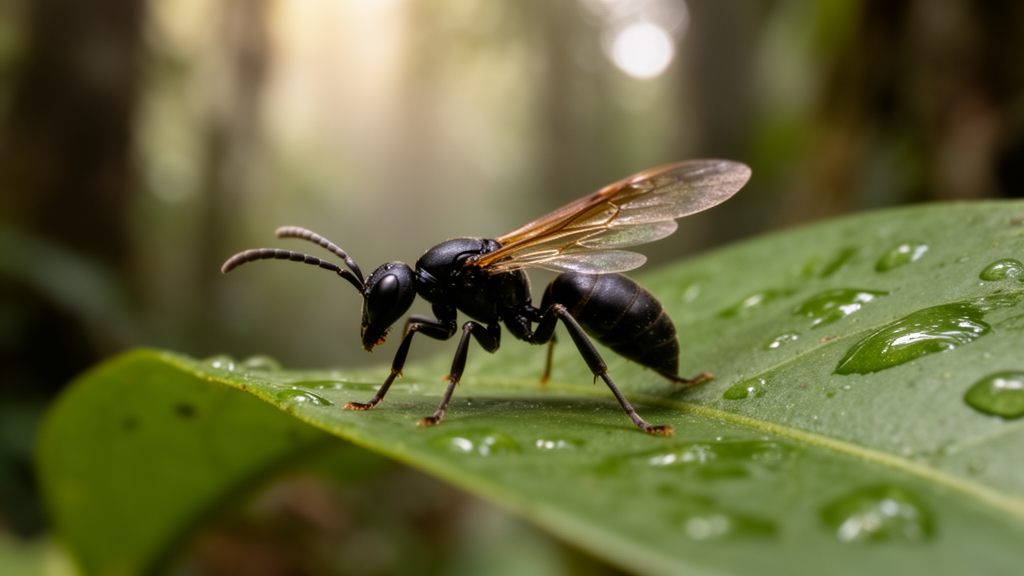
A tiny parasitoid wasp collected in a mountain forest in northern Thailand has turned out to be something far more significant than a single new species. In a taxonomic review of the subgenus Larsoceraphron of the genus Ceraphron, researchers have described Ceraphron (Larsoceraphron) chularoipaad sp. nov., a new species that represents the first confirmed species-level record of the genus Ceraphron in Thailand. The study, published in the Journal of Hymenoptera Research, also provides revised diagnoses and descriptions for all four known species of the subgenus, along with two new identification keys: one separating the six subgenera of Ceraphron and another distinguishing the species of Larsoceraphron.
The finding matters because ceraphronoid wasps, despite being globally distributed on every continent except Antarctica and frequently caught in insect traps, remain among the most neglected groups in the parasitoid wasp superfamily Ceraphronoidea. The superfamily contains just two extant families, Ceraphronidae and Megaspilidae, and both have been largely ignored in morphological and molecular research. A recent review of the Afrotropical fauna more than doubled the number of described species across Africa, and more than 80 percent of those newly described species came from a single small, threatened forest fragment in Kenya. That result underscored how badly the current count of described species understates the true diversity of the group.
Southeast Asia presents an even starker picture. Almost nothing is known about ceraphronoids in the region, and no identification key exists for ceraphronoid genera there. The only available key to genera is a world key published by Dessart and Cancemi in 1986, which is outdated, does not reflect current taxonomic advances, and was written in French, further limiting its accessibility. Against this backdrop, the new Thai species is not just an addition to a catalogue but a demonstration of how much unexplored diversity may be sitting in museum drawers and field collections across the region.
Ceraphronidae can be distinguished from their sister family Megaspilidae by a suite of morphological characters: the mesotibia carries a single apical spur, the fore wing usually lacks a pterostigma, notauli are usually absent, the sixth tergite bears a structure known as Waterston’s evaporatorium, the first metasomal sternite is not subdivided, and the apex of the protibial spur is simple and equipped with a comb. More than 90 percent of ceraphronid species fall into just two genera, Ceraphron with roughly 230 described species and Aphanogmus with about 140, yet many species remain undescribed. Their recorded host range is remarkably broad, spanning beetles, flies, true bugs, other wasps, butterflies and moths, lacewings, thrips, and caddisflies, although the biology of most species is essentially unknown.
Identifying ceraphronids has long been hampered by their morphological monotony. Female ceraphronids have traditionally been separated at the genus level by a single diagnostic character, the width-to-height ratio of the mesosoma, which is higher than wide in Aphanogmus and wider than high in Ceraphron. However, tropical species of Ceraphron have revealed greater heterogeneity than usually assumed. Some tropical species possess well-developed notauli, a feature previously considered characteristic of Megaspilidae. These findings prompted the taxonomist Paul Dessart to revise the classification within Ceraphron in 1981, dividing the genus into six subgenera: Allomicrops, Ceraphron, Eulagynodes, Larsoceraphron, Oktoceraphron, and Pristomicrops. Most species in the morphologically distinct subgenera occur in tropical regions of the Afrotropical, Neotropical, and Oriental realms, and only the monotypic Oktoceraphron and the species of Larsoceraphron are known exclusively from tropical habitats.
Until now, Larsoceraphron was documented from Brazil, Malaysia, and Vietnam, with no biological, ecological, or molecular data available for any of its species. The new species was described from two female specimens. The holotype was collected in August 2023 in hill evergreen forest at 1,341 meters in Doi Phu Kha National Park in Nan province, using a Malaise trap as part of the Global Malaise Program. The paratype came from Doi Pha Hom Pok National Park in Chiang Mai province, trapped at 2,174 meters in November 2007. The species name chularoipaad combines Chula, for Chulalongkorn University, with the Thai phrase roi paad, meaning one hundred and eight, commemorating the university’s 108th anniversary in 2025.
Ceraphron (L.) chularoipaad is a small wasp, with the female body measuring 2.6 millimeters, and it is separated from its relatives by a specific combination of features. Its eyes are medium-sized, the anterior ocellar fovea extends ventrally into the facial sulcus and reaches the dorsal margin of the antennal scrobe, the occipital carina is straight, the scape measures 1.23 times the combined length of the pedicel and the first four flagellomeres, the notauli are present only in the anterior third of the mesoscutum, and the metafemur is slightly thickened with a length 3.8 times its maximum width. The head and mesosoma are black while the metasoma is dark brown, and the four apical flagellomeres of the female antenna are distinctly thickened. The male remains unknown, as does the host.
The taxonomic treatment also clarified the other three species of the subgenus. Ceraphron (L.) huggerti, known from a male holotype collected in Sarawak, Malaysia in 1979, is distinguished by a short malar distance, a triangular anterior ocellar fovea with carinate margins, and complete notauli. Ceraphron (L.) sylviae, described from Brazil with both female and male types, stands out with reddish-brown mesosoma and metasoma marked with black patches, extremely raised lateral margins of the toruli, and distinctly broadened notauli. Ceraphron (L.) tobiasi, from Vietnam, has very large eyes and a metafemur whose length is slightly more than twice its maximum width. The authors reinterpreted the original description of C. tobiasi because the antennal segment measurements in the 2004 description were ambiguous, and the type specimen could not be found, so no images were taken and no re-examination was conducted.
The disjunct distribution of Larsoceraphron, with its type species in Brazil and other species in Malaysia, Vietnam, and now Thailand, raises biogeographical questions about whether this Old World and New World tropical pattern reflects a historical connection or independent dispersal events. The authors note that cryptic diversity may exist within both Ceraphron and Larsoceraphron, and that some currently recognised species could represent distinct, undescribed lineages. Resolving these uncertainties, they argue, will require integrating molecular phylogenetics, detailed morphological analysis, and ecological data. They also highlight the case of Ceraphron krogmanni, described in 2018, which shares some traits with Larsoceraphron, including distinct ocellar foveae, incomplete notauli, and an epomial carina, but lacks the subgenus’s defining posteriorly protruding occipital carina and prominent internotaular area, suggesting it may not fit any currently recognised subgenus.
Perhaps the most striking evidence of how understudied these wasps are comes from DNA barcode data. As of February 2025, the public BOLD Systems dataset contains at least 430 published barcode records forming 166 BINs, putative species clusters, for Ceraphronidae from Thailand alone, and 58 records forming 19 BINs for Megaspilidae. Yet previous work reported only about 20 species of Ceraphron, ten of Aphanogmus, and one or two of Cyoceraphron for all of Southeast Asia, with Megaspilidae represented by fewer than ten species of Lagynodes, roughly ten of Conostigmus, and a few more of Dendrocerus in the region. With 166 Ceraphronidae BINs in Thailand alone far exceeding the roughly 30 species reported for the entire region, the authors conclude that a vast number of species remain undescribed and that both families are grossly understudied across Southeast Asia. The disparity between the two families’ BIN counts may partly reflect sampling or identification bias, but the authors judge that it likely reflects genuine differences in species richness. Their message is clear: systematic research and species-description efforts in these neglected wasp families are urgently needed, and the tiny wasp from Doi Phu Kha is only the beginning.
Subject of Research: Taxonomic revision of the parasitoid wasp subgenus Larsoceraphron with description of a new species from Thailand
Article Title: Review of the subgenus Larsoceraphron Dessart, 1981 of the genus Ceraphron Jurine, 1807 ( Hymenoptera , Ceraphronidae ) with the description of a new species from Thailand
Article References: Ghafouri Moghaddam, M., Salden, T., Heidari Latibari, M., & Butcher, B. A. (2025). Review of the subgenus Larsoceraphron Dessart, 1981 of the genus Ceraphron Jurine, 1807 (Hymenoptera, Ceraphronidae) with the description of a new species from Thailand. Journal of Hymenoptera Research, 98, 579-602. https://doi.org/10.3897/jhr.98.151607
Image Credits: AI Generated
Keywords: Ceraphronidae, Ceraphronoidea, Larsoceraphron, parasitoid wasps, Thailand, new species, taxonomy, Hymenoptera, Southeast Asia, DNA barcoding, biogeography, species diversity
Cite Scienmag News
Margaret Porter. (October 27, 2026). New Parasitoid Wasp Species from Thailand Reveals Hidden Diversity of Neglected Ceraphronid Wasps. Scienmag. https://scienmag.com/new-parasitoid-wasp-species-from-thailand-reveals-hidden-diversity-of-neglected-ceraphronid-wasps/
Margaret Porter. "New Parasitoid Wasp Species from Thailand Reveals Hidden Diversity of Neglected Ceraphronid Wasps." Scienmag, 27 October 2026, https://scienmag.com/new-parasitoid-wasp-species-from-thailand-reveals-hidden-diversity-of-neglected-ceraphronid-wasps/. Accessed 27 October 2026.
Margaret Porter. "New Parasitoid Wasp Species from Thailand Reveals Hidden Diversity of Neglected Ceraphronid Wasps." Scienmag. October 27, 2026. https://scienmag.com/new-parasitoid-wasp-species-from-thailand-reveals-hidden-diversity-of-neglected-ceraphronid-wasps/


