


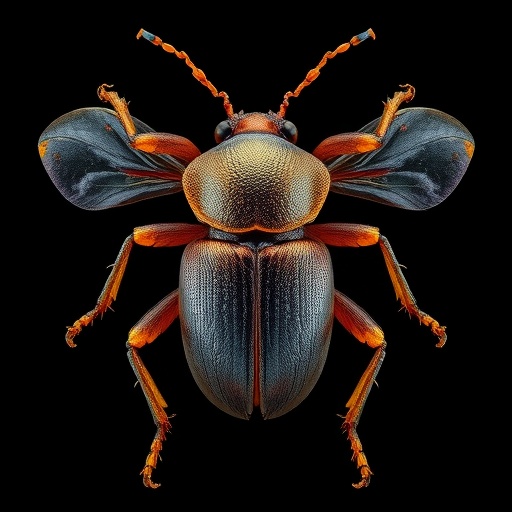
In a groundbreaking study that promises to enhance our understanding of evolutionary biology and mitochondrial genomics, researchers A. Cardoso and J. Gómez-Zurita have unveiled the first complete mitochondrial genome sequences of an ancient orphan evolutionary lineage of Eumolpinae leaf beetles endemic to the South Pacific. This remarkable finding not only establishes a new genetic framework for the species but also provides critical insights into their evolutionary history, ecological roles, and adaptations.
The researchers embarked on this ambitious project to fill significant gaps in the existing knowledge regarding the Eumolpinae subfamily of leaf beetles, which has long puzzled scientists due to its unique evolutionary trajectory. By sequencing the complete mitochondrial genomes, the team aimed to elucidate the phylogenetic relationships between this orphan lineage and other closely related species, potentially shedding light on the processes that drove their evolution within the isolated environments of the South Pacific.
The Eumolpinae leaf beetles are a diverse group, characterized by their distinctive morphology and varied dietary preferences. However, the specific lineage that the study focuses on has remained largely uncharacterized. The mitochondrial genome, often referred to as the “mitogenome,” is an essential tool for understanding genetic variation and evolutionary mechanisms. It contains critical genes responsible for cellular energy production, as well as genes that provide insight into evolutionary relationships through molecular phylogenetics.
In this study, Cardoso and Gómez-Zurita utilized advanced sequencing technologies to obtain high-quality mitochondrial genomes from specimens collected from various South Pacific islands. The comprehensive analysis revealed not only the structural organization of the mitochondrial DNA but also highlighted unique genetic markers that differentiate this lineage from other Eumolpinae beetles. Such distinctions are vital for understanding the evolutionary pressures and environmental conditions that may have shaped their development over millennia.
One of the remarkable aspects of this research is the identification of unique gene arrangements within the mitochondrial genomes. This suggests that the lineage has undergone significant evolutionary changes, possibly in response to the unique ecological niches available in the South Pacific. The findings raise intriguing questions about the evolutionary strategies employed by these beetles to thrive in isolation and adapt to their environments, which often involve limited food sources and specific climatic conditions.
Furthermore, the study emphasizes the importance of conserving such unique biodiversity. The Eumolpinae leaf beetles of the South Pacific play crucial roles in their ecosystems, influencing plant dynamics and contributing to nutrient cycling. Understanding their genetics and evolutionary history is essential not only for academic purposes but also for informing conservation strategies aimed at protecting these endemic species from environmental threats and habitat loss.
The completion of the mitochondrial genomes also opens up new avenues for future research into the evolutionary biology of Eumolpinae. By comparing these genomes with those of other beetle lineages, scientists can investigate deeper questions about the origin of this subfamily and its adaptive radiation throughout different ecosystems. Such comparative studies are vital for reconstructing evolutionary narratives and understanding how species adapt to changing environments over geological time scales.
Moreover, the implications of this study extend beyond the realm of Eumolpinae beetles. It serves as a model for how genomic data can revolutionize our understanding of biodiversity and the evolutionary processes that underlie it. As researchers worldwide increasingly turn to genomic tools, studies like this underscore the significance of mitochondrial genomics in unravelling the complexities of evolutionary histories.
In conclusion, the work of Cardoso and Gómez-Zurita represents a significant contribution to the field of evolutionary genetics and highlights the intricate connections between genetics, ecology, and evolutionary biology. This study not only charts new territory in the understanding of Eumolpinae leaf beetles but also promotes a broader appreciation for the biodiversity found within isolated ecosystems. The findings underscore the need for continued research and conservation efforts aimed at preserving the unique evolutionary legacies represented by such endemic species.
With the full mitochondrial genomic data in hand, scientists are now better equipped than ever to explore the evolutionary dynamics of the Eumolpinae subfamily. This research bears the promise of generating future studies that will investigate ecological interactions and evolutionary mechanisms in more depth, revealing the intricate tapestry of life that unfolds in the South Pacific and beyond.
As researchers continue to build on this foundational work, the quest to understand the enigmas of evolution will undoubtedly gain momentum. The future of evolutionary biology rests on such groundbreaking studies that enhance our comprehension of life’s diversity and the forces that have shaped it.
Cardoso, A., Gómez-Zurita, J. The first complete mitochondrial genome sequences of an ancient orphan evolutionary lineage of Eumolpinae leaf beetles endemic to the South Pacific. BMC Genomics 26, 982 (2025). https://doi.org/10.1186/s12864-025-12170-z
Cite Scienmag News
Juliet Wilcox. (October 31, 2025). Ancient Eumolpinae Beetles’ Mitochondrial Genome Unveiled. Scienmag. https://scienmag.com/ancient-eumolpinae-beetles-mitochondrial-genome-unveiled/
Juliet Wilcox. "Ancient Eumolpinae Beetles’ Mitochondrial Genome Unveiled." Scienmag, 31 October 2025, https://scienmag.com/ancient-eumolpinae-beetles-mitochondrial-genome-unveiled/. Accessed 3 September 2026.
Juliet Wilcox. "Ancient Eumolpinae Beetles’ Mitochondrial Genome Unveiled." Scienmag. October 31, 2025. https://scienmag.com/ancient-eumolpinae-beetles-mitochondrial-genome-unveiled/


