


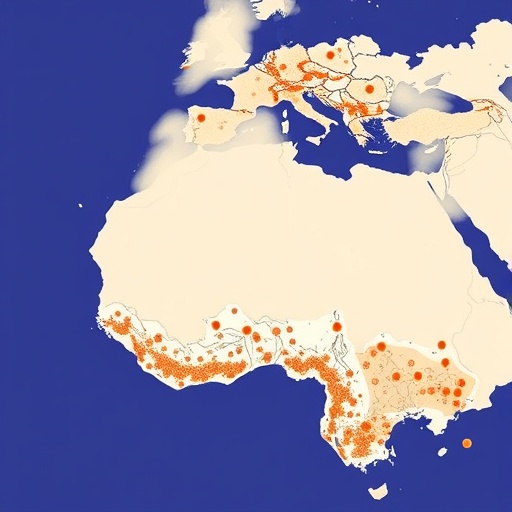
In a groundbreaking study published in the journal Archaeological and Anthropological Sciences, researchers provide unprecedented insights into how ancient communities managed the risks associated with earthquakes. The team, led by archaeologist Andrea Barbieri and his colleagues, has uncovered early evidence of how societal structures and mobility patterns were strategically adjusted in response to seismic threats in the Vale Boi region of Southwest Iberia. This research not only sheds light on the adaptive strategies of prehistoric populations but also opens up discussions regarding the implications for modern-day disaster management.
The Vale Boi site, rich in archaeological artifacts and remnants of ancient settlements, provides a unique window into the behavioral response of communities faced with natural catastrophes. The evidence gathered indicates that these early societies implemented specific strategies aimed at mitigating the impact of seismic events. Such actions exemplify a level of social adaptability that has often been overlooked in discussions surrounding prehistoric resilience to natural disasters. This finding challenges prevailing notions that ancient communities were purely reactive to environmental stresses, revealing a more nuanced understanding of their social dynamics.
Barbieri’s team utilized a combination of archaeological excavation techniques alongside advanced analytical methods to study the artifacts and settlement patterns at Vale Boi. The results indicate significant changes in habitation trends, spatial distribution of resources, and modifications in social networks following seismic events. For instance, changes in the location of settlements suggest that communities moved to safer areas, highlighting an active assessment of risk that underscores human ingenuity in critical moments. Such adaptations reveal a sophisticated understanding of their environment, which is crucial for survival.
The social networks that emerged following these seismic events are equally noteworthy. The researchers found compelling evidence that these ancient populations formed new alliances and cooperative relationships to enhance their resilience. By collaborating and sharing resources, communities were able to buffer the adverse effects of earthquakes, essentially redistributing risk and fostering a supportive environment for recovery. This interconnectedness speaks volumes about the social fabric of prehistoric societies, suggesting that social cohesion played a pivotal role in their collective strategy for managing disasters.
In examining the impact of these strategies on cultural continuity, Barbieri and his colleagues also delved into the rituals and practices that may have accompanied these adaptive shifts. The researchers discovered that the communities not only changed their physical locations and social arrangements but also potentially transformed their cultural expressions, adjusting their practices in ways that reinforced communal bonds. This dynamic interplay between mobility, social structure, and cultural resilience adds valuable depth to our understanding of how ancient peoples navigated the challenges posed by their environment.
The findings from Vale Boi not only contribute to archaeological scholarship but also hold significance for contemporary disaster resilience initiatives. As societies worldwide grapple with the increasing frequency and intensity of natural disasters due to climate change, insights drawn from these ancient practices could inform modern approaches. By understanding how early communities responded to seismic threats, contemporary planners and policymakers can glean valuable lessons about the importance of social networks, community engagement, and adaptive strategies in the face of crisis.
One of the most compelling aspects of the research is the application of technology in uncovering these historical narratives. The integration of Geographic Information Systems (GIS) and remote sensing technologies allowed the researchers to visualize settlement patterns and mobility trends effectively. These innovative methodologies are revolutionizing archaeological research, enabling scholars to draw connections that were not previously possible and leading to richer interpretations of the past. As technology continues to advance, the prospects for understanding ancient human behavior in the context of environmental stressors expand significantly.
In terms of academic discourse, this research pushes the boundaries of traditional archaeological inquiry. It invites scholars across disciplines to engage in dialogues about resilience, adaptation, and the complexities of human-environment interactions. By bringing together perspectives from anthropology, geology, and social sciences, this study illustrates the interdisciplinary nature of contemporary research and underscores the importance of collaborative scholarship in addressing global challenges.
Furthermore, the publication of this research also calls attention to the necessity of preserving archaeological sites like Vale Boi, as they hold the keys to understanding our past. As urban development and environmental degradation threaten such invaluable resources, the imperative to protect these sites for future research becomes even more pressing. The lessons learned from Vale Boi are not just relevant for historians and archaeologists; they have far-reaching implications for how society approaches issues surrounding vulnerability and resilience in the face of natural disasters.
In conclusion, the early evidence presented by Barbieri and his colleagues at Vale Boi marks a significant step forward in our understanding of prehistoric disaster management. Their findings illuminate the importance of mobility, social networks, and cultural practices in shaping community responses to seismic threats. As the world faces increasing geological and environmental challenges, the insights gained from this study resonate more than ever, reminding us that adaptation and resilience are timeless human traits that continue to be vital for thriving amidst uncertainty.
This research not only reshapes perceptions of ancient communities but also contributes to a larger narrative about the human experience in the face of adversity. By examining the past, we can better prepare for the future, drawing connections between historical resilience and contemporary strategies for disaster management. Ultimately, the lessons gleaned from Vale Boi serve as a powerful reminder of the enduring human spirit and our capacity to adapt and thrive in the face of ever-changing challenges.
Barbieri, A., Martínez, J.S., Belmiro, J. et al. Early evidence of earthquake management through mobility and social network adjustments at Vale Boi (SW Iberia). Archaeol Anthropol Sci 18, 25 (2026). https://doi.org/10.1007/s12520-025-02400-6
Cite Scienmag News
Violet Maxwell. (January 20, 2026). Ancient Earthquake Response: Mobility and Networks in Iberia. Scienmag. https://scienmag.com/ancient-earthquake-response-mobility-and-networks-in-iberia/
Violet Maxwell. "Ancient Earthquake Response: Mobility and Networks in Iberia." Scienmag, 20 January 2026, https://scienmag.com/ancient-earthquake-response-mobility-and-networks-in-iberia/. Accessed 3 September 2026.
Violet Maxwell. "Ancient Earthquake Response: Mobility and Networks in Iberia." Scienmag. January 20, 2026. https://scienmag.com/ancient-earthquake-response-mobility-and-networks-in-iberia/


