


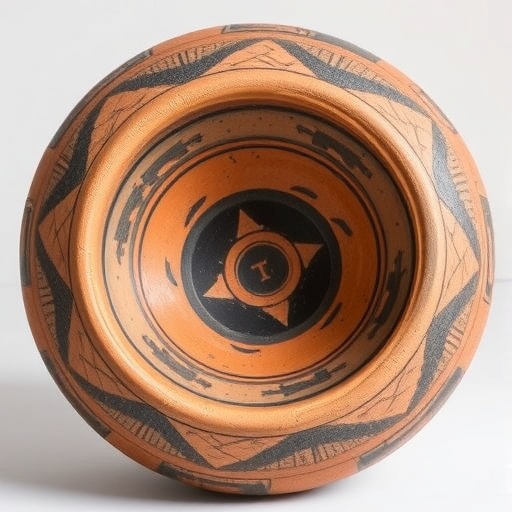
In a groundbreaking study, researchers R. Johnson, J. Nesbitt, and J. Sjödahl focus their attention on the Chavín heartland, specifically examining the village of Canchas Uckro in Ancash, Peru. This area, which saw dynamic social and economic interactions between 1100 and 800 BCE, has been the bedrock of Chavín ceramic production and exchange. The study employs advanced archaeometric techniques that provide insights into the materials, manufacturing processes, and the trade routes that facilitated the widespread distribution of ceramics.
Ceramics have long served as a cultural touchstone for understanding ancient civilizations. In the case of the Chavín civilization, these artifacts are not merely functional objects; they are intricately tied to the social fabric and identity of the community. The authors highlight the significance of utilizing a multidisciplinary approach to assess both the physical and chemical properties of ceramic samples excavated from the site, thereby illuminating their production techniques and exchange networks.
Canchas Uckro, with its strategic location, became a pivotal player in the regional trade. The research team meticulously collected ceramic samples from various contexts and applied techniques such as compositional analysis through neutron activation and petrographic thin-section analysis. These methods allowed the researchers to discern the raw materials used in ceramic production and to identify their provenance, thus revealing not only local crafting techniques but also longer-distance trade networks.
The findings indicate that the Chavín potters used materials harvested from specific geological formations accessible only within certain areas. By tracing the mineralogical and geochemical signatures of the ceramics, the researchers crafted a detailed picture of the distribution of pottery across communities. This information sheds light on the socioeconomic dynamics and the extent of trade relations in the region during a time characterized by significant cultural development.
The study also provides compelling evidence that the exchange of ceramics extended far beyond simple local consumption. The distinct styles and types of ceramics unearthed at Canchas Uckro suggest a variety of influences, signifying interactions with distinct Chavín cultural zones. The intricate designs and forms of ceramics indicate a complex level of artistic expression, which likely served not only functional purposes but also played a role in ceremonial and sociopolitical contexts.
Moreover, the article emphasizes the importance of understanding these cultural artifacts in the context of their role in ritualistic and social practices. The researchers argue that the ceramics found at Canchas Uckro could have held symbolic value, possibly serving as status symbols or as offerings in various rituals. This aspect underscores the interplay between utilitarian objects and their embedded meanings in societal structures at the time.
Throughout the narrative of ceramic production and exchange, the authors evoke a sense of continuity and change within Chavín society. By analyzing the evolution of ceramic styles through comprehensive comparative analysis, they reveal shifting patterns not only in production techniques but also in consumer preferences over generations. Such evolutions reflect broader social transformations, suggesting the presence of cultural exchanges that were influenced by fluctuating sociopolitical landscapes.
In addition to its implications for understanding ancient Chavín practices, the research offers a methodological framework that can be applied to other archaeological sites. The integration of multiple scientific techniques provides a robust basis for interpreting ceramic artifacts, which could open new avenues of exploration in other regions known for their complex historical tapestries.
The study also acknowledges limitations in the current understanding of ceramic exchanges, suggesting that the complexities of ancient economies may not be entirely captured through artifact analysis alone. Historical documents, ethnographic comparisons, and ecological studies may also be necessary to construct a fuller picture of Chavín’s societal dynamics.
Furthermore, the interdisciplinary nature of this research underlines the importance of collaboration among archaeologists, chemists, and historians to foster richer narratives about ancient cultures. As such, this kind of holistic approach promises to reveal intricacies that may have remained obscured in more traditional studies focused solely on artifactual analysis.
With the culmination of the research illustrating vital aspects of Chavín ceramic culture, the authors present their work as not just an academic accomplishment but as a significant contribution to the larger discourse concerning pre-Columbian societies of South America. Their findings spark new questions, encouraging ongoing inquiries into the realm of ancient ceramics, trade networks, and cultural exchanges.
As the landscape of archaeological research continues to evolve, studies like Johnson et al.’s resonate profoundly within academic realms and beyond, fostering a greater understanding of the interconnectedness inherent in ancient civilizations. The implications of this research extend far, making it relevant not only to scholars but also to anyone interested in the intricate tapestry of human history, culture, and economics.
With the potential to inspire future research initiatives, Johnson, Nesbitt, and Sjödahl’s comprehensive study illuminates the pathways of ancient production and exchange, coupling rigorous scientific methodology with the storytelling power of archaeology. As new discoveries await beneath the earth, this research lays the groundwork for subsequent scholars to build upon, ensuring that the legacy of the Chavín civilization remains vibrant and engaging.
In summary, Johnson et al. provide an intricate analysis of ceramic production and exchange in the Chavín heartland, showcasing how advanced techniques can unravel the fabric of ancient societies. Their work underscores the role of pottery not merely as artifacts but as vessels of meaning and context within the ever-evolving story of human culture.
Johnson, R., Nesbitt, J., Sjödahl, J. et al. Ceramic production and exchange in the Chavín heartland: an archaeometric study from Canchas Uckro (1100 − 800 BCE), Ancash, Peru.
Archaeol Anthropol Sci 17, 238 (2025). https://doi.org/10.1007/s12520-025-02333-0
Cite Scienmag News
Courtney Benton. (November 22, 2025). Ancient Ceramics: Insights from Chavín Heartland Study. Scienmag. https://scienmag.com/ancient-ceramics-insights-from-chavin-heartland-study/
Courtney Benton. "Ancient Ceramics: Insights from Chavín Heartland Study." Scienmag, 22 November 2025, https://scienmag.com/ancient-ceramics-insights-from-chavin-heartland-study/. Accessed 3 September 2026.
Courtney Benton. "Ancient Ceramics: Insights from Chavín Heartland Study." Scienmag. November 22, 2025. https://scienmag.com/ancient-ceramics-insights-from-chavin-heartland-study/


