


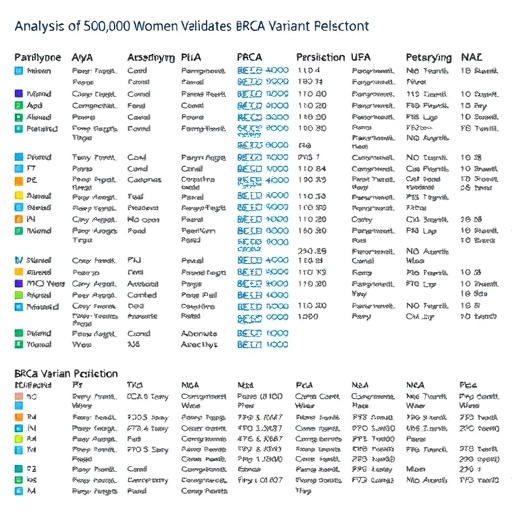
In a monumental advancement for genetic medicine and oncology, a consortium of researchers has published an extensive case-control study analyzing genetic data from over 400,000 women to refine the classification of variants in the BRCA1 and BRCA2 genes. These two genes have long been implicated in hereditary breast and ovarian cancer susceptibility, yet accurately distinguishing harmful mutations from benign variants remains a formidable challenge in clinical genetics. This new research represents a pivotal step towards resolving ambiguity in variant interpretation by leveraging one of the largest datasets ever compiled in this area, thereby providing unequivocal evidence that reshapes our understanding of BRCA1/2 variant pathogenicity.
The study, spearheaded by Zanti, O’Mahony, Parsons, and colleagues, harnesses population-scale genetic screening combined with rigorous epidemiological methods to compare variant frequencies between large cohorts of women with and without breast or ovarian cancers. Unlike previous approaches often constrained by smaller sample sizes or case series, this investigation deploys a case-control design on an unprecedented scale, enabling statistically robust associations between specific BRCA1/2 variants and cancer risk. The sheer breadth of the sample pool—exceeding 400,000 women—affords unparalleled resolution to detect subtle effect sizes and refine the spectrum of genetic risk.
BRCA1 and BRCA2 genes are tumor suppressor genes responsible for DNA repair through the homologous recombination pathway. Mutations that disrupt the function of these genes can precipitate uncontrolled cellular proliferation and oncogenesis, particularly in breast and ovarian tissue. However, not all variants are deleterious; many are benign polymorphisms or variants of uncertain significance (VUS). The inability to decisively categorize these VUS has historically impeded genetic counseling and clinical decision-making, prompting a pressing need for enhanced classification methods grounded in robust empirical datasets.
The researchers analyzed germline DNA sequencing data encompassing diverse populations, ensuring representation that mitigates ethnic biases often observed in genetic studies. They meticulously curated variant call sets and implemented stringent quality control parameters to assure data reliability. Each identified BRCA1 and BRCA2 variant was then cross-referenced against comprehensive clinical phenotypic information, encompassing cancer diagnosis, age at onset, family history, and other relevant covariates, to enable sophisticated case-control comparisons.
Advanced statistical modeling techniques, including logistic regression adjusted for covariates and sophisticated variant burden analyses, formed the analytical backbone. These models quantified the odds ratios of developing breast or ovarian cancer for carriers of specific variants in the BRCA genes relative to non-carriers or carriers of known benign variants. Crucially, this approach provided high-confidence risk estimates that accentuate which variants confer increased susceptibility and which do not, thereby refining prior variant classifications.
One of the salient findings centers on the identification of novel pathogenic variants hitherto classified as uncertain or likely benign. The large sample size empowered the researchers to detect statistically significant associations for numerous rare variants, enabling their re-classification as pathogenic or likely pathogenic. Conversely, a subset of variants previously considered suspicious demonstrated no appreciable association with cancer risk, warranting their categorization as benign. This recalibration of variant interpretation provides a critical update for clinical geneticists and oncologists.
The implications for patient management are profound. Accurate variant classification enables tailored surveillance strategies, prophylactic interventions, and targeted therapies such as PARP inhibitors, which exhibit efficacy in BRCA-mutated cancers. Moreover, it can alleviate undue anxiety in individuals carrying harmless variants and prevent unnecessary medical procedures, ultimately contributing to personalized medicine and precision oncology.
This research also underscores the power of population-scale genomic data combined with rigorous phenotypic characterization to disentangle complex genotype-phenotype relationships. The approach exemplified here sets a new gold standard for variant interpretation in clinically actionable genes beyond BRCA, reinforcing the utility of large-scale biobanks and national genetic screening initiatives in advancing human health.
Importantly, the study addresses longstanding challenges related to variant heterogeneity and pathogenicity classification frameworks. Current guidelines from entities such as the American College of Medical Genetics and Genomics (ACMG) often struggle with ambiguous evidence due to limited datasets. The integration of extensive case-control data surpasses traditional criteria by incorporating allele frequency information contextualized by cancer risk association, thereby enhancing the robustness of clinical variant assessment.
The authors highlight the potential for integrating this refined variant catalog into clinical testing pipelines, fostering harmonization between research findings and diagnostic laboratories. This alignment can expedite the translation of genomic discoveries into actionable clinical insights, informing decision algorithms used by genetic counselors and multidisciplinary care teams worldwide.
Furthermore, the study sheds light on the continuum of cancer risk conferred by different BRCA variants, challenging the binary pathogenic/benign classification. By delineating gradients of risk based on variant type and position within functional domains, the findings pave the way for more nuanced risk stratification models, accommodating a spectrum of penetrance effects that more accurately reflect biological reality.
From a technical perspective, the rigorous bioinformatic pipeline implemented ensures reproducibility and scalability, crucial attributes as genomic datasets continue to grow exponentially. The researchers also emphasize the importance of international data sharing to consolidate variant databases and amplify the power of meta-analyses, catalyzing further discoveries in hereditary cancer genetics.
In conclusion, this landmark study harnesses the scale of population genomics to deliver definitive evidence for the classification of BRCA1 and BRCA2 variants, dismantling barriers that have impeded clinical interpretation for decades. Its extensive size, methodological rigor, and translational potential mark it as a cornerstone contribution to the field of cancer genetics, offering hope for more precise, evidence-based management of cancer risk worldwide. As genomic technologies permeate clinical practice, such comprehensive analyses will be indispensable in fulfilling the promise of precision medicine.
Cite Scienmag News
Juliet Wilcox. (May 25, 2025). Analysis of 400,000 Women Validates BRCA Variant Classification. Scienmag. https://scienmag.com/analysis-of-400000-women-validates-brca-variant-classification/
Juliet Wilcox. "Analysis of 400,000 Women Validates BRCA Variant Classification." Scienmag, 25 May 2025, https://scienmag.com/analysis-of-400000-women-validates-brca-variant-classification/. Accessed 3 September 2026.
Juliet Wilcox. "Analysis of 400,000 Women Validates BRCA Variant Classification." Scienmag. May 25, 2025. https://scienmag.com/analysis-of-400000-women-validates-brca-variant-classification/


