


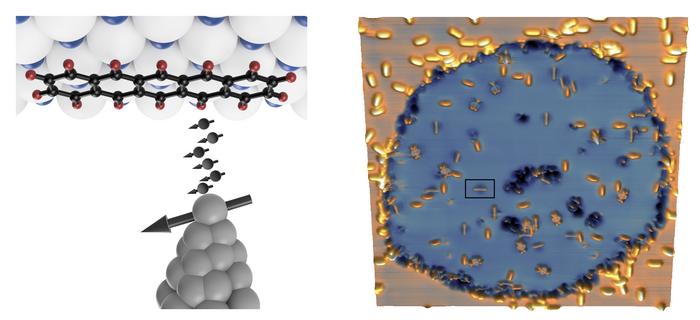
Electrons have an intrinsic angular momentum, the so-called spin, which means that they can align themselves along a magnetic field, much like a compass needle. In addition to the electric charge of electrons, which determines their behaviour in electronic circuits, their spin is increasingly used for storing and processing data. Already now, one can buy MRAM memory elements (magnetic random access memories), in which information is stored in very small but still classical magnets – that is, containing very many electron spins. The MRAM’s are based on currents of electrons with spins aligned in parallel that can change the magnetisation at a particular point in a material.

Credit: (Visualisations: ETH Zürich / Aishwarya Vishwakarma und Stepan Kovarik)
Electrons have an intrinsic angular momentum, the so-called spin, which means that they can align themselves along a magnetic field, much like a compass needle. In addition to the electric charge of electrons, which determines their behaviour in electronic circuits, their spin is increasingly used for storing and processing data. Already now, one can buy MRAM memory elements (magnetic random access memories), in which information is stored in very small but still classical magnets – that is, containing very many electron spins. The MRAM’s are based on currents of electrons with spins aligned in parallel that can change the magnetisation at a particular point in a material.
Pietro Gambardella and his collaborators at ETH Zurich now show that such spin-polarized currents can also be used to control the quantum states of single electron spins. Their results, which have just been published in the scientific journal Science, could be used in different technologies in the future, for instance in the control of quantum states of quantum bits (qubits).
Tunnel currents in single molecules
“Traditionally, electron spins are manipulated using electromagnetic fields such as radio-frequency waves or microwaves”, says Sebastian Stepanow, a Senior Scientist in Gambardella’s laboratory. This technique, also known as electron paramagnetic resonance, was developed already in the mid-1940’s and has since been used in different fields such as materials research, chemistry and biophysics. “A few years ago, it was demonstrated that one can induce electron paramagnetic resonance in single atoms; however, so far the exact mechanism for this has been unclear”, says Stepanow.
To study the quantum mechanical processes behind this mechanism more closely, the researchers prepared molecules of pentacene (an aromatic hydrocarbon) on a silver substrate. A thin insulating layer of magnesium oxide had previously been deposited on the substrate. This layer ensures that the electrons in the molecule behave more or less as they would in free space.
Using a scanning tunnelling microscope, the researchers first characterised the electron clouds in the molecule. This implies measuring the current that is created when the electrons tunnel quantum mechanically from the tip of a tungsten needle to the molecule. According to the laws of classical physics, the electrons should not be able to hop across the gap between the tip of the needle and the molecule because they lack the necessary energy. Quantum mechanics, however, allows the electrons to “tunnel” through the gap in spite of that lack, which leads to a measurable current.
Miniature magnet on the tip of a needle
This tunnel current can be spin-polarised by first using the tungsten tip to pick up a few iron atoms, which are also on the insulating layer. On the tip, the iron atoms create a kind of miniature magnet. When a tunnel current flows through this magnet, the spins of the electrons in the current all align parallel to its magnetisation.
Now, the researchers applied a constant voltage as well as a fast-oscillating voltage to the magnetised tungsten tip, and they measured the resulting tunnel current. By varying the strength of both voltages and the frequency of the oscillating voltage, they were able to observe characteristic resonances in the tunnel current. The exact shape of these resonances allowed them to draw conclusions about the processes that occurred between the tunnelling electrons and those of the molecule.
Direct spin control by polarised currents
From the data, Stepanow and his colleagues were able to glean two insights. On the one hand, the electron spins in the pentacene molecule reacted to the electromagnetic field created by the alternating voltage in the same way as in ordinary electron paramagnetic resonance. On the other hand, the shape of the resonances suggested that there was an additional process that also influenced the spins of the electrons in the molecule.
“That process is the so-called spin transfer torque, for which the pentacene molecule is an ideal model system”, says PhD student Stepan Kovarik. Spin transfer torque is an effect in which the spin of the molecule is changed under the influence of a spin-polarised current without the direct action of an electromagnetic field. The ETH researchers demonstrated that it is also possible to create quantum mechanical superposition states of the molecular spin in this way. Such superposition states are used, for instance, in quantum technologies.
“This spin control by spin-polarised currents at the quantum level opens up various possible applications”, says Kovarik. In contrast to electromagnetic fields, spin-polarised currents act very locally and can be steered with a precision of less than a nanometre. Such currents could be used to address electronic circuit elements in quantum devices very precisely and thus, for instance, control the quantum states of magnetic qubits.
Journal
Science
Article Title
Spin torque–driven electron paramagnetic resonance of a single spin in a pentacene molecule
Cite Scienmag News
Katie Riggs. (July 2, 2024). An alternative way to manipulate quantum states. Scienmag. https://scienmag.com/an-alternative-way-to-manipulate-quantum-states/
Katie Riggs. "An alternative way to manipulate quantum states." Scienmag, 2 July 2024, https://scienmag.com/an-alternative-way-to-manipulate-quantum-states/. Accessed 3 September 2026.
Katie Riggs. "An alternative way to manipulate quantum states." Scienmag. July 2, 2024. https://scienmag.com/an-alternative-way-to-manipulate-quantum-states/

