


Imagine a thin film, just nanometers thick, that could store gigabytes of data – enough for movies, video games, and videos. This is the exciting potential of ferroelectric materials for memory storage. These materials have a unique arrangement of ions, resulting in two distinct polarization states analogous to 0 and 1 in binary code, which can be used for digital memory storage. These states are stable, meaning they can ‘remember’ data without power, and can be switched efficiently by applying a small electric field. This property makes them extremely energy-efficient and capable of fast read and write speeds. However, some well-known ferroelectric materials, such as Pb(Zr,Ti)O3 (PZT) and SrBi2Ta2O9, degrade and lose their polarization when exposed to heat treatment with hydrogen during fabrication.

Credit: TOKYO INSTITUTE OF TECHNOLOGY
Imagine a thin film, just nanometers thick, that could store gigabytes of data – enough for movies, video games, and videos. This is the exciting potential of ferroelectric materials for memory storage. These materials have a unique arrangement of ions, resulting in two distinct polarization states analogous to 0 and 1 in binary code, which can be used for digital memory storage. These states are stable, meaning they can ‘remember’ data without power, and can be switched efficiently by applying a small electric field. This property makes them extremely energy-efficient and capable of fast read and write speeds. However, some well-known ferroelectric materials, such as Pb(Zr,Ti)O3 (PZT) and SrBi2Ta2O9, degrade and lose their polarization when exposed to heat treatment with hydrogen during fabrication.
In a study published in the journal Applied Physics Letters, a research team led by Assistant Professor Kazuki Okamoto and Hiroshi Funakubo at Tokyo Institute of Technology (Tokyo Tech), in collaboration with Canon ANELVA Corporation and Japan Synchrotron Radiation Research Institute (JASRI), has shown that aluminum scandium nitride (AlScN) ferroelectric films remain stable and maintain their ferroelectric properties at temperatures up to 600°C.
“Our results attest to the high stability of the ferroelectricity of the films subjected to heat treatment in hydrogen-included atmosphere, regardless of the electrode material. This is a highly promising result for next-generation ferroelectric memory devices and offers more processing options,” says Funakubo.
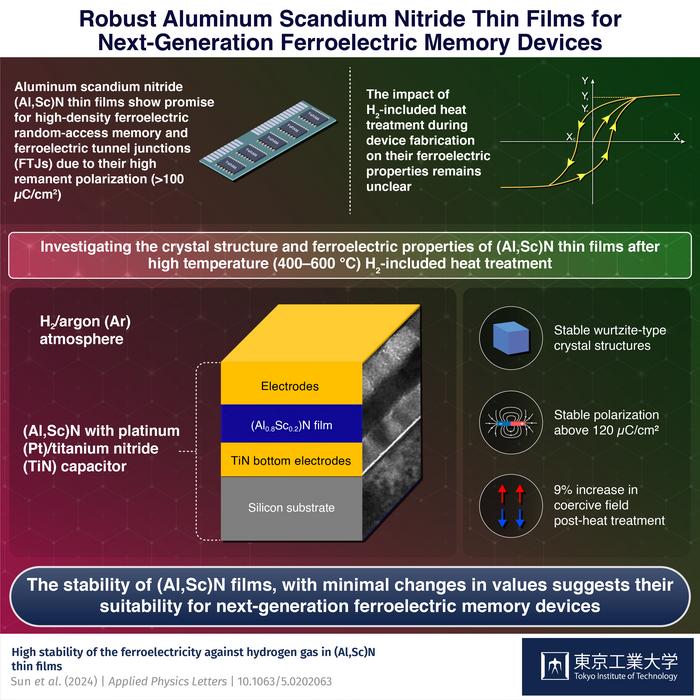
For ferroelectric materials to be compatible with high-temperature fabrication processes under an H2-included atmosphere, they ideally should experience little to no degradation in their crystal structure and ferroelectric properties. Two crucial parameters in this regard are remnant polarization (Pr) and coercive field (Ec). Pr refers to the polarization retained after removing the electric field, while Ec is the electric field required to switch the material’s polarization state. AlScN has a higher Pr (>100 µC/cm²) than PZT (30–50 µC/cm²). However, the impact of heat treatment under an H2-included atmosphere on its properties was unclear until now.
To investigate this, the researchers deposited (Al0.8Sc0.2)N film on a silicon substrate using sputtering at 400°C. The films were placed between two electrodes of platinum (Pt) and titanium nitride (TiN). Electrodes play a crucial role in the material’s stability. Pt encourages the incorporation of hydrogen gas into the film, while TiN acts as a barrier to H₂ diffusion. So, evaluating its performance with different electrode materials is crucial.
The films underwent post-heat-treatment in a hydrogen and argon atmosphere for 30 minutes at temperatures ranging from 400 to 600 °C at 800 Torr. The researchers used X-ray diffraction (XRD) to examine changes in the crystal structure in the bulk and the film-electrode interface. Positive-up-negative-down (PUND) measurements were used to evaluate Pr and Ec. This technique involves applying positive and negative electric fields to the film and observing the resulting polarization response.
The films maintained a stable wurtzite-type crystal structure. Pr remained stable above 120 µC/cm², regardless of the electrode or treatment atmosphere, a value five times larger than HfO2-based films and three times larger than that of PZT. Furthermore, Ec increased only slightly by about 9%. This increase was attributed to changes in the film’s crystal lattice constant not due to the presence of hydrogen or the choice of electrode used. Notably, unlike other ferroelectric materials susceptible to hydrogen diffusion, the high bond energy between Al and N prevents hydrogen from penetrating the film.
“The results show that (Al0.8Sc0.2)N is much more resistant to degradation by post-heat treatment than conventional ferroelectric and HfO₂-based ferroelectric films,” says Funakubo. With a relatively stable crystal structure, a high Pr value, and a small change in Ec, (Al,Sc)N films are a promising candidate for next-generation ferroelectric memory devices.
###
About Tokyo Institute of Technology
Tokyo Tech stands at the forefront of research and higher education as the leading university for science and technology in Japan. Tokyo Tech researchers excel in fields ranging from materials science to biology, computer science, and physics. Founded in 1881, Tokyo Tech hosts over 10,000 undergraduate and graduate students per year, who develop into scientific leaders and some of the most sought-after engineers in industry. Embodying the Japanese philosophy of “monotsukuri,” meaning “technical ingenuity and innovation,” the Tokyo Tech community strives to contribute to society through high-impact research.
Institute of Science Tokyo (Science Tokyo) will be established on October 1, 2024, following the merger between Tokyo Medical and Dental University (TMDU) and Tokyo Institute of Technology (Tokyo Tech), with the mission of “Advancing science and human wellbeing to create value for and with society.”
Journal
Applied Physics Letters
Method of Research
Experimental study
Subject of Research
Not applicable
Article Title
High stability of the ferroelectricity against hydrogen gas in (Al,Sc)N thin films
Article Publication Date
15-Jul-2024
Cite Scienmag News
Violet Maxwell. (July 22, 2024). Aluminum scandium nitride films: Enabling next-gen ferroelectric memory devices. Scienmag. https://scienmag.com/aluminum-scandium-nitride-films-enabling-next-gen-ferroelectric-memory-devices/
Violet Maxwell. "Aluminum scandium nitride films: Enabling next-gen ferroelectric memory devices." Scienmag, 22 July 2024, https://scienmag.com/aluminum-scandium-nitride-films-enabling-next-gen-ferroelectric-memory-devices/. Accessed 3 September 2026.
Violet Maxwell. "Aluminum scandium nitride films: Enabling next-gen ferroelectric memory devices." Scienmag. July 22, 2024. https://scienmag.com/aluminum-scandium-nitride-films-enabling-next-gen-ferroelectric-memory-devices/

