


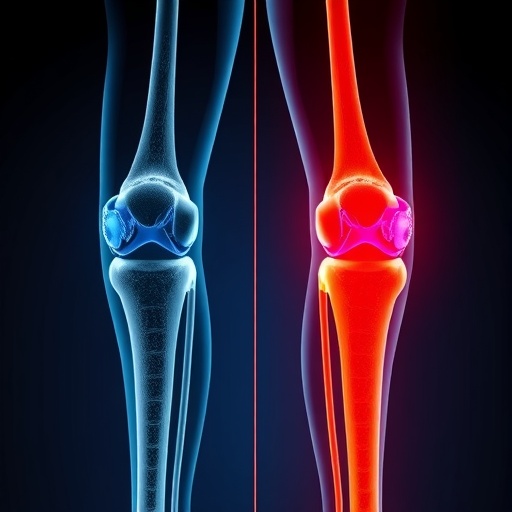
In a groundbreaking advancement in orthopedic care, researchers at Dell Medical School, part of The University of Texas at Austin, have unveiled a novel AI-powered decision-making tool that significantly enhances patient outcomes in knee replacement surgeries. This innovative technology, detailed in a forthcoming publication in Lancet eClinicalMedicine, capitalizes on artificial intelligence to create personalized digital twins of patients, thereby transforming clinical decision-making into a more precise, individualized process.
The digital twin concept involves constructing a sophisticated virtual replica of a patient’s knee based on comprehensive health data inputs. This model simulates how the individual’s knee osteoarthritis might progress under various treatment scenarios, including surgical and non-surgical options. The AI leverages machine learning algorithms trained on vast datasets to predict probable outcomes, risks, and benefits with remarkable accuracy. This approach is a substantial departure from traditional methods, which often rely on generalized statistics and clinician experience without granular personalization.
The clinical trial underpinning this research enrolled over 200 participants diagnosed with advanced knee osteoarthritis at the Musculoskeletal Institute at UT Health Austin. Participants were randomly assigned either to a control group receiving standard educational materials or to an intervention group utilizing the AI-based decision aid. The findings were compelling—those engaging with the AI tool reported markedly higher decision quality and expressed significantly less decisional regret. Importantly, these patients demonstrated superior functional knee outcomes in the six to nine months following their consultations.
Unlike conventional educational tools that provide broad, non-specific data on knee osteoarthritis treatment options, the AI-driven system facilitates a guided, interactive decision-making process. It allows patients to visualize potential surgical outcomes tailored to their unique physiology and medical history. This clarity helps patients articulate their treatment preferences more effectively and align their chosen interventions with personal health goals, whether that entails opting for knee replacement surgery or pursuing conservative therapies.
Dr. Prakash Jayakumar, the lead author and a surgical faculty member at Dell Med, emphasizes that this technology is designed to augment, not replace, clinical judgment. “Our goal is to empower patients with data-driven insights in a digestible format, enabling them to take an active role in their treatment choices,” he explains. This melding of AI analytics with human-centered care represents a significant evolution in managing chronic musculoskeletal conditions.
The AI model’s predictive capabilities stem from analyzing multidimensional health variables such as age, body mass index, comorbid conditions, and biomechanical factors. Machine learning techniques calibrate these inputs to forecast individualized surgical risks including infection rates, prosthesis longevity, and rehabilitation timelines. Concurrently, the tool assesses expected improvements in knee function and quality of life metrics post-treatment. This dual focus on risk minimization and benefit maximization exemplifies precision medicine in orthopedic surgery.
Patient feedback corroborates the tool’s efficacy. Those using the AI aid felt more confident entering into shared decision-making consultations with their healthcare providers. Notably, decisional conflict scores were substantially lower in the digital twin group, highlighting a reduction in uncertainty and anxiety typically associated with major surgery deliberations. The improved psychological readiness likely contributed to enhanced engagement in postoperative rehabilitation protocols, thereby boosting functional recovery.
This study’s outcomes also carry far-reaching implications for healthcare systems aiming to optimize resource allocation and patient satisfaction. By aligning treatments more closely with individual goals and predictive outcomes, unnecessary surgeries and suboptimal interventions may be reduced. This personalized approach supports value-based care principles by improving efficacy while potentially curbing costs associated with complications and revisions.
The integration of AI decision aids into routine clinical workflows, particularly for heterogeneous diseases like osteoarthritis where patient responses to treatments vary widely, represents a paradigm shift. Traditional decision aids lack the granularity needed to tailor recommendations effectively, whereas digital twins incorporate real-time data analytics for dynamic, adaptive guidance. This advancement aligns with broader trends in digital health technologies ushering in an era of smarter, more patient-centric medicine.
Future iterations of this technology might expand beyond knee osteoarthritis to other chronic conditions requiring complex decision-making frameworks. Moreover, ongoing refinement of AI models through continuous learning and increased data diversity will enhance predictive accuracy and generalizability. Researchers also anticipate that combining digital twin technology with emerging fields such as wearable sensor data and genomics could further revolutionize individualized care pathways.
Ultimately, this pioneering randomized clinical trial confirms that AI-driven decision support can democratize healthcare information and empower patients more fully in their treatment journeys. By fusing cutting-edge computational models with empathetic clinical practices, it marks a major milestone toward achieving optimized, personalized outcomes in orthopedic surgery and beyond.
Cite Scienmag News
Ophelia Keating. (October 30, 2025). AI-Powered Digital Twins Enhance Patient Decision-Making for Knee Surgery, Study Shows. Scienmag. https://scienmag.com/ai-powered-digital-twins-enhance-patient-decision-making-for-knee-surgery-study-shows/
Ophelia Keating. "AI-Powered Digital Twins Enhance Patient Decision-Making for Knee Surgery, Study Shows." Scienmag, 30 October 2025, https://scienmag.com/ai-powered-digital-twins-enhance-patient-decision-making-for-knee-surgery-study-shows/. Accessed 3 September 2026.
Ophelia Keating. "AI-Powered Digital Twins Enhance Patient Decision-Making for Knee Surgery, Study Shows." Scienmag. October 30, 2025. https://scienmag.com/ai-powered-digital-twins-enhance-patient-decision-making-for-knee-surgery-study-shows/


