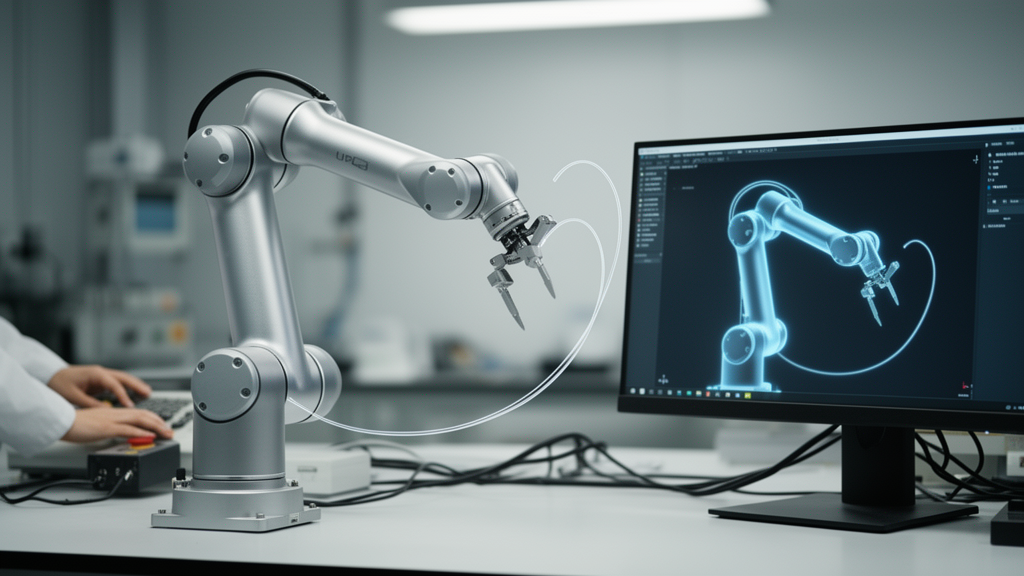
Researchers have assembled a single, end-to-end framework that teaches a computer to predict the torques a six-degree-of-freedom UR5 industrial manipulator needs for any given motion, and then pushes those predictions through adaptive control, optimization, stability analysis and sensorless torque estimation. The study, published as an open-access research article in Discover Artificial Intelligence, reports that Gaussian Process Regression delivered the most accurate torque predictions, with a root-mean-square error of 7.87 Nm and a coefficient of determination of 0.892, while a Deep Neural Network followed with an RMSE of 11.90 Nm and an R² of 0.753. Crucially, the entire pipeline was validated in simulation rather than on physical hardware, a limitation the authors state explicitly and repeatedly.
Inverse dynamics is the mathematical heart of robot motion control. It maps joint positions, velocities and accelerations to the torques required to realize a desired trajectory. Classical approaches derive this mapping from Newton–Euler or Lagrangian mechanics under rigid-body assumptions, but real robots exhibit nonlinear friction, actuator dynamics, structural flexibility and parameter uncertainties that idealized models fail to capture. Because inverse dynamics directly influences motion tracking, control precision and interaction safety, the authors argue that learning-based complements to analytical models deserve systematic evaluation rather than isolated demonstrations of prediction accuracy.
The experimental platform was a UR5 collaborative manipulator modeled in MATLAB’s Robotics System Toolbox, with ground-truth torques computed by the toolbox’s inverseDynamics function, which implements the recursive Newton–Euler formulation. The team generated 5,000 samples from sinusoidal joint trajectories lasting five seconds each, sampled at 0.01-second intervals, producing 18 input features and six torque outputs. Four thousand samples trained the models and 1,000 were held out for testing, with 10-fold cross-validation. Gaussian noise at three levels, corresponding to signal-to-noise ratios of 40.93, 31.39 and 26.94 dB, was injected to mimic sensor imperfections. Residual validation on the test split showed an overall RMSE of 0.2551 Nm with a mean residual of 0.0001 Nm, and Kolmogorov–Smirnov tests confirmed the residuals were statistically consistent with the intended noise model.
Three regression architectures were trained independently for each joint. The Deep Neural Network used four hidden layers of 64, 128, 64 and 32 neurons with batch normalization, ReLU activation and dropout, trained for 300 epochs with the Adam optimizer and a piecewise learning-rate schedule. The Type-2 Fuzzy system compressed its inputs with principal component analysis to at most four components preserving 95 percent of the variance, yielding an initial rule base of 81 rules per joint that particle swarm optimization then pruned to roughly 65 to 80 rules. Gaussian Process Regression, a nonparametric Bayesian method with a squared-exponential kernel, required minimal hyperparameter tuning and, notably, less than half the training time of the neural network while also producing per-prediction uncertainty estimates.
The model comparison produced a clear hierarchy. GPR achieved the best overall accuracy, explaining 89.2 percent of torque variance, and the DNN remained closely comparable, but the Type-2 Fuzzy System lagged substantially with an RMSE of 29.27 Nm, a shortfall the authors attribute to the PCA-compressed rule base struggling with highly nonlinear, coupled joint dynamics. Joint-wise analysis revealed a consistent pattern: Joint 1, the base rotation axis, showed the largest errors for every model because it experiences the widest motion range and the strongest dynamic coupling with all downstream links, while distal joints such as Joint 4 and Joint 6 were predicted far more accurately. Even for the troublesome base joint, DNN and GPR held errors to 15.39 and 16.67 Nm respectively, whereas the fuzzy system rose sharply to 46.17 Nm.
A practical wrinkle shaped the control experiments: although GPR won the offline accuracy contest, the team selected the DNN as the feedforward model inside the closed-loop controller. The reason is computational. GPR inference cost scales with the size of the training set because every prediction requires evaluating kernel functions against stored training points, whereas a neural network performs a fixed-cost forward pass regardless of dataset size. For a control loop demanding low-latency evaluation at every timestep, that distinction proved decisive, and GPR’s strengths were instead reserved for prediction-focused tasks such as sensorless torque estimation.
The adaptive controller combined the learned feedforward torque with proportional-derivative feedback and an online-updated scalar adaptive gain. With manually chosen gains of Kp = 80 and Kd = 16, the controller achieved a tracking RMSE of 0.04735 rad with a maximum error of 0.2696 rad, while commanded torques stayed within physically realistic bounds for the UR5. Particle swarm optimization then tuned the gains under a multi-objective formulation balancing tracking error against control energy, using 30 particles over 50 iterations. The result was a tracking RMSE reduced to 0.0238 rad, a 49.77 percent improvement, achieved alongside a 5.41 percent reduction in control energy, meaning accuracy and efficiency improved together rather than trading off. The authors note candidly that the optimized proportional gains for Joints 1 through 3 hit the upper bound of the search space, so the true optimum may lie beyond the tested range.
Stability verification used two complementary lenses. A Lyapunov energy function remained bounded over the simulated trajectory but settled into bounded oscillation rather than decaying monotonically to zero, a behavior the authors characterize as uniformly ultimately bounded tracking error, consistent with theory for adaptive PD-type controllers without integral action tracking periodic references. Frequency-domain analysis, conducted under the idealized assumption of perfect feedforward cancellation, yielded a phase margin of 73.56 degrees, with the open-loop phase never crossing minus 180 degrees in the analyzed range, implying an effectively unbounded gain margin under that linearized representation. The Nyquist plot confirmed the open-loop locus did not encircle the critical point. The authors stress that this analysis does not capture residual coupling from the learned feedforward’s approximation error.
The sensorless component may prove the most immediately useful result. Because direct torque sensing adds cost and complexity, the team built a model-based observer that reconstructs joint torques from the learned dynamics and joint motion alone. Without compensation, the estimation RMSE was 12.29 Nm; with a compensation factor of 0.7 to suppress high-frequency noise, it fell to 3.69 Nm, an approximately 70 percent improvement in estimation accuracy. The authors suggest this indicates potential feasibility for deployment without torque sensors, though they tie even this claim to pending hardware validation.
The study’s most valuable quality may be its honesty about scope. The authors emphasize that internal statistical consistency of a synthetic dataset does not establish equivalence to physical measurements, and that idealized Gaussian noise fails to capture actuator and gearbox friction, backlash, encoder quantization, joint compliance, thermal effects, payload variation and model-plant mismatch. They list concrete deployment challenges, from recalibrating noise assumptions to evaluating GPR inference time against real control-loop rates and incorporating torque saturation limits and fault detection. The framework, they conclude, should be read as evidence of methodological coherence, connecting inverse dynamics learning to control validation, optimization, stability analysis and sensorless estimation in one workflow, with experimental validation on a physical UR5 platform identified as the necessary next step before any claim of real-world performance.
Subject of Research: AI-based inverse dynamics modelling, adaptive control and sensorless torque estimation for a 6-DOF UR5 manipulator, validated in simulation
Article Title: A systematic AI-based approach for inverse dynamics modelling and validation on UR5 manipulator
Article References: Nataraj, S. K. (2026). A systematic AI-based approach for inverse dynamics modelling and validation on UR5 manipulator. Discover Artificial Intelligence, 6(1), Article 1000. https://doi.org/10.1007/s44163-026-02076-4
Image Credits: AI Generated
DOI: 10.1007/s44163-026-02076-4
Keywords: inverse dynamics, UR5 manipulator, Gaussian Process Regression, deep neural networks, adaptive control, particle swarm optimization, Lyapunov stability, sensorless torque estimation, Type-2 fuzzy systems, robotics, simulation study, trajectory tracking
Cite Scienmag News
Denise Maddox. (October 27, 2026). AI Learns Robot Arm Dynamics in Simulation, Halving Tracking Error on a UR5 Manipulator. Scienmag. https://scienmag.com/ai-learns-robot-arm-dynamics-in-simulation-halving-tracking-error-on-a-ur5-manipulator/
Denise Maddox. "AI Learns Robot Arm Dynamics in Simulation, Halving Tracking Error on a UR5 Manipulator." Scienmag, 27 October 2026, https://scienmag.com/ai-learns-robot-arm-dynamics-in-simulation-halving-tracking-error-on-a-ur5-manipulator/. Accessed 2 November 2026.
Denise Maddox. "AI Learns Robot Arm Dynamics in Simulation, Halving Tracking Error on a UR5 Manipulator." Scienmag. October 27, 2026. https://scienmag.com/ai-learns-robot-arm-dynamics-in-simulation-halving-tracking-error-on-a-ur5-manipulator/