


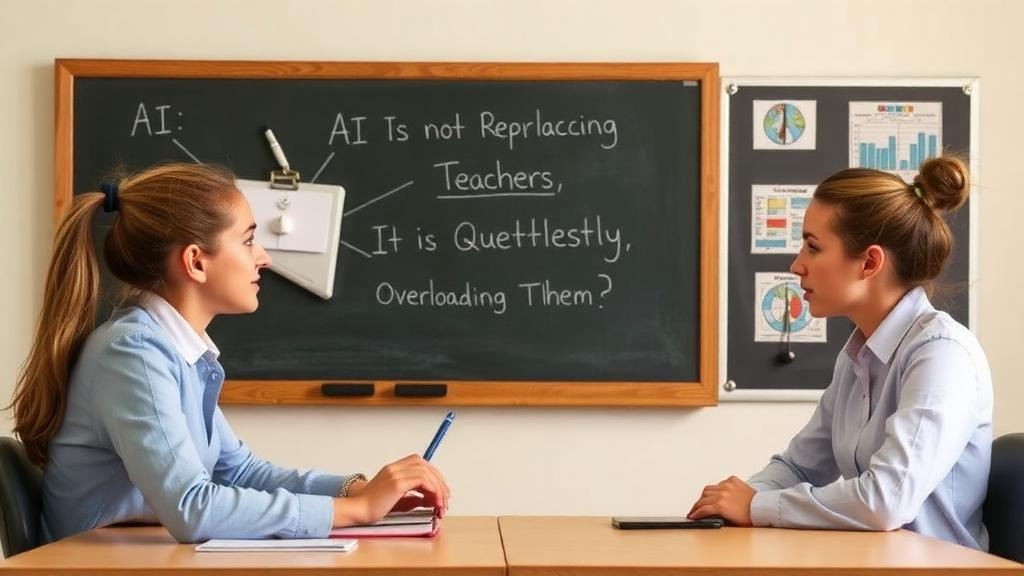
For nearly three years, the loudest question in educational technology has been blunt: will artificial intelligence replace the teacher? A new conceptual analysis published in Discover Education argues that this question is not merely premature but analytically wrong. Researchers Xufeng Zhang and Han Li contend that large language models are not erasing teacher authority at all. Instead, they are reorganizing it, shifting its foundations from knowledge possession toward a set of more demanding professional capacities, while simultaneously transferring responsibility downward onto teachers who do not control the systems reshaping their classrooms.
The argument begins with a simple observation about what generative AI actually destabilizes. In traditional classrooms, part of a teacher’s legitimacy rested on comparative informational advantage: disciplinary command, curricular gatekeeping, and the practical ability to be the fastest credible explainer in the room. When students can now summon plausible explanations, summaries, translations, and draft arguments in seconds, that informational scarcity collapses. But the authors insist that authority does not vanish with it. It migrates. What changes is not the need for authority but the basis of its legitimacy, a distinction that reframes the entire debate about AI in schools.
Zhang and Li identify three forms of authority that become newly central in AI-mediated classrooms. The first is epistemic-arbitration authority: the recognized right to judge whether generated content should count as educationally valid. Large language models produce text that is locally coherent yet potentially misleading, biased, or epistemically shallow, because their outputs are probabilistic compositions rather than statements grounded in disciplinary accountability. A model may simplify an idea so efficiently that students feel they understand it while bypassing the conceptual struggle through which understanding is actually built. Teachers must therefore arbitrate not only truth but epistemic quality, distinguishing fast plausibility from warranted claim-making.
The second form is pedagogical-orchestration authority, the power to decide when, where, and under what constraints AI may enter a learning sequence. The educational value of these tools is intensely task-dependent: a model may helpfully generate multiple examples after students have met a concept, yet undermine learning if used before students grapple with first principles. Crucially, the authors argue, orchestration includes the authority to refuse AI. Deciding that an exercise should cultivate memory, slow reading, or dialogic reasoning without algorithmic assistance is not anti-technology reflex but curricular judgement, and it requires what the researchers call boundary-setting competence, the professional ability to justify when AI use should be limited, delayed, scaffolded, or excluded.
The third form, normative-accountability authority, covers the ethical and civic dimensions of teaching under AI conditions: academic integrity, fairness, inclusion, data protection, safeguarding, and the defense of education’s public purposes. Responsible AI scholarship consistently identifies these as contextual rather than merely computational concerns. A platform may offer moderation filters and disclaimers, but it never assumes the situated responsibility of deciding whether a generated example reproduces stereotypes, whether a student’s reliance on AI erodes learning, or whether a tool is appropriate for vulnerable learners. Those questions return, always, to teachers and school leaders, even when the underlying infrastructure is privately owned.
To name the hidden work these new authorities demand, the paper introduces a striking concept: judgement labour. Drawing an analogy to emotional labour, the authors distinguish professional judgement, a capacity, from judgement labour, a labour process through which that capacity is repeatedly required, intensified, and often left unrecognized. They break it into six dimensions: verification labour, checking facts and fabricated references; orchestration labour, redesigning tasks so learning remains visible; translation labour, converting abstract policy into concrete classroom rules; refusal labour, defending pedagogical non-use in innovation-obsessed environments; ethical mediation labour, intervening when outputs encode bias or deepen inequality; and continuing AI-learning labour, keeping pace with model updates that can invalidate prior knowledge overnight.
The evidence for intensification is already visible in policy and trials. The UK Department for Education acknowledges that generative AI can help with lesson preparation but insists that professionals remain finally responsible for the accuracy, legality, and quality of outputs. A major trial by the Education Endowment Foundation found that teachers using ChatGPT alongside guidance cut lesson-planning time by more than thirty percent, yet showed no clear improvement in lesson quality, and the time savings did not eliminate the need for expert oversight. AI may shorten the time needed to produce a draft, the authors note, but not the time needed to determine whether that draft is educationally sound.
Beneath these dynamics lies the paper’s sharpest political claim: an authority-responsibility asymmetry driven by platform governance. Citing work on platform power in education, Zhang and Li argue that private companies increasingly shape the conditions of teaching through interface defaults, moderation policies, model updates, data retention rules, subscription tiers, and procurement contracts. Algorithmic decisions can function as de facto policy decisions, made with substantial public consequences but limited public oversight. When something goes wrong, a fabricated source, a biased example, a privacy breach, the teacher is the actor nearest to the event and most likely to be blamed or expected to repair the damage. Power moves upward; responsibility moves downward.
The asymmetry operates along four channels. Epistemically, providers generate content at scale but never bear the obligation to ensure a specific explanation suits a specific classroom. Ethically, teachers manage bias and disclosure in concrete interactions that terms of service cannot reach. Organizationally, adoption often begins through informal experimentation, with teachers becoming local implementers and troubleshooters; research describing teachers’ covert generative AI use as a ‘dirty little secret’ reflects exactly this institutional vacuum. Politically, public schools remain answerable to parents, inspectors, and legal standards, while vendors iterate through opaque updates that teachers encounter before their institutions can respond.
The authors’ conclusion is deliberately unsentimental. They do not argue that teachers are irreplaceable as a matter of rhetoric; they argue that the real danger is quieter than replacement. Unless procurement rules, transparency requirements, audit rights, workload models, and teacher education catch up, the likely outcome is the continued privatization of infrastructural power alongside the public intensification of teachers’ responsibility, with ‘human in the loop’ becoming a euphemism for unfunded human liability. A human-centred future for education, the paper suggests, cannot be secured by assurances that teachers matter. It requires governance arrangements that align authority with responsibility, before the gap between them becomes permanent.
Subject of Research: The reorganization of teacher authority and responsibility in generative AI-supported classrooms
Article Title: Teacher authority, responsibility, and platform governance in generative AI-supported classrooms
Article References: Zhang, X., & Li, H. (2026). Teacher authority, responsibility, and platform governance in generative AI-supported classrooms. Discover Education, 5(1), Article 1040. https://doi.org/10.1007/s44217-026-02214-1
Image Credits: AI Generated
DOI: 10.1007/s44217-026-02214-1
Keywords: generative AI, teacher authority, judgement labour, platform governance, postdigital education, AI literacy, assessment, responsible AI, teacher agency, education policy, large language models, accountability
Cite Scienmag News
Courtney Benton. (October 5, 2026). AI Is Not Replacing Teachers. It Is Quietly Overloading Them. Scienmag. https://scienmag.com/ai-is-not-replacing-teachers-it-is-quietly-overloading-them/
Courtney Benton. "AI Is Not Replacing Teachers. It Is Quietly Overloading Them." Scienmag, 5 October 2026, https://scienmag.com/ai-is-not-replacing-teachers-it-is-quietly-overloading-them/. Accessed 5 October 2026.
Courtney Benton. "AI Is Not Replacing Teachers. It Is Quietly Overloading Them." Scienmag. October 5, 2026. https://scienmag.com/ai-is-not-replacing-teachers-it-is-quietly-overloading-them/


