


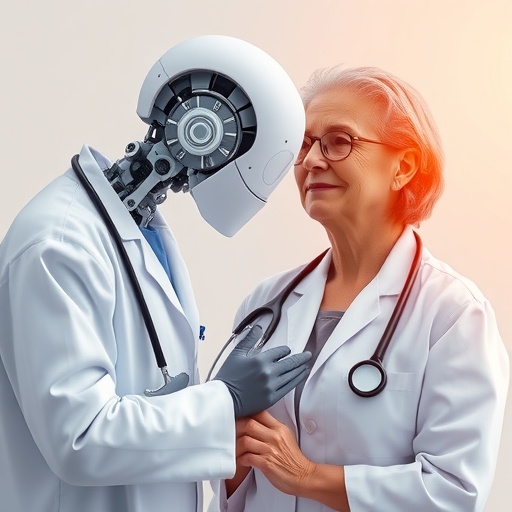
In recent years, the integration of machine learning into healthcare has revolutionized how we understand and improve patient experiences. The study conducted by Marks, Baptista, Gaines, and colleagues, published in the Journal of General Internal Medicine, delves into this evolution by specifically investigating the connection between physician actions and the patient experience of compassion. Through this innovative research, a deeper comprehension of compassion in medical interactions emerges, shedding light on the potential for machine learning to transform healthcare practices.
The researchers’ inquiry is particularly timely, as healthcare systems worldwide grapple with patient satisfaction and the efficacy of compassionate care amid rising demands and limited resources. By focusing on physician actions, the study aims to bridge a gap in understanding how specific behaviors influence patients’ perceptions and their overall experiences in clinical settings. Compassionate communication not only enhances patient satisfaction but is also linked to improved health outcomes, making it an essential focus for healthcare providers.
Machine learning serves as an essential tool in this research, a method capable of processing vast datasets to identify patterns that may escape conventional analytical approaches. The study utilizes advanced algorithms to parse through extensive patient feedback and electronic health records. This data-driven exploration allows researchers to pinpoint which physician actions resonate most positively with patients, enabling healthcare providers to refine their practices based on quantifiable insights.
Central to this research is the concept of compassion itself. Traditionally, compassion in healthcare has been viewed as a qualitative aspect of patient-provider interactions—one that is often difficult to quantify. However, with machine learning and data mining, the complexity of emotional interactions within healthcare settings can be distilled into actionable data. The research aims to categorize physician actions, ranging from verbal communication to physical gestures, and assess their correlation with patient-reported experiences of compassion.
One compelling aspect of the study is its focus on real-world applications. As healthcare continues to evolve with the advent of telemedicine and digital interaction, understanding compassion within these new modalities is critical. The findings from this research could offer valuable insights for virtual consultations, where non-verbal cues may be diminished, and establishing a compassionate rapport becomes even more crucial.
Moreover, the use of machine learning in identifying compassionate actions may lead to the development of targeted training programs for physicians. By understanding which actions are most effective in conveying empathy and understanding, medical institutions can enhance their educational initiatives. This could ultimately create a new generation of healthcare providers equipped not only with clinical expertise but also a profound ability to connect with patients on a human level.
The study’s implications extend beyond individual interactions; they may influence broader healthcare policies. With the importance of compassion being underscored in modern medicine, this research could support the advocacy for systemic changes aimed at promoting empathetic care as a cornerstone of healthcare delivery. By substantiating the importance of compassion through data, advocates can push for policies that prioritize compassionate care in clinical settings, fostering an environment where patients feel valued and understood.
Ethical considerations arise from utilizing machine learning in healthcare, particularly regarding patient data. The research addresses these concerns by ensuring that data utilization adheres to strict privacy standards and ethical guidelines. Transparency in how patient data is managed fosters trust between patients and healthcare institutions, which is vital for obtaining accurate feedback and improving care practices.
The findings hold promise not only for enhancing patient satisfaction but also for improving healthcare metrics overall. With compassionate care linked to better patient adherence to treatment plans and reduced rates of hospital readmissions, the economic implications for healthcare systems are profound. A focus on compassion could lead to a more efficient allocation of resources, as patients who feel understood and cared for are more likely to engage in their health management positively.
As the healthcare landscape continues to evolve, driven by technology and patient-centric approaches, the intersection of machine learning and compassion presents a new frontier. This research embodies a paradigm shift where data and empathy coexist, laying the groundwork for improved healthcare delivery that meets the emotional and physical needs of patients alike. The potential for such advancements ignites optimism in the future of medicine, highlighting that compassion can be as measurable and essential as clinical skills.
Ultimately, this study serves as a beacon for future research into the intersection of technology and healthcare. The implications extend beyond machine learning applications; they pave the way for a comprehensive understanding of patient experiences that integrates human emotion with technological precision. As this field continues to evolve, the collaboration between AI methodology and compassionate care holds the potential to redefine patient-provider relationships and enhance the quality of healthcare across the globe.
In essence, the work by Marks and colleagues captures a critical moment in the evolution of healthcare, one that acknowledges the necessity of compassion alongside scientific advancement. Employing machine learning to dissect the nuances of human interactions within medical settings could fundamentally reshape how care is delivered and perceived, placing compassion at the forefront of patient-centered healthcare.
The convergence of compassion and technology stands as a testament to the potential that exists in reshaping healthcare for the better. Medical practitioners and institutions willing to embrace this research can take strides towards building a more empathetic, efficient, and effective healthcare system.
Marks, C. ., Baptista, P., Gaines, C. et al. Machine Learning to Identify Physician Actions Associated with Patient Experience of Compassion.J GEN INTERN MED (2025). https://doi.org/10.1007/s11606-025-09914-8
Cite Scienmag News
Ophelia Keating. (October 22, 2025). AI Discovers Physician Actions Linked to Patient Compassion. Scienmag. https://scienmag.com/ai-discovers-physician-actions-linked-to-patient-compassion/
Ophelia Keating. "AI Discovers Physician Actions Linked to Patient Compassion." Scienmag, 22 October 2025, https://scienmag.com/ai-discovers-physician-actions-linked-to-patient-compassion/. Accessed 4 September 2026.
Ophelia Keating. "AI Discovers Physician Actions Linked to Patient Compassion." Scienmag. October 22, 2025. https://scienmag.com/ai-discovers-physician-actions-linked-to-patient-compassion/


