


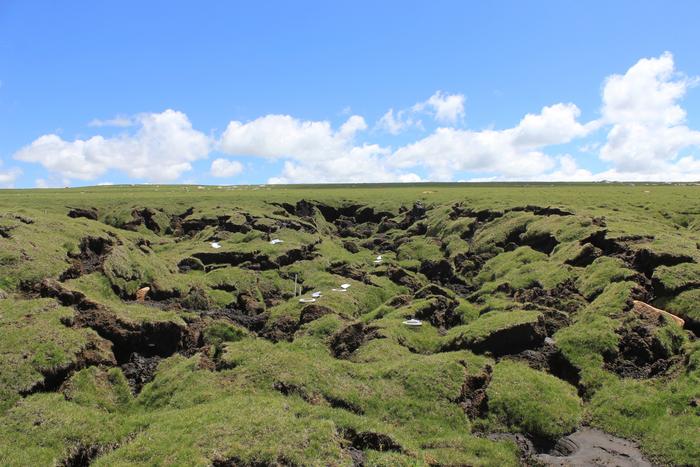
According to a recent study published in Nature Geoscience, scientists have found that soil carbon dioxide (CO2) emissions are more sensitive to climate warming in permafrost-collapsed areas than in non-collapsed areas.

Credit: WANG Guanqin
According to a recent study published in Nature Geoscience, scientists have found that soil carbon dioxide (CO2) emissions are more sensitive to climate warming in permafrost-collapsed areas than in non-collapsed areas.
This study, based on field warming experiments combined with laboratory incubation of soils from a large-scale sampling, provides new insights about permafrost carbon–climate feedback in the context of future climate warming.
Warmer temperatures have led to rapid permafrost thawing in high-latitude and -altitude permafrost regions. Abrupt permafrost thaw, known as thermokarst, occurs in ~20% of the northern permafrost region, but this region stores about half of all below-ground organic carbon. This type of thawing can restructure land surface morphology, causing abrupt changes to the soil biotic and abiotic properties, which may significantly alter ecosystem carbon cycling.
Since both thermokarst and non-thermokarst areas are simultaneously experiencing ongoing warming, an important but so far overlooked consideration is whether the warming effects on soil CO2 flux might differ between these two distinct landforms.
To fill this knowledge gap, a collaborative research group led by Prof. YANG Yuanhe from the Institute of Botany of the Chinese Academy of Sciences has investigated how thermokarst formation influences the responses of soil CO2 fluxes to climate warming, using multiple approaches.
In a well-replicated warming experiment conducted simultaneously in thermokarst and non-thermokarst areas, the researchers found that the warming-induced increase in soil CO2 release was about 5.5 times higher in thermokarst features than in adjacent non-thermokarst landforms.
They then analyzed over 30 potential drivers of the warming effects on CO2 release using soil physicochemical analyses, solid-state 13C nuclear magnetic resonance, and metagenomic sequencing. They found that the greater warming response was mainly due to the lower soil substrate quality and higher abundance of microbial functional genes related to organic carbon decomposition in thermokarst-affected soils.
Furthermore, by incubating soils from six additional thermokarst-affected sites along a 550-km permafrost transect, they found that thermokarst formation significantly increased the temperature sensitivity of CO2 release, providing additional evidence for the stronger soil CO2 response to warming in thermokarst landscapes.
“As a preliminary exploration of its global importance, extrapolating the warming response of soil CO2 flux to all upland thermokarst regions in the Northern Hemisphere, there could be an additional 0.4 Pg C year-1 of soil carbon release, which is about a quarter of the projected permafrost soil carbon losses by the end of the 21st century,” said Prof. YANG, corresponding author of the study.
This study provides multiple lines of evidence that warming-induced soil CO2 loss is stronger under thermokarst formation. These findings may help to more accurately project the future trajectory of permafrost carbon–climate feedback.
Journal
Nature Geoscience
Method of Research
Meta-analysis
Subject of Research
Not applicable
Article Title
Enhanced response of soil respiration to experimental warming upon thermokarst formation
Article Publication Date
30-Apr-2024
Cite Scienmag News
Violet Maxwell. (April 30, 2024). Abrupt permafrost thaw intensifies warming effects on soil CO2 emission. Scienmag. https://scienmag.com/abrupt-permafrost-thaw-intensifies-warming-effects-on-soil-co2-emission/
Violet Maxwell. "Abrupt permafrost thaw intensifies warming effects on soil CO2 emission." Scienmag, 30 April 2024, https://scienmag.com/abrupt-permafrost-thaw-intensifies-warming-effects-on-soil-co2-emission/. Accessed 4 September 2026.
Violet Maxwell. "Abrupt permafrost thaw intensifies warming effects on soil CO2 emission." Scienmag. April 30, 2024. https://scienmag.com/abrupt-permafrost-thaw-intensifies-warming-effects-on-soil-co2-emission/

