


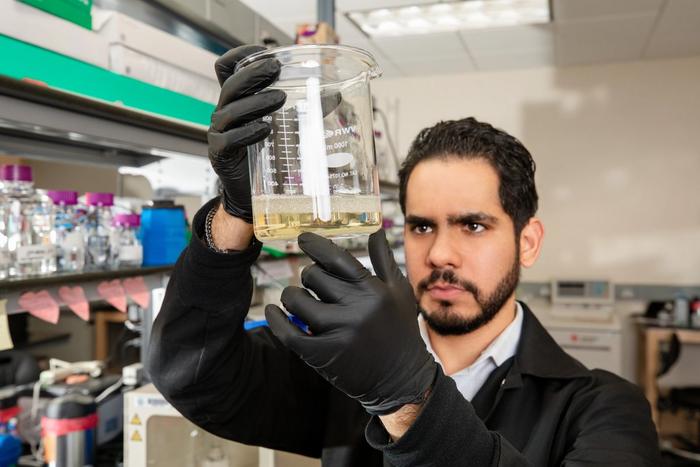
EL PASO, Texas (April 30, 2024) – An estimated 168 billion gallons of wastewater — or produced water — is generated annually by the Permian Basin fracking industry, according to a 2022 report by the Texas Produced Water Consortium. The major waste stream has proved both difficult and costly to treat because of the chemical complexity of the water.

Credit: The University of Texas at El Paso
EL PASO, Texas (April 30, 2024) – An estimated 168 billion gallons of wastewater — or produced water — is generated annually by the Permian Basin fracking industry, according to a 2022 report by the Texas Produced Water Consortium. The major waste stream has proved both difficult and costly to treat because of the chemical complexity of the water.
In a new study published in the journal Water, researchers at The University of Texas at El Paso have identified a novel means of treating the wastewater generated by oil and gas production: bacteriophages.
Ramón Antonio Sánchez, a doctoral candidate within UTEP’s chemistry program, is the first author on the publication, detailing how bacteriophages, viruses that are often highly specific and lethal to a single species of bacteria, can be used as a rapid and cost-effective method to treat produced water on an industrial scale.
Sánchez said if the work is successful, it would give the oil and gas industry a means of treating, reusing and recycling produced water, rather than the current industry practice of disposing the majority of produced water by injecting it into the ground post oil exploration.
The research focuses on two of the most prominent bacteria found within produced water across the oil and gas industry — Pseudomonas aeruginosa and Bacillus megaterium. P. aeruginosa has the ability to corrode stainless steel and presents a challenge for the longevity of pipelines and other metal-based infrastructure, while B. megaterium, can decompose hydrocarbons — the basis for oil.
Sánchez, along with one of his collaborators, Zacariah Hildenbrand, Ph.D., a UTEP alum, were inspired to use bacteriophages based on their applications in the medical industry, where they are used to combat infections caused by multi-drug resistant bacteria.
“Since the bacteria are living organisms, over time they developed a resistance, in the form of a less penetrable membrane, to traditional disinfectants,” Sánchez explained. “But the bacteriophages, which are viruses themselves, attach to specific receptors on the surface of the host cell and evolve alongside the bacteria they are trying to infect, meaning that any resistance acquired by the bacteria triggers the modification of bacteriophages to keep the infection going.”
The team’s experiments with bacteriophages have been effective, achieving the inactivation of both P. aeruginosa and B. megaterium in laboratory settings. For Sánchez, who graduates this spring with his Ph.D., the work will continue in the industry where his focus will be on replicating his laboratory results out in the field. He will also try to expand the number of microorganisms that can be treated in produced water by securing a larger catalog of bacteriophages.
The team admits the approach does have its challenges. There are currently a limited amount of commercially available Bacteriophages, which is critical since bacteriophages are often highly specific to a single species of bacteria. There are also other species of bacteria in produced water that remain to be tested.
“As UTEP’s status and research prowess nationwide continues to grow, so does its ability to attract talented students like Ramón and provide them with the opportunities to conduct meaningful work that has tangible and tremendous impact,” said Ricardo Bernal, Ph.D., an associate professor in UTEP’s Department of Chemistry and Biochemistry and Sánchez’ doctoral advisor. “I feel a great sense of pride for the work Ramón has accomplished in his time here and look forward to seeing the next step of his research and ultimately how the knowledge he creates will improve lives.”
About The University of Texas at El Paso
The University of Texas at El Paso is America’s leading Hispanic-serving university. Located at the westernmost tip of Texas, where three states and two countries converge along the Rio Grande, 84% of our 24,000 students are Hispanic, and more than half are the first in their families to go to college. UTEP offers 170 bachelor’s, master’s and doctoral degree programs at the only open-access, top-tier research university in America.
Journal
Water
Article Title
Using Bacteriophages to Treat Resilient Bacteria Found in Produced Water
Article Publication Date
7-Mar-2024
Cite Scienmag News
Kristina Jarvis. (April 30, 2024). A virus could help save billions of gallons of wastewater produced by fracking. Scienmag. https://scienmag.com/a-virus-could-help-save-billions-of-gallons-of-wastewater-produced-by-fracking/
Kristina Jarvis. "A virus could help save billions of gallons of wastewater produced by fracking." Scienmag, 30 April 2024, https://scienmag.com/a-virus-could-help-save-billions-of-gallons-of-wastewater-produced-by-fracking/. Accessed 4 September 2026.
Kristina Jarvis. "A virus could help save billions of gallons of wastewater produced by fracking." Scienmag. April 30, 2024. https://scienmag.com/a-virus-could-help-save-billions-of-gallons-of-wastewater-produced-by-fracking/

