


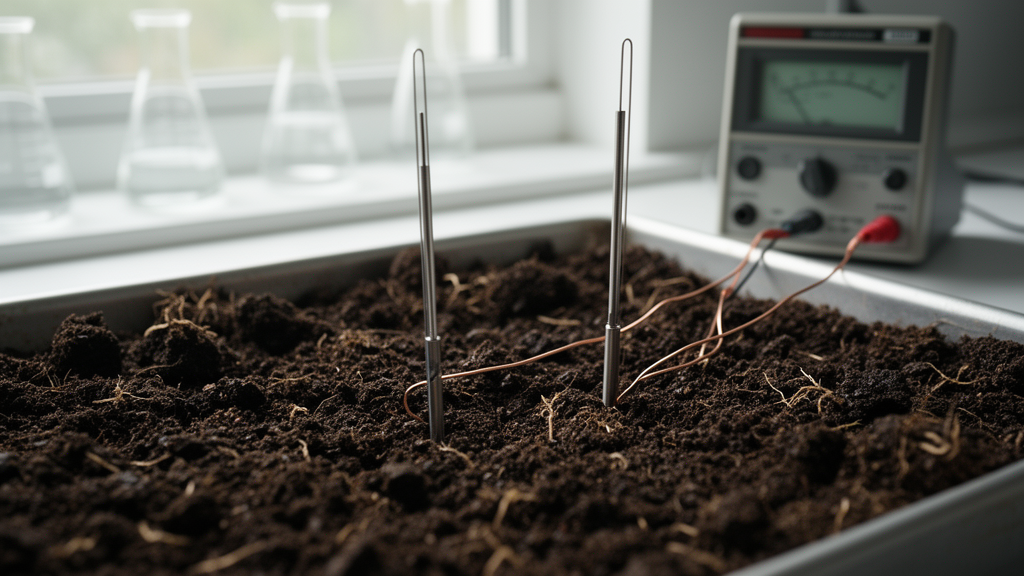
Soils are among the most complex and least understood components of the global carbon cycle. They hold more organic carbon than the atmosphere and all the world’s vegetation combined, and whether that carbon stays locked away or escapes as carbon dioxide depends on the activity of trillions of microorganisms living in the dark, water-filmed pores beneath our feet. A new study published in the journal SOIL by Orsolya Fülöp and colleagues at Sorbonne Université suggests that a remarkably simple geophysical measurement, electrical conductivity, could serve as a window into the hidden biology of drying soils, offering a non-destructive way to track when and why microbial activity grinds to a halt.
The central challenge the researchers tackled is one of access. Soil microorganisms and the organic matter they decompose are distributed unevenly through a labyrinthine pore network, and only a small fraction of soil microbes can move under their own power. Most bacterial decomposition therefore relies on diffusion: organic molecules must drift through water films to reach the microbes or their extracellular enzymes. Because diffusion only happens in water, the connectivity of the aqueous phase becomes the master variable. As a soil dries, water retreats into progressively thinner and more disconnected films, forcing substrates to travel ever more tortuous paths, and respiration declines sharply.
What makes the new work clever is the recognition that electricity faces exactly the same physical constraints. When a voltage is applied across a soil, charge carriers, mostly dissolved ions, must move through the same water-filled pore network that substrates use. If drying breaks the continuity of the water phase, both ionic conduction and substrate diffusion suffer. The team hypothesized that electrical conductivity, measured across a range of soil moisture conditions, could therefore act as a mechanistically informed proxy for respiration whenever microbial activity is limited by diffusion rather than by the sheer amount of carbon available.
To test this idea, the researchers collected soil from the long-term La Cage field experiment at the INRAE campus in Versailles, France, established in 1998 on a well-drained Luvisol. They compared two contrasting management systems: conventional tillage, with annual ploughing to 30 centimeters, and conservation agriculture, which leaves the soil untilled under persistent cover crops. From each system they took both sieved topsoil and subsoil samples, homogenized to two millimeters, and undisturbed cores collected in PVC rings that preserved the natural pore architecture. The samples were frozen, thawed gradually, saturated by capillary rise, and placed in airtight microcosms fitted with ceramic plates connected to a suction pump.
By applying matric potentials ranging from −70 to −630 hectopascals, and a final step near −996 hectopascals using an oversaturated lithium chloride solution, the team could dry the samples in controlled increments without physically disturbing them. At each moisture level they measured carbon dioxide accumulation in the microcosm headspace with a micro gas chromatograph, calculating respiration flux per gram of organic matter, while simultaneously recording the real part of the complex electrical conductivity at one hertz using a portable spectral induced polarization unit and custom brass-screw electrodes. Water retention curves fitted with the van Genuchten model converted each applied suction into an equivalent water saturation for every sample.
The results revealed a striking and mechanistically coherent picture. Relative respiration rates, normalized to the wettest condition, rose by roughly three orders of magnitude as the soils dried from −996 to −70 hectopascals, but the response was not monotonic. Undisturbed samples showed a distinct respiration peak at −250 hectopascals, beyond which further wetting brought no additional increase. The researchers attribute this plateau to oxygen limitation: near saturation, oxygen, which diffuses far more slowly through water than through air, becomes the bottleneck, even as substrate diffusion is at its easiest. There is, in effect, an optimal moisture window where oxygen supply and substrate connectivity are balanced.
Electrical conductivity, by contrast, declined systematically as the soils desaturated, exactly as expected from the progressive loss of connectivity in the conductive water phase. Fitting the bulk conductivity data with the Waxman-Smits pedophysical relationship allowed the team to derive a tortuosity factor for the water phase in each sample, a quantitative measure of how winding and constrained the diffusive pathways had become. Tortuosity increased steadily with drying in every soil, and when the researchers plotted log-transformed respiration flux against log-transformed tortuosity within the diffusion-limited range, they found significant negative relationships in both the conventionally tilled and conservation agriculture samples. The drier and more tortuous the water phase, the slower the microbes respired.
The influence of soil structure emerged in a subtle but important way. In the conventionally tilled samples, the slope of the respiration-tortuosity relationship was significantly steeper for sieved soils than for undisturbed ones, suggesting that homogenized pore networks make respiration more sensitive to diffusive constraints. Sieving also raised respiration rates near saturation, likely because breaking aggregates exposes physically protected organic carbon to microbial attack. In the conservation agriculture samples, whose long-term aggregate stability is known to be greater, no such structural modulation appeared, hinting that stable aggregation may buffer biological responses to changes in tortuosity. Notably, the tortuosity values themselves did not differ significantly between structural treatments, revealing a decoupling between bulk transport metrics and biological response that the authors argue deserves further attention.
The broader implications are considerable. Carbon models routinely represent the moisture dependence of soil respiration with empirical curves, but this study points toward a physically grounded alternative: if electrical conductivity tracks the connectivity of the aqueous phase, then geophysical sensors already used to map soil moisture in the field could, in principle, deliver quantitative information about diffusion-limited microbial activity without disturbing the soil at all. The authors are careful to note that the approach applies in the absence of substantial water flow, that near-saturated conditions fall outside its scope because of oxygen limitation, and that one anomalous conductivity increase in a tilled subsoil sample, possibly linked to fungal growth on the core surface, remains unexplained. Field validation is the clear next step. Still, the prospect is tantalizing: a routine electrical measurement, of the kind that can be made with electrodes and a modest instrument, may one day tell us how fast the largest terrestrial carbon reservoir is breathing, pore by tortuous pore, as the planet warms and dries.
Subject of Research: Using electrical conductivity as a proxy for diffusion-limited microbial respiration in soils
Article Title: Electrical conductivity measurements as proxies for diffusion-limited microbial activity in soils under controlled laboratory conditions
Article References: Fülöp, O., Nunan, N., Gueye, M., & Jougnot, D. (2026). Electrical conductivity measurements as proxies for diffusion-limited microbial activity in soils under controlled laboratory conditions. SOIL, 12(1), 703-714. https://doi.org/10.5194/soil-12-703-2026
Image Credits: AI Generated
Keywords: soil respiration, electrical conductivity, geophysics, microbial activity, carbon cycle, diffusion limitation, tortuosity, soil moisture, soil structure, conservation agriculture, Luvisol, pedophysics
Cite Scienmag News
Alan Morgan. (October 9, 2026). A Simple Electric Current Could Reveal How Thirsty Soils Breathe. Scienmag. https://scienmag.com/a-simple-electric-current-could-reveal-how-thirsty-soils-breathe/
Alan Morgan. "A Simple Electric Current Could Reveal How Thirsty Soils Breathe." Scienmag, 9 October 2026, https://scienmag.com/a-simple-electric-current-could-reveal-how-thirsty-soils-breathe/. Accessed 9 October 2026.
Alan Morgan. "A Simple Electric Current Could Reveal How Thirsty Soils Breathe." Scienmag. October 9, 2026. https://scienmag.com/a-simple-electric-current-could-reveal-how-thirsty-soils-breathe/


