
Thursday, July 23, 2026
Science
No Result
View All Result
  • Login
  • HOME
  • SCIENCE NEWS
  • CONTACT US
  • HOME
  • SCIENCE NEWS
  • CONTACT US
No Result
View All Result
Scienmag
No Result
View All Result
Home Science News Earth Science

Human activity over natural inputs determines the bacterial community in an ice core from the Muztag ata glacier

May 20, 2024
in Earth Science
Reading Time: 3 mins read
0
Human activity over natural inputs determines the bacterial community in
66
SHARES
601
VIEWS
Share on FacebookShare on Twitter
ADVERTISEMENT

This study is led by Dr. Yongqin Liu (Institute of Tibetan Plateau Research, Chinese Academy of Sciences). The Tibetan Plateau (TP) has the third-largest number of glaciers after the Antarctic and Greenland. Bacteria, deposited on glacier surfaces through dry and wet deposition, undergo in-situ growth and are subsequently preserved in ice cores following environmental selection pressures such as UV radiation and low temperatures. Since glacier bacteria are largely transported from distant or local sources by atmospheric circulation, changes in source ecosystems can also affect the composition of surface glacier bacteria. Therefore, the characteristics of bacterial communities in ice cores can serve as indicators of past climates and human activities.

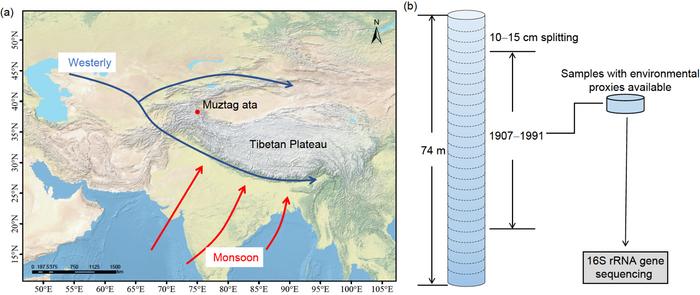
The location of Muztag ata glacier and the ice core sampling strategy.

Credit: ©Science China Press

This study is led by Dr. Yongqin Liu (Institute of Tibetan Plateau Research, Chinese Academy of Sciences). The Tibetan Plateau (TP) has the third-largest number of glaciers after the Antarctic and Greenland. Bacteria, deposited on glacier surfaces through dry and wet deposition, undergo in-situ growth and are subsequently preserved in ice cores following environmental selection pressures such as UV radiation and low temperatures. Since glacier bacteria are largely transported from distant or local sources by atmospheric circulation, changes in source ecosystems can also affect the composition of surface glacier bacteria. Therefore, the characteristics of bacterial communities in ice cores can serve as indicators of past climates and human activities.

The team investigated the bacterial community from a 74 m ice core of Muztag ata glacier on the Tibetan Plateau to link biological indicators with past climate and anthropogenic activities. They observed an increase in bacterial richness throughout the ice core, which was associated with higher NH+4, an indicator of agricultural development. Meanwhile, the evenness demonstrated negative correlations with DOC and MAP, and positive correlation with δ18O, Na+, K+, Mg2+, Ca2+, Cl−, SO42-, and NO3–. These indicators collectively offer promising insights for inferring past climate and environmental changes.

The researchers further investigate the composition of bacterial communities in ice cores. Cluster analysis at the bacterial family level indicates three distinct groupings of samples. Through cluster analysis at the bacterial family level, they uncovered three distinct groupings of samples. Cluster A encompasses the years 1953 to 1991, Cluster B consists of 11 samples from 1933 to 1951, while the majority of samples in Cluster C are dated between 1907 and 1930. It was found that the bacterial community composition was shaped by a combination of human activity, natural inputs, and air temperature, with a pronounced human influence becoming evident after the 1950s. Furthermore, the relative abundance of animal gut-associated bacteria, including Aerococcaceae, Nocardiaceae, Muribaculaceae, and Lachnospiraceae, was associated with livestock number changes in the Central Asian region. Together with other bacterial lineages, they jointly explained 59.8% of the livestock number changes.

“These new findings not only quantify the relationship between bacterial diversity and community composition with past climates and human activities but also highlight how changes in land use, driven by agriculture and livestock, intensify the presence of potentially harmful bacteria on glaciers.  This enhances our understanding of regional climate and human activities.” Dr. Liu says.

This study provides a comprehensive analysis of the century-long dynamics of bacterial communities in the Muztag Ata ice core. The identified bacterial markers offer valuable insights into past environmental conditions and human activities in the source regions, underscoring the microbial potential in ice core climate studies.

Liu Y, Jiao N, Ji M, Liu K, Xu B, Guo B, Yao T. 2024. Human activity over natural inputs determines the bacterial community in an ice core from the Muztag ata glacier. Science China Earth Sciences, 67(5): 1489–1499,


Journal

Science China Earth Sciences

DOI

10.1007/s11430-022-1282-x

Share26Tweet17
Previous Post

BESIII collaboration discovers glueball-like particle—X(2370)

Next Post

DIProT: An interactive deep learning toolkit for efficient protein design

Related Posts

Crustose Coralline Algae Shield Shallow Reefs from Dissolution
Earth Science

Crustose Coralline Algae Shield Shallow Reefs from Dissolution

July 18, 2026
Ice-to-ocean method tracks mercury mobilization and export from Greenland ice sheet
Earth Science

Ice-to-ocean method tracks mercury mobilization and export from Greenland ice sheet

July 17, 2026
Scientists identify rare oddball meteorite linked to dinosaur extinction
Earth Science

Scientists identify rare oddball meteorite linked to dinosaur extinction

July 17, 2026
Mediterranean Outflow Waters Power North Atlantic Deep Convection Sites
Earth Science

Mediterranean Outflow Waters Power North Atlantic Deep Convection Sites

July 17, 2026
Elevation-Driven Warming at High Altitudes Across the Westerly Tibetan Plateau
Earth Science

Elevation-Driven Warming at High Altitudes Across the Westerly Tibetan Plateau

July 17, 2026
Long-Term Evaluation of Restoration Outcomes Under China’s Shan-Shui Initiative
Earth Science

Long-Term Evaluation of Restoration Outcomes Under China’s Shan-Shui Initiative

July 17, 2026
Next Post
DIProT: An interactive deep learning toolkit for efficient protein design

DIProT: An interactive deep learning toolkit for efficient protein design

  • Mothers who receive childcare support from maternal grandparents show more

    Mothers who receive childcare support from maternal grandparents show more parental warmth, finds NTU Singapore study

    27656 shares
    Share 11059 Tweet 6912
  • University of Seville Breaks 120-Year-Old Mystery, Revises a Key Einstein Concept

    1061 shares
    Share 424 Tweet 265
  • Bee body mass, pathogens and local climate influence heat tolerance

    682 shares
    Share 273 Tweet 171
  • Researchers record first-ever images and data of a shark experiencing a boat strike

    546 shares
    Share 218 Tweet 137
  • Groundbreaking Clinical Trial Reveals Lubiprostone Enhances Kidney Function

    531 shares
    Share 212 Tweet 133
Science

Embark on a thrilling journey of discovery with Scienmag.com—your ultimate source for cutting-edge breakthroughs. Immerse yourself in a world where curiosity knows no limits and tomorrow’s possibilities become today’s reality!

RECENT NEWS

  • Rannasangpei crocin-1 improves valproate-induced autism-like behaviors by reducing oxidative stress
  • Sleep Quality Links Synergistically with Frailty to Increase Cardiometabolic Multimorbidity in Elderly Chinese
  • Gut Microbiome Metabolites Shape Development of Stress-Related Mental Disorders
  • Cognitive reserve helps older adults resist frailty and recover better

Categories

  • Agriculture
  • Anthropology
  • Archaeology
  • Athmospheric
  • Biology
  • Biotechnology
  • Blog
  • Bussines
  • Cancer
  • Chemistry
  • Climate
  • Earth Science
  • Editorial Policy
  • Marine
  • Mathematics
  • Medicine
  • Pediatry
  • Policy
  • Psychology & Psychiatry
  • Science Education
  • Social Science
  • Space
  • Technology and Engineering

Subscribe to Blog via Email

Success! An email was just sent to confirm your subscription. Please find the email now and click 'Confirm Follow' to start subscribing.

Join 5,146 other subscribers

© 2025 Scienmag - Science Magazine

Welcome Back!

Login to your account below

Forgotten Password?

Retrieve your password

Please enter your username or email address to reset your password.

Log In
No Result
View All Result
  • HOME
  • SCIENCE NEWS
  • CONTACT US

© 2025 Scienmag - Science Magazine
