

Friday, September 4, 2026
Science
No Result
View All Result
  • Login
  • HOME
  • SCIENCE NEWS
  • CONTACT US
  • HOME
  • SCIENCE NEWS
  • CONTACT US
No Result
View All Result
Scienmag
No Result
View All Result
Home Science News Biology

DIProT: An interactive deep learning toolkit for efficient protein design

May 20, 2024
in Biology
Blake Davidson
By Blake Davidson Scienmag Editorial Profile - Data Science
Reading Time: 3 mins read
0
DIProT: An interactive deep learning toolkit for efficient protein design
68
SHARES
617
VIEWS
Share on FacebookShare on Twitter
ADVERTISEMENT

Protein design, a crucial aspect of biological sciences, involves creating amino acid sequences that fold into desired protein structures. This process, known as the protein inverse folding problem, has been a challenge in the field.

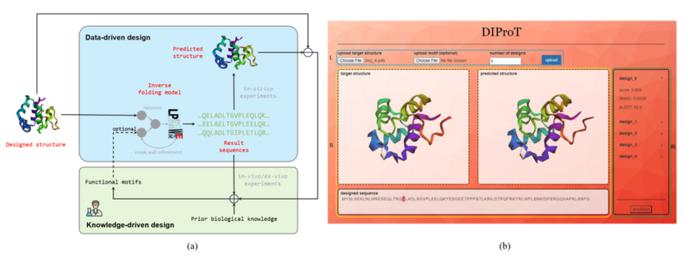
OVERVIEW OF HOW DIPROT WORKS

Credit: Jieling He, Wenxu Wu, Xiaowo Wang

Protein design, a crucial aspect of biological sciences, involves creating amino acid sequences that fold into desired protein structures. This process, known as the protein inverse folding problem, has been a challenge in the field.

To that end, a team of researchers from Tsinghua University (THU) in China introduced DIProT, an interactive protein design toolkit that leverages a non-autoregressive deep generative model to tackle this issue.

“Proteins play a crucial role in numerous biological functions,” explains corresponding author of the study Xiaowo Wang, a professor in the Department of Automation at Tsinghua University. “Both predicting the structure of a given protein sequence, as exemplified by AlphaFold, and designing amino acid sequences that conform to a given protein structure pose their unique challenges.”

To developing DIProT, the researchers integrated deep learning models with human expertise directly into the design process, thereby enhancing the efficiency and effectiveness of protein design.

“DIProT’s unique approach allows users to specify the target structure and fix parts of the sequence they want to preserve, enhancing the design process’s flexibility,” adds Wang. “The toolkit also incorporates a protein structure prediction model to evaluate designs in silico, forming a virtual design loop that significantly improves protein design efficiency.”

One of the key features of DIProT is its user-friendly graphical user interface (GUI), which integrates multiple algorithms to facilitate a fast and intuitive feedback design loop. The GUI allows users to interact with the design outcomes visually, aiding understanding and interpretation of the results.

The authors, who published their study in the KeAi journal Synthetic and Systems Biotechnology, expect DIProT to be highly useful for practical protein design tasks. “We hope that DIProT will stimulate further research in the field and serve as a useful tool for tackling increasingly complex and diverse protein design challenges.”

The researchers plan to refine their inverse folding model and toolkit to tackle increasingly complex and diverse protein design challenges in the future.

###

Contact the author: Xiaowo Wang, Ministry of Education Key Laboratory of Bioinformatics; Center for Synthetic and Systems Biology; Bioinformatics Division, Beijing National Research Center for Information Science and Technology; Department of Automation, Tsinghua University, Beijing, China.

The publisher KeAi was established by Elsevier and China Science Publishing & Media Ltd to unfold quality research globally. In 2013, our focus shifted to open access publishing. We now proudly publish more than 100 world-class, open access, English language journals, spanning all scientific disciplines. Many of these are titles we publish in partnership with prestigious societies and academic institutions, such as the National Natural Science Foundation of China (NSFC).


Journal

Synthetic and Systems Biotechnology

DOI

10.1016/j.synbio.2024.01.011

Method of Research

Computational simulation/modeling

Subject of Research

Not applicable

Article Title

DIProT: A deep learning based interactive toolkit for efficient and effective Protein design

COI Statement

The authors declare that they have no known competing financial interests or personal relationships that could have appeared to influence the work reported in this paper.

Subject of Research: Biology

Article Title: DIProT: An interactive deep learning toolkit for efficient protein design

Article References: Original research article

Image Credits: AI Generated

DOI: Not provided

Keywords: Not provided

Cite Scienmag News

Blake Davidson. (May 20, 2024). DIProT: An interactive deep learning toolkit for efficient protein design. Scienmag. https://scienmag.com/diprot-an-interactive-deep-learning-toolkit-for-efficient-protein-design/

Blake Davidson. "DIProT: An interactive deep learning toolkit for efficient protein design." Scienmag, 20 May 2024, https://scienmag.com/diprot-an-interactive-deep-learning-toolkit-for-efficient-protein-design/. Accessed 4 September 2026.

Blake Davidson. "DIProT: An interactive deep learning toolkit for efficient protein design." Scienmag. May 20, 2024. https://scienmag.com/diprot-an-interactive-deep-learning-toolkit-for-efficient-protein-design/

Share27Tweet17
Previous Post

Human activity over natural inputs determines the bacterial community in an ice core from the Muztag ata glacier

Next Post

Study explores association between fluoride exposure in pregnancy and neurobehavioral issues in young children

Related Posts

Damaged lysosomes undergo budding-type fission driven by mitochondrial vesicles
Biology

Damaged lysosomes undergo budding-type fission driven by mitochondrial vesicles

September 4, 2026
How a disease-spreading tick reproduces without males
Biology

How a disease-spreading tick reproduces without males

September 4, 2026
Gene mutation dosage predicts prognosis and metastasis across 60,000 cancer samples
Biology

Gene mutation dosage predicts prognosis and metastasis across 60,000 cancer samples

September 4, 2026
Galectin-1-high monocytes boost functional memory CD8+ T cell generation
Biology

Galectin-1-high monocytes boost functional memory CD8+ T cell generation

September 4, 2026
Engineering a kinase-controlled allosteric switch for improved performance
Biology

Engineering a kinase-controlled allosteric switch for improved performance

September 4, 2026
ATRX partners with 9-1-1 and CST to protect genome replication and telomeres
Biology

ATRX partners with 9-1-1 and CST to protect genome replication and telomeres

September 4, 2026
Next Post
Study explores association between fluoride exposure in pregnancy and neurobehavioral

Study explores association between fluoride exposure in pregnancy and neurobehavioral issues in young children

  • Mothers who receive childcare support from maternal grandparents show more optimized

    Mothers who receive childcare support from maternal grandparents show more parental warmth, finds NTU Singapore study

    27656 shares
    Share 11059 Tweet 6912
  • University of Seville Breaks 120-Year-Old Mystery, Revises a Key Einstein Concept

    1061 shares
    Share 424 Tweet 265
  • Bee body mass, pathogens and local climate influence heat tolerance

    682 shares
    Share 273 Tweet 171
  • Researchers record first-ever images and data of a shark experiencing a boat strike

    546 shares
    Share 218 Tweet 137
  • Groundbreaking Clinical Trial Reveals Lubiprostone Enhances Kidney Function

    531 shares
    Share 212 Tweet 133
Science

Embark on a thrilling journey of discovery with Scienmag.com—your ultimate source for cutting-edge breakthroughs. Immerse yourself in a world where curiosity knows no limits and tomorrow’s possibilities become today’s reality!

RECENT NEWS

  • Multi-modal data integration uncovers predictive biomarkers for ovarian cancer
  • Thyroid cancer mutations drive distinct dedifferentiation paths and stromal interactions
  • Study maps tissue-specific aging trajectories across the human body
  • Dalpiciclib with endocrine therapy treats HR-positive advanced breast cancer in visceral crisis

Categories

  • Agriculture
  • Anthropology
  • Archaeology
  • Athmospheric
  • Biology
  • Biotechnology
  • Blog
  • Bussines
  • Cancer
  • Chemistry
  • Climate
  • Earth Science
  • Editorial Policy
  • Marine
  • Mathematics
  • Medicine
  • Pediatry
  • Policy
  • Psychology & Psychiatry
  • Science Education
  • Social Science
  • Space
  • Technology and Engineering

Subscribe to Blog via Email

Enter your email address to subscribe to this blog and receive notifications of new posts by email.

Join 5,151 other subscribers

© 2025 Scienmag - Science Magazine

Welcome Back!

Login to your account below

Forgotten Password?

Retrieve your password

Please enter your username or email address to reset your password.

Log In
No Result
View All Result
  • HOME
  • SCIENCE NEWS
  • CONTACT US

© 2025 Scienmag - Science Magazine

Discover more from Science

Subscribe now to keep reading and get access to the full archive.

Continue reading