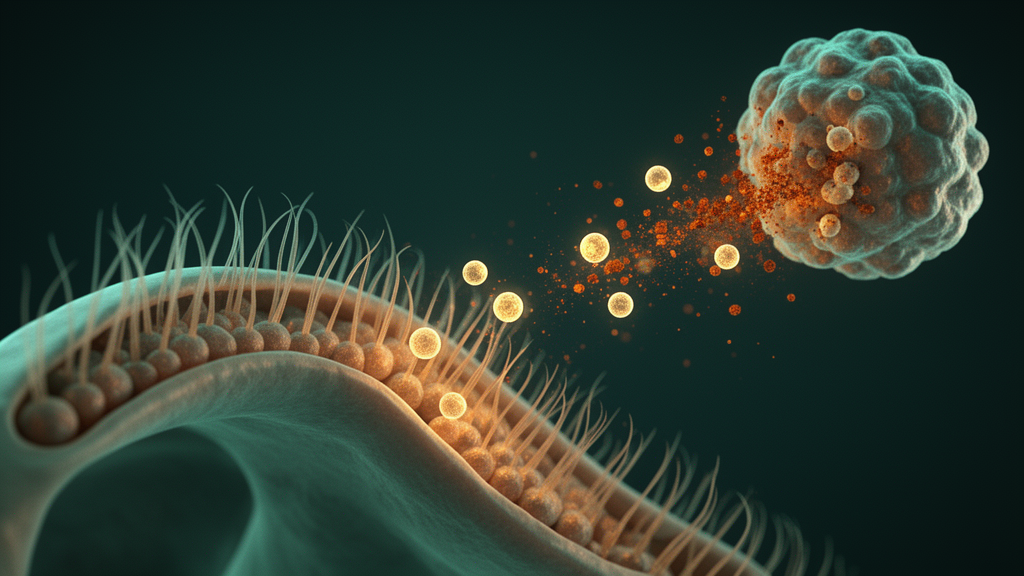
Vestibular schwannoma, the most common benign tumor of the cerebellopontine angle, leaves roughly 95% of patients with sensorineural hearing loss, yet the mechanisms linking the tumor to cochlear damage remain incompletely understood. A new study published in Cell Death Discovery reports that exosomes released by vestibular schwannomas can induce ferroptosis, an iron-dependent form of regulated cell death driven by lipid peroxidation, in cochlear hair cells.
The research team compared exosomes isolated from vestibular schwannoma patients with poor hearing against those from patients with good hearing, using proteomic and bioinformatic analyses to characterize differences between the two groups.
In laboratory experiments, the vesicles from vestibular schwannoma patients suppressed glutathione peroxidase 4, or GPX4, a key enzyme that normally protects cellular membranes from oxidative damage. Loss of GPX4 activity was accompanied by a disruption of iron homeostasis, with ferrous ions accumulating inside hair cells along with reactive oxygen species and lipid peroxidation products, the biochemical hallmarks of ferroptosis.
The comparison between patient groups proved particularly striking. Exosomes from patients with poor hearing induced significantly greater ferroptotic damage to cochlear hair cells than exosomes from patients whose hearing remained relatively preserved, suggesting that the cargo of these vesicles may differ according to the clinical severity of hearing loss.
To test whether blocking ferroptosis could protect hearing, the researchers used ferrostatin-1, a well-characterized inhibitor of the ferroptotic pathway. Treatment with ferrostatin-1 effectively alleviated hair cell injury in cell models and preserved auditory function in vivo, indicating that the damage observed was specifically mediated by ferroptosis rather than by other forms of cell death.
The findings point to a mechanistic chain in which tumor-derived signaling suppresses a central antioxidant enzyme, destabilizes iron regulation, and thereby tips vulnerable cochlear hair cells into iron-dependent death.
Beyond ferroptosis itself, the study suggests that the exosome-mediated communication between tumor and cochlea may itself be a target. Interfering with the vesicles or their cargo, the authors note, could offer an additional route to protecting hearing alongside direct inhibition of the ferroptotic pathway.
The work remains at the preclinical stage, combining cell culture experiments with animal models, and the abstract notes that the role of ferroptosis in vestibular schwannoma-associated hearing loss was previously poorly understood. The authors position their results as uncovering a novel mechanism and as an early step toward therapeutic strategies, with clinical translation still requiring further study. Even so, the identification of a specific, druggable cell death pathway connecting vestibular schwannoma to hair cell injury offers a concrete lead for hearing preservation research in this patient population.
Subject of Research: Exosome-induced ferroptosis in cochlear hair cells as a mechanism of hearing loss in vestibular schwannoma
Article Title: Exosome-induced ferroptosis mediates cochlear hair cell injury via GPX4 suppression and iron overload
Article References: Maimaitiming, D., Gao, Y., Wang, Z., Yang, T., Wu, H., Huo, Z., & Zhang, Z. (2026). Exosome-induced ferroptosis mediates cochlear hair cell injury via GPX4 suppression and iron overload. Cell Death Discovery. https://doi.org/10.1038/s41420-026-03419-x
Image Credits: AI Generated
DOI: 10.1038/s41420-026-03419-x
Keywords: vestibular schwannoma, exosomes, ferroptosis, cochlear hair cells, GPX4, iron overload, lipid peroxidation, sensorineural hearing loss, ferrostatin-1, Cell Death Discovery, Exosome-induced, mediates
Cite Scienmag News
Nathaniel Bowman. (October 28, 2026). Tumor-derived exosomes drive cochlear hair cell ferroptosis in vestibular schwannoma. Scienmag. https://scienmag.com/tumor-derived-exosomes-drive-cochlear-hair-cell-ferroptosis-in-vestibular-schwannoma/
Nathaniel Bowman. "Tumor-derived exosomes drive cochlear hair cell ferroptosis in vestibular schwannoma." Scienmag, 28 October 2026, https://scienmag.com/tumor-derived-exosomes-drive-cochlear-hair-cell-ferroptosis-in-vestibular-schwannoma/. Accessed 29 October 2026.
Nathaniel Bowman. "Tumor-derived exosomes drive cochlear hair cell ferroptosis in vestibular schwannoma." Scienmag. October 28, 2026. https://scienmag.com/tumor-derived-exosomes-drive-cochlear-hair-cell-ferroptosis-in-vestibular-schwannoma/