

Tuesday, October 27, 2026
Science
No Result
View All Result
  • Login
  • HOME
  • SCIENCE NEWS
  • CONTACT US
  • HOME
  • SCIENCE NEWS
  • CONTACT US
No Result
View All Result
Scienmag
No Result
View All Result
Home Science News Climate

Recyclable oligo(disulfide) anolyte pushes aqueous flow batteries toward grid scale

October 27, 2026
in Climate
Bethany Barker
By Bethany Barker Scienmag Editorial Profile - Catalysis
Reading Time: 2 mins read
0
Recyclable oligo(disulfide) anolyte pushes aqueous flow batteries toward grid scale

Recyclable oligo(disulfide) anolyte pushes aqueous flow batteries toward grid scale

65
SHARES
587
VIEWS
Share on FacebookShare on Twitter
ADVERTISEMENT

Aqueous redox flow batteries are widely regarded as promising candidates for large-scale grid energy storage, but researchers have struggled to find anolyte materials that combine high capacity, environmental compatibility, recyclability, low cost and long-term stability in a single system. A study published in Nature Sustainability reports a recyclable oligo(disulfide)-based anolyte that the authors say addresses this long-standing trade-off.

The new anolyte relies on robust sulfur–sulfur bonds as its redox-active sites. According to the paper, the material is synthesized by ring-opening polymerization of potassium-form endogenous thioctic acid, a route the authors describe as scalable for producing high-concentration redox-active species.

When paired with a sulfonated cobalt phthalocyanine catalyst, the oligo(disulfide) anolyte delivered a capacity density of 128 ampere-hours per litre with a 95.5% material utilization rate at a current density of 50 milliamperes per square centimetre, the researchers report.

Long-term stability was tested using a carbon-coated sulfonated poly(ether ether ketone) membrane with a sulfur–sulfur bond concentration of 0.25 M. In that configuration, the battery retained 98.1% of its capacity over 2,200 cycles while maintaining an energy efficiency of approximately 70% at 100 milliamperes per square centimetre.

The team also validated the scalability and closed-loop recyclability of the chemistry in a 63 watt-hour stack, demonstrating that the anolyte can be recovered and reused rather than discarded at end of life.

The closed-loop aspect is central to the design. Because the anolyte is built from an endogenous thioctic acid precursor through a polymerization route, the authors position oligo(disulfide)s as a circular redox platform in which the active material can be returned to its starting state after use.

The findings, the researchers write, establish oligo(disulfide)s as a robust and circular redox platform, providing a pathway toward more resource-efficient and sustainable grid-scale energy storage. The reported performance figures come from laboratory cell and small-stack testing described in the paper, and the abstract notes the work as a demonstration of scalability rather than a commercial deployment.

If the chemistry can be reproduced at larger scales, the combination of high capacity density, stable cycling and recyclability could help address one of the key barriers to wider implementation of aqueous flow batteries, which until now have lacked anolyte materials able to satisfy all of these competing requirements simultaneously.

Subject of Research: A recyclable oligo(disulfide) anolyte for aqueous redox flow batteries

Article Title: A circular oligo(disulfide) anolyte enables practical aqueous redox flow batteries

Article References: Chen, Q., Ou, H., Zhao, X., Jin, Y., Guo, W., & Fu, Y. (2026). A circular oligo(disulfide) anolyte enables practical aqueous redox flow batteries. Nature Sustainability. https://doi.org/10.1038/s41893-026-01970-0

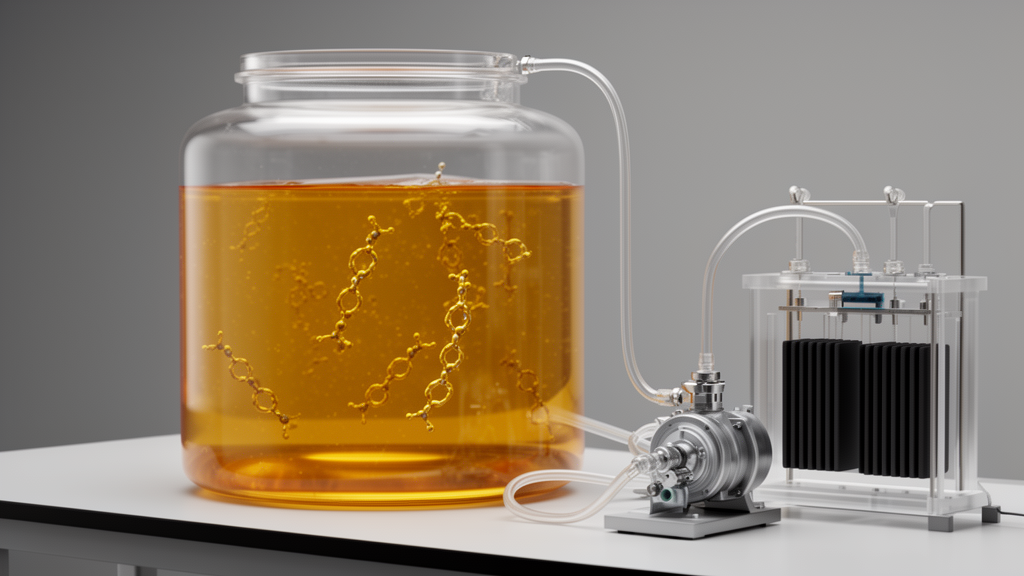
Image Credits: AI Generated

DOI: 10.1038/s41893-026-01970-0

Keywords: aqueous redox flow batteries, oligo(disulfide), anolyte, grid energy storage, recyclability, closed-loop recycling, sulfur-sulfur bonds, cobalt phthalocyanine catalyst, energy efficiency, battery membranes, circular, oligo

Cite Scienmag News

Bethany Barker. (October 27, 2026). Recyclable oligo(disulfide) anolyte pushes aqueous flow batteries toward grid scale. Scienmag. https://scienmag.com/recyclable-oligodisulfide-anolyte-pushes-aqueous-flow-batteries-toward-grid-scale/


Bethany Barker. "Recyclable oligo(disulfide) anolyte pushes aqueous flow batteries toward grid scale." Scienmag, 27 October 2026, https://scienmag.com/recyclable-oligodisulfide-anolyte-pushes-aqueous-flow-batteries-toward-grid-scale/. Accessed 27 October 2026.

Bethany Barker. "Recyclable oligo(disulfide) anolyte pushes aqueous flow batteries toward grid scale." Scienmag. October 27, 2026. https://scienmag.com/recyclable-oligodisulfide-anolyte-pushes-aqueous-flow-batteries-toward-grid-scale/

Tags: anolyteaqueous flow batteries for grid energy storageaqueous redox flow batteriesbattery membranescircularclosed-loop recyclability of flow battery electrolytesclosed-loop recyclingcobalt phthalocyanine catalystenergy efficiencyenvironmentally friendly battery materialsgrid energy storagehigh capacity density in flow batterieslong-term stability of aqueous redox flow batterieslow-cost materials for large-scale energy storageoligooligo(disulfide)performance metrics of flow batteriesrecyclabilityrecyclable oligo(disulfide) anolytescalable synthesis of redox-active speciessulfur-based redox-active materialssulfur-sulfur bondssulfur-sulfur bonds in redox chemistrysustainable energy storage solutions
Share26Tweet16
Previous Post

Cardiovascular Tech Prioritized in Colombia, With 3D Models Top for Education

Next Post

New Matrix Framework Maps How People Form Emotional Bonds With Places

Related Posts

Silicon–graphite composite anodes made with scalable powder process hit near 600 mAh/g
Climate

Silicon–graphite composite anodes made with scalable powder process hit near 600 mAh/g

October 27, 2026
Molecularly Thin Bilayer Carbon Membranes Deliver Sharp CO2 Sieving
Climate

Molecularly Thin Bilayer Carbon Membranes Deliver Sharp CO2 Sieving

October 27, 2026
Borneo’s Forest Frontier Faces a $74 Billion Carbon Bill by 2050
Climate

Borneo’s Forest Frontier Faces a $74 Billion Carbon Bill by 2050

October 27, 2026
Coconut Husk Biochar Shows Promise for Trapping Landfill Gases in Soil Covers
Climate

Coconut Husk Biochar Shows Promise for Trapping Landfill Gases in Soil Covers

October 27, 2026
Acetamiprid Resistance in Cowpea Aphid Carries Measurable Fitness Costs, Study Finds
Climate

Acetamiprid Resistance in Cowpea Aphid Carries Measurable Fitness Costs, Study Finds

October 27, 2026
Weather Data Alone Struggles to Predict Building Heating Demand, Norwegian Machine Learning Study Finds
Climate

Weather Data Alone Struggles to Predict Building Heating Demand, Norwegian Machine Learning Study Finds

October 27, 2026
Next Post
New Matrix Framework Maps How People Form Emotional Bonds With Places

New Matrix Framework Maps How People Form Emotional Bonds With Places

  • Mothers who receive childcare support from maternal grandparents show more optimized

    Mothers who receive childcare support from maternal grandparents show more parental warmth, finds NTU Singapore study

    27656 shares
    Share 11059 Tweet 6912
  • University of Seville Breaks 120-Year-Old Mystery, Revises a Key Einstein Concept

    1061 shares
    Share 424 Tweet 265
  • Bee body mass, pathogens and local climate influence heat tolerance

    682 shares
    Share 273 Tweet 171
  • Researchers record first-ever images and data of a shark experiencing a boat strike

    546 shares
    Share 218 Tweet 137
  • Groundbreaking Clinical Trial Reveals Lubiprostone Enhances Kidney Function

    531 shares
    Share 212 Tweet 133
Science

Embark on a thrilling journey of discovery with Scienmag.com—your ultimate source for cutting-edge breakthroughs. Immerse yourself in a world where curiosity knows no limits and tomorrow’s possibilities become today’s reality!

RECENT NEWS

  • New Matrix Framework Maps How People Form Emotional Bonds With Places
  • Recyclable oligo(disulfide) anolyte pushes aqueous flow batteries toward grid scale
  • Cardiovascular Tech Prioritized in Colombia, With 3D Models Top for Education
  • Thai Gen Z students use AI chatbots mainly for study, with a companion side emerging

Categories

  • Agriculture
  • Anthropology
  • Archaeology
  • Athmospheric
  • Biology
  • Biotechnology
  • Blog
  • Bussines
  • Cancer
  • Chemistry
  • Climate
  • Earth Science
  • Editorial Policy
  • Marine
  • Mathematics
  • Medicine
  • Pediatry
  • Policy
  • Psychology & Psychiatry
  • Science Education
  • Science News
  • Social Science
  • Space
  • Technology and Engineering

Subscribe to Blog via Email

Enter your email address to subscribe to this blog and receive notifications of new posts by email.

Join 5,151 other subscribers

© 2025 Scienmag - Science Magazine

Welcome Back!

Login to your account below

Forgotten Password?

Retrieve your password

Please enter your username or email address to reset your password.

Log In
No Result
View All Result
  • HOME
  • SCIENCE NEWS
  • CONTACT US

© 2025 Scienmag - Science Magazine

Discover more from Science

Subscribe now to keep reading and get access to the full archive.

Continue reading