


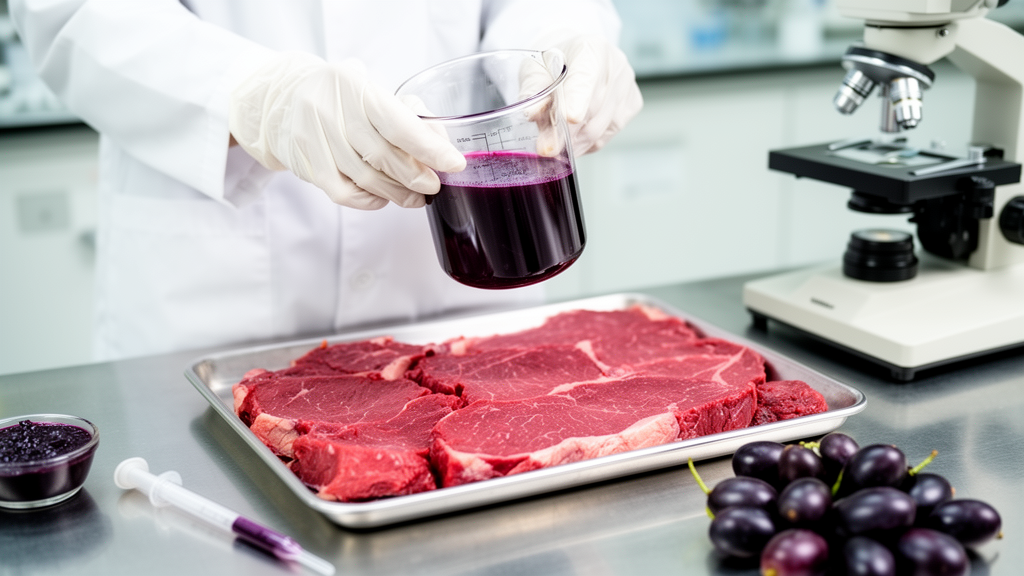
Researchers in Pakistan have reported that a concentrate made from jamun fruit, known scientifically as Syzygium cumini and also called Indian blackberry or java plum, improved several quality attributes of beef during nine days of refrigerated storage. In the study, conducted at Bahauddin Zakariya University in Multan, fresh boneless beef from the thigh muscles of three healthy Sahiwal cattle was marinated in the fruit concentrate for one, two or three hours and then compared with unmarinated control samples. The marinated beef showed lower lipid oxidation, slower microbial growth, better water retention and improved tenderness-related texture measurements than the untreated meat, although the authors emphasize that the microbiological findings do not establish the safety of the treated beef.
The team prepared the concentrate by washing fresh jamun fruit, removing the seeds and homogenizing the pulp into juice, then evaporating the water in a rotary evaporator at 45 to 50 degrees Celsius until roughly 30 percent of the original volume remained. Characterization of the resulting concentrate revealed a pH of 3.40, a titratable acidity of 1.13 percent and total soluble solids of 31.2 degrees Brix. The concentration step appears to have amplified the fruit’s functional profile: the concentrate delivered a free radical scavenging activity of 77.1 percent in a DPPH assay, a total phenolic content of 48.4 milligrams of gallic acid equivalents per milliliter and a total flavonoid content of 28.3 milligrams of quercetin equivalents per milliliter. For comparison, the researchers cited earlier work reporting 14.4 milligrams GAE per milliliter of phenolics, 8.3 milligrams QE per milliliter of flavonoids and 53.4 percent DPPH activity in fresh jamun juice, suggesting that water removal during evaporation concentrated the bioactive compounds responsible for antioxidant capacity.
Jamun is a tropical fruit of the Myrtaceae family grown widely across Pakistan, India, China, Sri Lanka, Bangladesh and other regions, with China estimated to produce about 13.5 million tons per year. The fruit is rich in anthocyanins such as cyanidin, malvidin and delphinidin, along with flavonoids like quercetin and kaempferol, phenolic acids including gallic and ellagic acid, tannins, terpenoids and alkaloids, all of which exhibit antioxidant and antimicrobial properties in previous research. Despite this nutritional richness, jamun remains underutilized as a food ingredient because of its staining purple pigment, acidic taste and astringent flavor, and its highly perishable flesh gives it a shelf life of only one to two days at ambient temperature. Converting the fruit into a concentrated marinade represents one strategy for adding value to a seasonal crop that would otherwise go to waste.
The experimental design divided the beef into four treatment groups: an unmarinated control labeled B0, and three groups marinated in the concentrate for one, two or three hours, designated BMS1, BMS2 and BMS3. Marination was carried out by submerging approximately 20 gram pieces of beef in the concentrate at a constant meat-to-concentrate ratio of 1:2 weight per volume at 4 degrees Celsius. After each marination period, samples drained for five minutes, were sealed in polyethylene zipper bags with air manually evacuated, and were stored at 4 degrees Celsius and 75 percent relative humidity. Each treatment was prepared in three independent biological replicates, one from each animal, and samples were analyzed at storage intervals from day 0 through day 9. Statistical evaluation used two-way analysis of variance to test treatment and storage day interactions at a significance threshold of p less than 0.05.
Color measurements taken with a Konica Minolta CR-400 colorimeter showed that marinated samples had lower lightness values but higher redness and yellowness values than the control by the end of storage. Lightness fell from 52.2 to 40.7, redness from 8.4 to 6.9 and yellowness rose from 13.6 to 16.4 across the marinated groups over the nine days, while the control shifted from 54.0 to 43.8 in lightness, 7.6 to 4.1 in redness and 12.1 to 15.9 in yellowness. The two-hour marination produced the strongest colorimetric performance, retaining redness values of 10.3 at day 0 and 6.2 at day 9. The researchers attribute the darker surface to penetration of anthocyanin pigments into the meat matrix, which reduces light reflectance, while the elevated redness in marinated samples may reflect both the fruit’s purple-red pigments and antioxidant stabilization of oxymyoglobin. Rising yellowness was linked to non-enzymatic browning reactions between muscle proteins and phenolics during storage.
Texture profile analysis revealed that marination softened the meat measurably. Hardness declined from 46.4 to 34.2 newtons across the marinated groups compared with 52.8 newtons in the control, while gumminess fell from 20.9 to 17.1 newtons and chewiness from 15.7 to 14.0 newtons. Cohesiveness increased from 0.45 to 0.50 and springiness from 0.75 to 0.82, against control values of 0.41 and 0.71. Cooking loss dropped from 27.9 to 21.4 percent in marinated samples versus 31.4 percent in the control, and water holding capacity rose from 62.7 to 70.9 percent compared with 58.26 percent untreated. The authors propose that the acidic environment and phenolic compounds of the concentrate alter muscle protein structure and fibrillar organization, shifting muscle pH away from its isoelectric point, increasing net charge and creating more water-binding sites on proteins, which together explain the improved moisture retention and tenderness.
Oxidative and microbial indicators both favored the marinated samples. Thiobarbituric acid reactive substances, a standard marker of lipid oxidation measured in milligrams of malondialdehyde per kilogram, rose from 0.9 to 1.4 in the marinated groups over nine days, while the control climbed from 1.2 to 2.6. The three-hour marination performed best, holding TBARS between 0.6 and 1.4 milligrams MDA per kilogram across the full storage period. Microbial counts told a similar story: total plate counts in marinated beef increased only from 3.9 to 4.4 log10 colony-forming units per gram, compared with 4.0 to 5.4 in the control, and counts of presumptive Escherichia coli and Staphylococcus aureus on selective media likewise remained lower in marinated samples, with the three-hour treatment again showing the smallest increases. The researchers link these outcomes to the antimicrobial potential of jamun’s anthocyanins, tannins and flavonoids combined with the acidic marinade pH, which creates unfavorable conditions for bacteria that prefer near-neutral environments.
Sensory evaluation by 50 semi-trained panelists aged 24 to 40, using a nine-point hedonic scale, rated the two-hour marinated beef highest across appearance, aroma, tenderness, juiciness, flavor and overall acceptability, with overall acceptability scores of 8.5 at day 0 declining to 6.9 at day 9. The control fell from 7.2 to 4.8 over the same interval, and the three-hour treatment, despite its stronger preservation performance, scored lower on flavor and aroma than the two-hour sample. To probe the underlying mechanisms, the team applied Fourier transform infrared spectroscopy and scanning electron microscopy. FTIR spectra showed shifts in the amide I band, associated with protein carbonyl stretching, from 1653.87 per centimeter in untreated beef to 1632.74 and 1632.59 per centimeter in the two- and three-hour samples, indicating probable conformational changes in muscle proteins. Electron micrographs revealed progressively loosened, separated and swollen muscle fibers in marinated samples, while the control retained a dense, tightly packed morphology.
Principal component analysis condensed these patterns into two axes explaining 79.03 percent of total variance, with the first component accounting for 65.77 percent. Microbial counts, TBARS and pH clustered on the positive side of the first axis, while sensory attributes and redness loaded on the negative side, framing the first component as a quality deterioration axis along which marinated samples shifted more slowly than the control. Correlation analysis confirmed that microbial indicators, pH and TBARS rose together while correlating negatively with sensory scores, consistent with the idea that oxidation and spoilage jointly erode eating quality. The authors note important limitations: the study lacked acidity-matched or water-based marinade controls that would isolate the specific contribution of jamun bioactives, included no economic analysis, and relied on enumeration from selective media rather than pathogen-targeted methods, so the results do not demonstrate reduced foodborne illness risk. They call for future work on optimized concentrations, validated pathogen testing and integration with technologies such as nanoencapsulation and ultrasonication to clarify the broader preservation potential of this underused fruit.
Subject of Research: Use of Syzygium cumini fruit concentrate as a natural marinade to preserve beef quality during refrigerated storage
Article Title: Unlocking the outcomes of Syzygium cumini concentrate marination on the physicochemical and sensorial properties, oxidative and microbial stability of beef
Article References: Khan, M. A. A., Suleman, R., Muzamil, M., Noor-Ul-Huda, Ismail, T., Zahoor, M. A., Liu, H., Aljobair, M. O., & Mohamed Ahmed, I. A. (2026). Unlocking the outcomes of Syzygium cumini concentrate marination on the physicochemical and sensorial properties, oxidative and microbial stability of beef. Food Chemistry: X, 40, Article 104673. https://doi.org/10.1016/j.fochx.2026.104673
Image Credits: AI Generated
DOI: 10.1016/j.fochx.2026.104673
Keywords: Syzygium cumini, jamun, beef marination, natural preservatives, lipid oxidation, TBARS, food microbiology, water holding capacity, sensory evaluation, anthocyanins, refrigerated storage, food science
Cite Scienmag News
Morgan Morrow. (October 25, 2026). Jamun fruit concentrate shows promise as natural beef marinade in lab study. Scienmag. https://scienmag.com/jamun-fruit-concentrate-shows-promise-as-natural-beef-marinade-in-lab-study/
Morgan Morrow. "Jamun fruit concentrate shows promise as natural beef marinade in lab study." Scienmag, 25 October 2026, https://scienmag.com/jamun-fruit-concentrate-shows-promise-as-natural-beef-marinade-in-lab-study/. Accessed 25 October 2026.
Morgan Morrow. "Jamun fruit concentrate shows promise as natural beef marinade in lab study." Scienmag. October 25, 2026. https://scienmag.com/jamun-fruit-concentrate-shows-promise-as-natural-beef-marinade-in-lab-study/


